
Server data from the Official MCP Registry
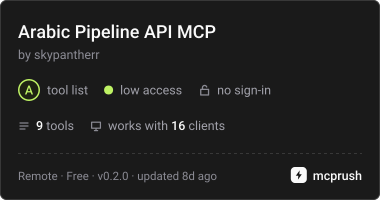
Pay-per-call Arabic text, audio and document utilities over x402. USDC on Base, no API key.
About
Pay-per-call Arabic text, audio and document utilities over x402. USDC on Base, no API key.
Remote endpoints: streamable-http: https://arabic-pipeline-mcp.arabic-pipeline.workers.dev/
Security Report
Valid MCP server (1 strong, 3 medium validity signals). No known CVEs in dependencies. Imported from the Official MCP Registry.
9 tools verified · Open access · No issues found
Security scores are indicators to help you make informed decisions, not guarantees. Always review permissions before connecting any MCP server.
Permissions Found in Source Code
Found by scanning the linked source code. This listing connects to a hosted endpoint, so none of this runs on your machine: it describes what the server software does where it is hosted.
How to Connect
Remote Plugin
No local installation needed. Your AI client connects to the remote endpoint directly.
Add this to your MCP configuration to connect:
{
  "mcpServers": {
    "io-github-skypantherr-arabic-pipeline": {
      "url": "https://arabic-pipeline-mcp.arabic-pipeline.workers.dev/"
    }
  }
}Documentation
View on GitHubFrom the project's GitHub README.
Arabic Pipeline API
Pay-per-call utilities for Arabic text, audio and documents, sold over x402 in USDC on Base.
No API key. No account. No subscription. The first request returns
402 Payment Required; the client signs a payment and retries; the money lands
in the provider's wallet. That is the whole protocol — and it is why this
service can pay a provider directly, with no payment processor in between.
# Claude Code (any Streamable HTTP MCP client works the same way)
claude mcp add --scope user --transport http arabic-pipeline-mcp \
  https://arabic-pipeline-mcp.arabic-pipeline.workers.dev/
No install, no key: the tools are already on the other end. A tool call without payment answers with the x402 challenge, and your client pays it on Base.
Live endpoints
| URL | |
|---|---|
| REST API | https://arabic-pipeline.arabic-pipeline.workers.dev |
| MCP server (streamable HTTP) | https://arabic-pipeline-mcp.arabic-pipeline.workers.dev/ |
| OpenAPI | https://arabic-pipeline.arabic-pipeline.workers.dev/openapi.json |
x402 manifest (/.well-known/x402) | https://arabic-pipeline.arabic-pipeline.workers.dev/.well-known/x402 |
llms.txt (agent-readable summary) | https://arabic-pipeline.arabic-pipeline.workers.dev/llms.txt |
| x402scan | https://www.x402scan.com/server/298e1e2b-3f5c-4890-9791-6d063fd20931 |
| mcprush (MCP marketplace) | https://mcprush.com/skypantherr/arabic-pipeline-api-mcp |
| PayAPI Market (settlement-verified listing) | https://payapi.market/api/arabic-pipeline-api |
| MCP registry | io.github.skypantherr/arabic-pipeline (v0.2.0, active) |
| Source | https://github.com/skypantherr/arabic-pipeline |
The MCP server exposes the same nine capabilities as tools, each behind its
own x402 payment (text_metrics, text_normalize, text_detect_language,
text_chunk, text_diff, text_search, audio_transcribe, doc_extract,
doc_extract_batch).
Why not a generic text tool
Arabic breaks naive string handling in ways that are invisible until they cost you a failed match:
- Tashkeel —
فَاطِمَةandفاطمةare the same name, but not the same bytes. - Letter variants —
أ إ آ → ا,ى → ي,ة → هare folded on purpose, not by accident. - Arabic-Indic digits —
١٢٣must match123, and the tashkeel range overlaps the digit range, so order of operations matters. - Bidi control characters — LRM/RLM and zero-width joiners are invisible, and strip "clean" text unless removed deliberately.
- Offsets — every text tool returns
start/endinto the original string, so a result can be applied to the caller's own text rather than a rewritten copy.
The paid routes declare this in the 402 itself: each challenge carries a Bazaar
input schema and an output example, so a client can see exactly what it is
buying before it signs anything.
Endpoints
| Route | What it does | Price | Cost to serve |
|---|---|---|---|
GET /text/metrics?text=… | Counts, language mix, sentence/word stats, reading time | $0.002 | $0 (pure code) |
POST /text/metrics | Same, JSON body | $0.002 | $0 (pure code) |
POST /text/normalize | Arabic text cleanup: tashkeel/tatweel, alef/ya/ta-marbuta folding, digit unification, bidi-control removal, whitespace collapse | $0.005 | $0 (pure code) |
POST /text/detect | Arabic / English / mixed detection with confidence and script mix | $0.002 | $0 (pure code) |
POST /text/chunk | Sentence-aligned chunks with exact offsets, for model context windows | $0.002 | $0 (pure code) |
POST /text/diff | Word-level diff after Arabic normalisation: equal flag, similarity, added/removed | $0.002 | $0 (pure code) |
POST /text/search | Normalised Arabic search (phrase / whole-word / fuzzy) with exact offsets and snippets | $0.002 | $0 (pure code) |
POST /audio/transcribe | Audio → clean text (Arabic or English) | $0.02 | model call |
POST /doc/extract | Document image/PDF → structured fields (receipts, invoices, IDs) | $0.03 | model call |
POST /doc/extract/batch | 1–5 documents in one call, independent results and partial failures | $0.10 | model call ×n |
POST /text/normalize accepts a mode:
light— lossless: whitespace, digit unification, bidi cleanup only.search— light + tashkeel removal + letter folding (أإآ→ا,ى→ي,ة→ه).index— search + punctuation stripped (use as a dedup / index key).
Try it
# 1. Any paid route answers 402 with a payment challenge
curl -i https://arabic-pipeline.arabic-pipeline.workers.dev/text/normalize \
  -H 'content-type: application/json' \
  -d '{"text":"مُحَمَّدٌ عَلِيّ","mode":"search"}'

# 2. Free routes (no payment needed)
curl https://arabic-pipeline.arabic-pipeline.workers.dev/openapi.json
curl https://arabic-pipeline.arabic-pipeline.workers.dev/
How x402 payment works (for agents)
- Call the route with no payment header →
402 Payment Required. - The response carries a base64
PAYMENT-REQUIREDheader and, in the body,accepts[]entries describing how to pay (network, asset, price, payTo). - Pick one entry, sign a payment for it, and retry the request with the
PAYMENT-SIGNATUREheader (base64 payment payload). - The server verifies and settles the payment (via the facilitator) and
returns the real result plus a
PAYMENT-RESPONSEheader with the receipt.
The full machine-readable contract — including per-operation x-payment-info —
is at GET /openapi.json.
Settlement
- Network: Base mainnet (
eip155:8453), asset USDC (0x833589fCD6eDb6E08f4c7C32D4f71b54bdA02913). - Payments are verified and settled by a public x402 facilitator
(
https://x402.dexter.cash— no account, no fees). The facilitator only executes the buyer's signed payment; it never holds funds. - Settlement destination:
0x05523af5bd166816D1418Ebf7D6371e1fFB1D2e6.
PayAPI Market independently verified this deployment by buying a call and
publishing the receipt: POST /text/normalize for $0.005 USDC, settled in
transaction
0xfc3e42f9…73ce9c
at block 53,330,178 on Base. The listing is
payapi.market/api/arabic-pipeline-api.
Model endpoints
/audio/transcribe uses gemini-3.5-transcribe; /doc/extract and
/doc/extract/batch use gemini-3.6-flash with a JSON response schema. Both
model names are configurable (GEMINI_TRANSCRIBE_MODEL, GEMINI_VISION_MODEL).
The six text endpoints are pure computation and cost nothing to serve.
A batch runs one model call per document, concurrently. At $0.10 for five
documents that is $0.02 each, a third below the $0.03 single-document price;
for one or two documents the single route is cheaper, and the batch route says
so. A failed document is reported in place (ok: false plus error) instead of
failing the whole call, so a bad scan costs one slot rather than the payment.
Local development
npm install
cp .dev.vars.example .dev.vars   # then add GEMINI_API_KEY
npm run dev                       # wrangler dev
npm test                          # vitest
npm run typecheck
Deployment
See DEPLOY.md. The short version: npm run login → npm run secret →
npm run deploy → register the listing.
Two Workers are deployed from this repo:
npm run deploy              # REST API  -> arabic-pipeline.arabic-pipeline.workers.dev
npx wrangler deploy -c wrangler.mcp.toml   # MCP server -> arabic-pipeline-mcp.arabic-pipeline.workers.dev
Licence
Proprietary — all rights reserved. The source is public so the service can be audited; it is not licensed for reuse or redistribution. The API itself is sold per call, not licensed.
Reviews
No reviews yet
Be the first to review this server!
More Developer Tools MCP Servers
Rea
Freeby Morluto · Developer Tools
Reverse engineer anything from your terminal or agent with one CLI and MCP server.
Paperclip
Freeby Paperclipai · Developer Tools
Trending hip-hop artist momentum scores across four cultural dimensions.
Fetch
Freeby Modelcontextprotocol · Developer Tools
Web content fetching and conversion for efficient LLM usage
Git
Freeby Modelcontextprotocol · Developer Tools
Read, search, and manipulate Git repositories programmatically
Toleno
Freeby Toleno · Developer Tools
Toleno Network MCP Server — Manage your Toleno mining account with Claude AI using natural language.
MCP Marketplace
Freeby mcp-marketplace · Developer Tools
Search and install MCP servers from inside your AI client.