
Server data from the Official MCP Registry
US import duty research: HTS codes, Chapter 99 duties, MPF/HMF fees, landed cost. USITC data.
About
US import duty research: HTS codes, Chapter 99 duties, MPF/HMF fees, landed cost. USITC data.
Security Report
Valid MCP server (4 strong, 3 medium validity signals). No known CVEs in dependencies. Package registry verified. Imported from the Official MCP Registry.
9 files analyzed · 1 issue found
Security scores are indicators to help you make informed decisions, not guarantees. Always review permissions before connecting any MCP server.
Permissions Required
This plugin requests these system permissions. Most are normal for its category.
How to Install
Add this to your MCP configuration file:
{
  "mcpServers": {
    "io-github-opsloft-tariff-resolver": {
      "args": [
        "-y",
        "tariff-resolver"
      ],
      "command": "npx"
    }
  }
}Documentation
View on GitHubFrom the project's GitHub README.
tariff-resolver







An MCP server that turns your AI assistant into a US import duty research tool — built on official USITC Harmonized Tariff Schedule data (US Government public domain, 35,000+ tariff lines).
- 🔍 HTS code candidates from plain product descriptions, with CBP CROSS ruling links
- 🧮 Landed-cost components: MFN/FTA base rates + Chapter 99 additional duties (IEEPA / Section 301 / 232) + MPF/HMF fees
- 📡 Tariff change tracking: watchlist your HTS codes, diff rates between HTS revisions
- 🤖 AI-optimized, hallucination-resistant: returns the actual Chapter 99 rule text with parsed rates, so your LLM reasons over real exception chains instead of inventing 2024-era numbers
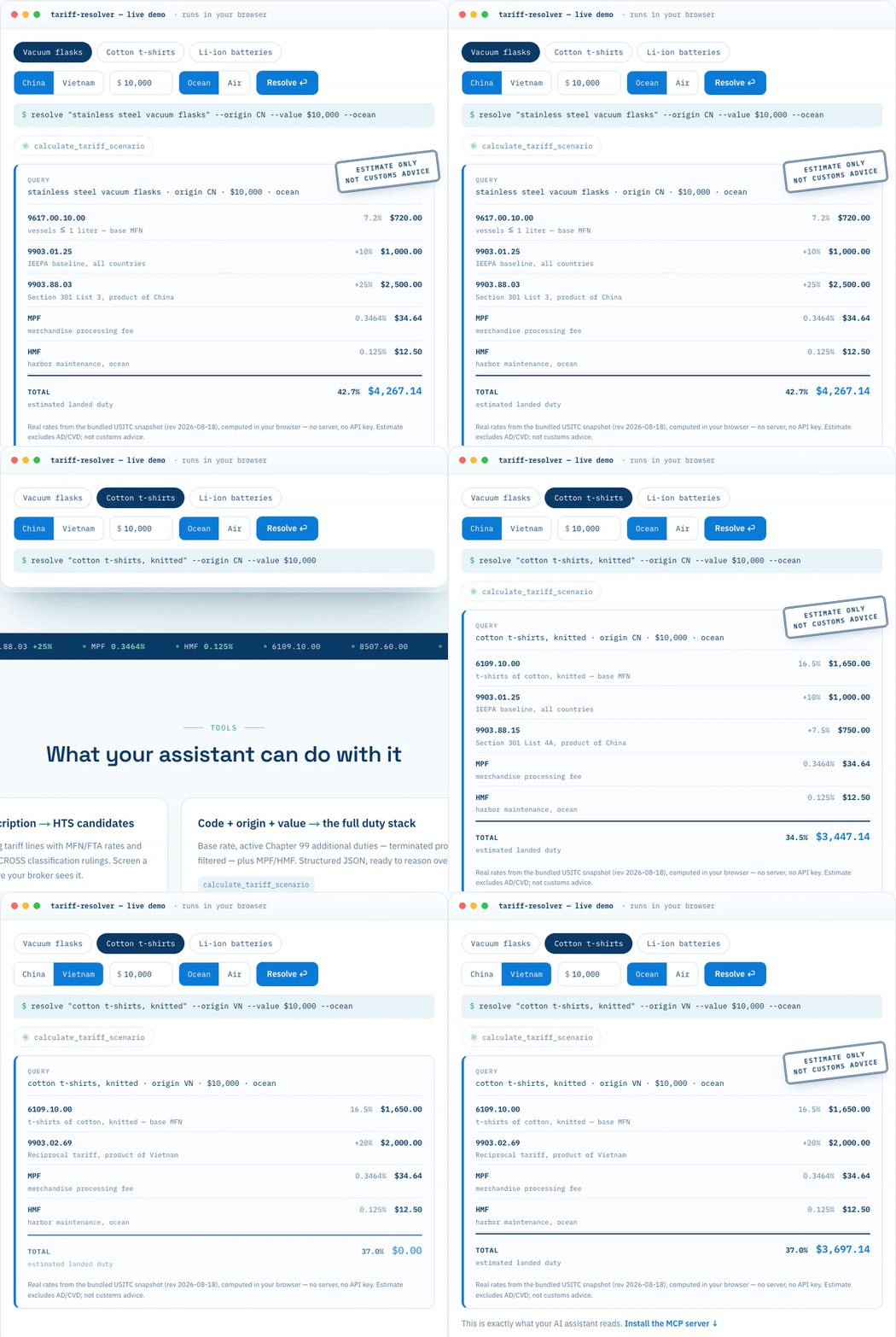
Why now: since the de minimis exemption ended (Aug 29, 2025), every US-bound shipment needs an HTS code and duty payment — and 2025–26 rates keep changing by executive order.
Not affiliated with any government agency. Outputs are candidates/estimates for pre-broker screening — not customs, legal, or tax advice. Estimates exclude AD/CVD duties.
Install
Requires Node.js ≥ 18.
claude mcp add tariff-resolver -- npx -y tariff-resolver
Or in any MCP client config:
{ "mcpServers": { "tariff-resolver": { "command": "npx", "args": ["-y", "tariff-resolver"] } } }
Claude Desktop (one-click): download tariff-resolver-<version>.mcpb from Releases and double-click it — no terminal needed.
💡 Try these prompts
- Basic search: "Find the HTS code for a men's 100% cotton t-shirt."
- Full scenario: "Calculate the tariff scenario for HTS 6109.10.00, origin China, customs value $5,000, ocean freight."
- Sourcing decision: "I'm importing $10k of stainless steel vacuum flasks. Compare landed cost if I source from China vs Vietnam."
- Stay current: "Watch tariff changes for my catalog: 6109.10.00, 8507.60.00, 9617.00.10."
Tools
| Tool | What it does |
|---|---|
search_hs_candidates | Product description → top HTS candidates with rates + CBP CROSS ruling links |
calculate_tariff_scenario | HTS code + origin + value (+ weight) → structured JSON: base MFN/FTA rate, active Chapter 99 rules (footnote-linked / origin-matched / universal, terminated rules filtered), MPF/HMF |
watch_tariff_changes | Register HTS codes to a local watchlist |
check_tariff_updates | Diff current vs previous HTS revision — see exactly which rates changed |
dataset_info | Data revision date, row counts, source, license |
Design
The server does the retrieval; your LLM does the reasoning. Chapter 99 rules are returned verbatim (with parsed adder_pct where applicable) so the model reads the actual exception chains instead of trusting a black-box calculation. Rates for 10-digit statistical suffixes inherit from their parent rate line. Headings the schedule marks as dead — terminated, suspended, expired — are filtered out and counted, and the USITC's own compiler_note rides along with any rule that carries one.
What the data cannot tell you. The published schedule is wrong in both directions at any given moment, so every result carries a stacking_warning and the snapshot date. Provisions whose collection has already stopped keep printing with no end date — IEEPA and Section 122 headings are the recurring case — and newly proclaimed actions appear in the schedule days after they take effect. Totalling every layer the schedule prints yields a rate nobody is charged. Treat the layers as candidates, and verify collection status against CBP CSMS messages before relying on a stack.
Data
Ships with a full HTS snapshot, fetched from USITC's official JSON API (US Government public domain). Refresh anytime:
python3 scripts/fetch_hts.py # ~2 min, fails hard rather than write a partial dataset
dataset_info reports the revision date your queries run against.
Privacy Policy
tariff-resolver runs entirely on your machine and collects nothing:
- Data collection: none. No queries, telemetry, analytics, or usage data are collected or transmitted.
- Usage and storage: your watchlist is stored in a local JSON file on your machine; all lookups run against the bundled local dataset.
- Third-party sharing: none. The server makes no network requests at runtime. (The optional
scripts/fetch_hts.pyrefresh script contacts only the official USITC API.) - Data retention: nothing to retain — delete the local watchlist file at any time.
- Contact: tom@opsloft.dev
Full policy: https://opsloft.dev/privacy
License
MIT. Tariff data is a work of the US Government (public domain).
Reviews
No reviews yet
Be the first to review this server!
More Developer Tools MCP Servers
Fetch
Freeby Modelcontextprotocol · Developer Tools
Web content fetching and conversion for efficient LLM usage
Git
Freeby Modelcontextprotocol · Developer Tools
Read, search, and manipulate Git repositories programmatically
Toleno
Freeby Toleno · Developer Tools
Toleno Network MCP Server — Manage your Toleno mining account with Claude AI using natural language.
mcp-creator-python
Freeby mcp-marketplace · Developer Tools
Create, build, and publish Python MCP servers to PyPI — conversationally.
MCP Marketplace
Freeby mcp-marketplace · Developer Tools
Search and install MCP servers from inside your AI client.
MarkItDown
Freeby Microsoft · Content & Media
Convert files (PDF, Word, Excel, images, audio) to Markdown for LLM consumption