
Server data from the Official MCP Registry
A PDF's real sections for agents: heading tree, pages and section text. Free mode is local.
About
A PDF's real sections for agents: heading tree, pages and section text. Free mode is local.
Security Report
This MCP server reads local PDFs and returns their heading trees and section text, with read-only tool annotations, path validation (absolute paths, .pdf suffix, optional --root restriction), and a per-document cost cap for paid modes. Its main concerns are that the default configuration allows reading any PDF path on the filesystem and that quick and standard modes send document text to a third-party model provider, which is disclosed in the README. No malicious patterns, hardcoded secrets, or shell execution were found in the reviewed code, though some files were truncated. Supply chain analysis found 15 known vulnerabilities in dependencies (1 critical, 4 high severity). Package verification found 1 issue.
15 files analyzed · 21 issues found
Security scores are indicators to help you make informed decisions, not guarantees. Always review permissions before connecting any MCP server.
Permissions Required
This plugin requests these system permissions. Most are normal for its category.
What You'll Need
Set these up before or after installing:
Environment variable: OPENAI_API_KEY
Environment variable: ANTHROPIC_API_KEY
How to Install
Add this to your MCP configuration file:
{
  "mcpServers": {
    "io-github-omniwot-section-anything": {
      "env": {
        "OPENAI_API_KEY": "your-openai-api-key-here",
        "ANTHROPIC_API_KEY": "your-anthropic-api-key-here"
      },
      "args": [
        "-y",
        "app-frontend"
      ],
      "command": "npx"
    }
  }
}Documentation
View on GitHubFrom the project's GitHub README.
Section Anything


Find the real sections of a PDF: every heading, its level, the pages it spans and the exact text under it. Built for RAG pipelines and document tools that need structure, with a dial from free rules to an LLM that reads the whole document, and a hard cost cap on every paid run.
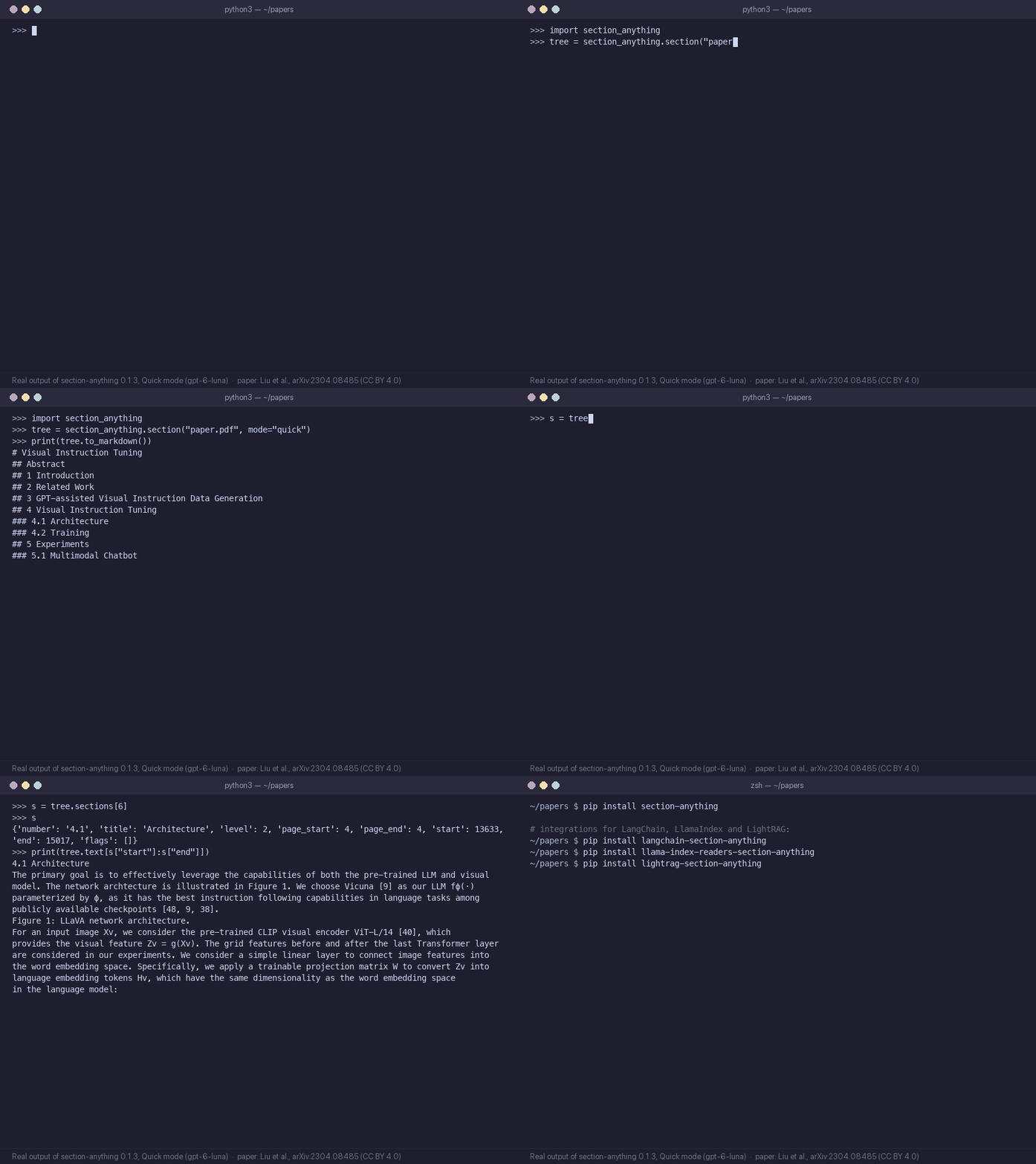
Real output of section-anything 0.1.3, Quick mode (gpt-6-luna), on Visual Instruction Tuning, Liu et al., arXiv:2304.08485, CC BY 4.0; the wait for the run is shortened (capture, script). Quick mode's output can vary slightly between runs. Try it on that paper in the Colab notebook (Free mode, no key needed), or in the browser on the Hugging Face Space (Free mode on any PDF, plus saved Quick check and Standard runs on three example papers; don't upload confidential documents).
Pre-release (0.1). The API may change before 1.0.
Website: https://omniwot.github.io/section-anything/ (how it works, benchmarks, examples)
import section_anything

tree = section_anything.section("paper.pdf", mode="quick")
print(tree.to_markdown())
# # A Study of Sectioning
# ## 1 Introduction
# ### 1.1 Scope
# ## 2 Methods
print(tree.summary())  # mode, model, pages, sections, calls, tokens, cost_usd, seconds
Use from an agent
An agent can take a PDF's outline first and then read only the sections it needs (0.1.6 or newer).
MCP server for Claude Code, Claude Desktop, Cursor and other MCP hosts, with three read-only
tools: section_pdf (the heading tree; free mode by default, no model, $0), read_sections (the
text of chosen sections) and estimate_cost (what quick and standard would cost).
claude mcp add --transport stdio section-anything -- uvx --from "section-anything[mcp]" section-anything-mcp
Other hosts take the same command in their mcpServers JSON:
{"mcpServers": {"section-anything": {"command": "uvx",
  "args": ["--from", "section-anything[mcp]", "section-anything-mcp", "--max-usd", "0"]}}}
Paid modes use the API keys in the server's environment (claude mcp add --env OPENAI_API_KEY=...)
and are capped per document by --max-usd (default 0.50; 0 keeps every run free). --root DIR
limits the folders the server may read.
Agent skill: copy skills/section-anything into your
agent's skills folder (Claude Code: ~/.claude/skills/) and the agent uses the command line the
same way: outline, then the sections it needs.
Shell: section-anything paper.pdf --format json --body prints every section with its
heading_path, parent, pages and text.
Why
PDF converters mostly infer headings from how a line looks, so paper titles, author names, captions and theorem statements can come out as sections, and real subsections can get the wrong level. Anything that chunks or navigates by headings inherits those mistakes. Section Anything combines the PDF's own outline (bookmarks) and printed table of contents, typography and numbering rules, and optionally a model that reviews or reads the text.
Results
Heading-tree similarity (TEDS, 0–100, higher is better) on READoc with READoc's own scoring code, October 2026. Docling and MinerU convert whole documents (layout, tables, figures, formulas, OCR); these numbers compare only the heading tree. Papers not used while developing the method:
| READoc arXiv papers (held out) | Docs | TEDS |
|---|---|---|
Section Anything standard (gpt-6-luna) | 905 | 70.0 |
Section Anything quick (gpt-6-luna) | 905 | 68.0 |
Section Anything free (no model) | 905 | 60.0 |
| Docling 2.140 (heading hierarchy on) | 905 | 49.4 |
quick is release 0.1.2 and free release 0.1.5. 0.1.1 found the abstract's heading (journals often set it
small, bold or run into the first line): +2.4 to free and +3.7 to quick in a pre-registered
held-out test (0.1.0: 54.8 and 63.9). 0.1.2 keeps a section number that the PDF extractor split
off its title ("1" | "Introduction"): +0.7 to free (95% CI +0.5 to +1.0) and +0.5 to quick
(95% CI +0.4 to +0.8; +1.7 on the 291 papers it changes) in a second pre-registered test (0.1.1:
57.2 and 67.4).
0.1.5 gives back matter (References, Acknowledgements, Appendix) and appendix sections the level of the
numbered sections: +2.1 to free (95% CI +1.7 to +2.4; 136 papers better, 4 worse) in a fourth
pre-registered test on these papers (0.1.4: 57.9); READMEs unchanged.
standard uses none of these. See the changelog.
On the same 905 papers with MinerU's cloud (3.4.4, VLM): our standard 70.0, our quick 68.0,
MinerU + its own LLM title levels (gpt-6.1-sol) 64.8 (paired difference: standard +5.1, 95% CI
+4.0 to +6.2, or +2.8 without the 154 papers where that step, run by us on gpt-6.1-sol, returned no
parsable levels and kept MinerU's raw levels; quick +3.1, 95% CI +2.1 to +4.1, but level without
those papers: +1.0, 95% CI −0.03 to +2.0),
MinerU alone 53.9, Docling 49.4.
On GitHub READMEs, free scores higher than Docling: on 1,112 bookmarked READoc READMEs not used
in development, 81.9 against 75.5, and Docling reaches 79.7 with the opt-in outline check we
proposed upstream (docling#5002), the
same idea as free's outline check.
On 27 UK government reports never used in development (answer keys from each report's HTML
version), the outline check improved free by +5.7 (95% CI +0.4 to +12.2; 43.1 → 48.8; measured on 0.1.0).
Where others win: on the 1,124 held-out READoc READMEs our quick and standard only tie with
Docling (about 75). On the 905 held-out papers Docling scored higher than standard on 103 papers
and lower on 773 (by more than 0.5 points). Nougat, an OCR model trained on arXiv, has the highest published READoc arXiv score
(88.5 in the READoc paper, older tool versions; we have not run it). Docling and MinerU also read
scanned pages with OCR; Section Anything needs a text layer. Better headings improved RAG retrieval in our
Qasper test but not answer quality.
Settings and cost
| Mode | What runs | Sent to a model | Cost per 1,000 pages |
|---|---|---|---|
free (default) | bookmarks or the printed contents as the outline, then typography and numbering rules; headings a complete-looking outline does not list are dropped | nothing | $0 |
quick | rules propose candidate heading lines; a small model keeps the real ones and sets levels | candidate lines only | about $0.07 (gpt-6-luna) |
standard | a model reads every line, with font hints, and marks where sections start and end | the document text | about $0.16 (gpt-6-luna, the default); $2.90 with gpt-6.1-sol |
local:<model> | quick, answered by a local Ollama model | nothing leaves the machine | $0 |
Every paid run is estimated first and capped (default $0.50 per document); over the cap it downgrades (standard → quick → free) or fails, as you choose.
The default model for quick and standard is gpt-6-luna, the model behind their READoc scores
above. standard can run on gpt-6.1-sol instead (SECTIONANY_STANDARD_MODEL=gpt-6.1-sol or
model="gpt-6.1-sol") at about 18 times the cost. On development documents only (98 READoc papers
and 100 READMEs, same code) it scored 5.8 points higher on READMEs (95% CI +2.1 to +9.6) and 0.9
higher on papers (CI -0.3 to +2.1, not significant); this is not confirmed on held-out documents.
Install
Python 3.11 or newer:
pip install section-anything
pip install "section-anything[anthropic]" # optional: Claude models on Anthropic's own API
pip install "section-anything[docling]"   # optional: tree.to_docling_document()
pip install "section-anything[langfuse]"  # optional Langfuse tracing
pip install "section-anything[mcp]"       # optional MCP server: section-anything-mcp
# latest from GitHub:
pip install "git+https://github.com/Omniwot/section-anything#subdirectory=packages/section-anything"
Command line:
section-anything paper.pdf                                # free, Markdown headings
section-anything paper.pdf --mode quick --format json     # JSON with spans and cost
section-anything paper.pdf --mode standard --max-usd 0.5  # cap this document at $0.50
API keys come from the environment only (SECTIONANY_API_KEY, or OPENAI_API_KEY for OpenAI's
endpoint); any OpenAI-compatible endpoint works. Claude models run on Anthropic's own API with
the anthropic extra and ANTHROPIC_API_KEY; on development documents Claude Haiku 5.5 tied the
default at about 3 times the cost (Providers). Full options, output format and the security
model for untrusted PDFs: packages/section-anything/README.md.
Integrations
One document per section, with the heading path, pages and character span as metadata. Each
package depends only on section-anything and the framework's core package.
pip install langchain-section-anything
pip install llama-index-readers-section-anything
pip install lightrag-section-anything
| Framework | Package | Use |
|---|---|---|
| LangChain | langchain-section-anything | SectionAnythingLoader("paper.pdf", mode="free").load() |
| LlamaIndex | llama-index-readers-section-anything | SectionAnythingReader(mode="free").load_data("paper.pdf"), or as the .pdf reader of SimpleDirectoryReader |
| LightRAG | lightrag-section-anything | parser engines (sectionany_free, sectionany_quick, ...) for LightRAG's heading-based chunker, without a MinerU or Docling service |
To run Docling's HybridChunker or Unstructured's chunk_by_title on these headings, export the
tree with tree.to_docling_document() or tree.to_unstructured_elements()
(how).
Limitations
- Reads the PDF's text layer; scanned PDFs need OCR first.
- Tables, figures and equations are not structured; their text stays in the section text.
freeis best when the PDF has bookmarks or a printed table of contents. When the bookmarks look complete, it drops headings they do not list; if the bookmarks stop at the top levels, real deeper headings are lost (about 6% of READMEs lose more than 5 points). Turn this off withSECTIONANY_DEMOTE_UNLISTED_HEADINGS='[]'.quickandstandardsend text to the provider you configure.
Repository
| Path | What it is |
|---|---|
packages/section-anything/ | the library and CLI (Apache-2.0) |
packages/langchain-section-anything/ | LangChain document loader |
packages/llama-index-readers-section-anything/ | LlamaIndex reader |
packages/lightrag-section-anything/ | LightRAG parser plugin |
backend/, frontend/ | a demo web app: upload a PDF, see the sections highlighted (docs/app.md) |
site/ | project website and benchmark tables (site/data/results.js) |
corpus/ | our test corpus: answer keys, results and the tools that rebuild it (no PDFs stored) |
docs/ | write-ups: RAG on Qasper, the Docling contribution, plans and a paper draft |
Data and credits
- Benchmarks use READoc (dataset MIT, Hugging Face) with READoc's own scoring code, which is not included here.
- Unseen-document checks use HiPS law-book annotations (CC BY-NC 4.0), UK government reports (Open Government Licence v3) and Canadian federal acts (Justice Laws website).
- Every corpus source and its licence:
corpus/DATA-LICENSES.md. - To cite this project, see
CITATION.cff.
Licence
Code: Apache-2.0 (LICENSE, NOTICE). The data under corpus/ keeps its sources' licences: see
corpus/DATA-LICENSES.md.
Reviews
No reviews yet
Be the first to review this server!
More Developer Tools MCP Servers
Rea
Freeby Morluto · Developer Tools
Reverse engineer anything from your terminal or agent with one CLI and MCP server.
Paperclip
Freeby Paperclipai · Developer Tools
Trending hip-hop artist momentum scores across four cultural dimensions.
Fetch
Freeby Modelcontextprotocol · Developer Tools
Web content fetching and conversion for efficient LLM usage
Git
Freeby Modelcontextprotocol · Developer Tools
Read, search, and manipulate Git repositories programmatically
Toleno
Freeby Toleno · Developer Tools
Toleno Network MCP Server — Manage your Toleno mining account with Claude AI using natural language.
MCP Marketplace
Freeby mcp-marketplace · Developer Tools
Search and install MCP servers from inside your AI client.