
Server data from the Official MCP Registry
Evidence-qualified architecture context for coding agents.
About
Evidence-qualified architecture context for coding agents.
Security Report
Valid MCP server (1 strong, 0 medium validity signals). 1 known CVE in dependencies Imported from the Official MCP Registry.
3 files analyzed · 1 issue found
Security scores are indicators to help you make informed decisions, not guarantees. Always review permissions before connecting any MCP server.
Documentation
View on GitHubFrom the project's GitHub README.
Architecture Intelligence Platform



Before changing a distributed system, do you know who relies on the part you're changing?
The answer may be spread across repositories, API contracts, broker configuration, runtime observations, catalogs, and other teams. Some relationships are documented; others appear in observations but have no matching documented promise.
AIP shows who relies on what across autonomous boundaries, which promises apply, what the evidence establishes, and what remains unresolved. It provides evidence-qualified architectural context that architects, engineering teams, and coding agents can inspect.
See the binding picture · Try the hosted MCP demo · Technical documentation
MCP Registry: io.github.michaelegner/architecture-intelligence-platform
What is AIP?
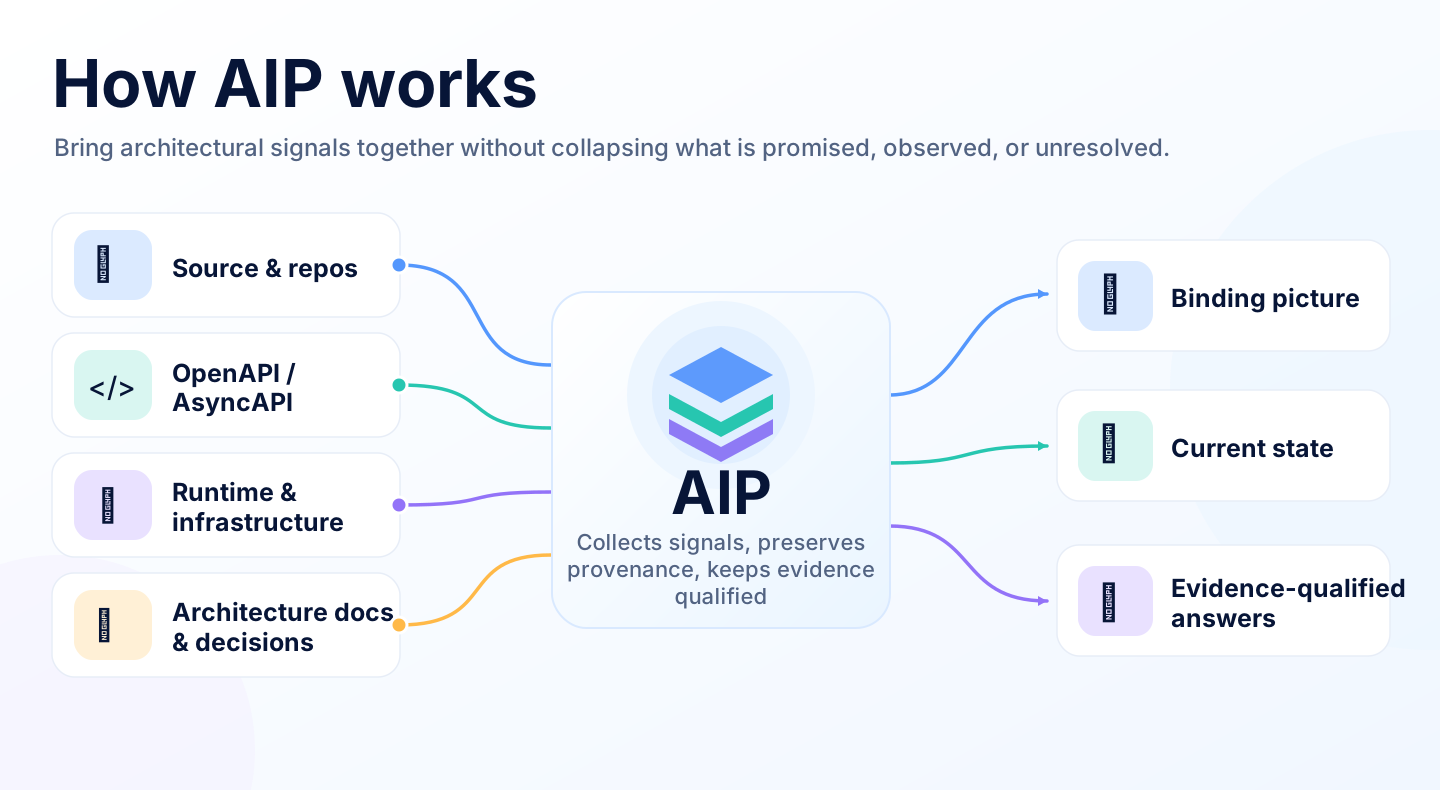
Repository and source-analysis tools explain implementations an engineer or agent can inspect. AIP complements them with attributable architectural promises and independent evidence about relationships across autonomous boundaries. It keeps what is promised, observed, and unresolved distinct instead of presenting assumptions as facts.
The binding picture
AIP binding picture brings cross-boundary relationships together
Sokol111 is an open-source, event-driven e-commerce platform built from independently developed Go microservices. AIP uses it as a realistic showcase: when planning a broker migration, understanding one service's documented event flows is not enough to know which other services may be affected.
Sokol111's architecture documents show Catalog Management publishing events to Storefront. But captured broker attachments reveal more: Catalog and Image also consume tenant events from Store Provisioning, and Storefront consumers are attached to attribute events. A migration planned from the documentation alone could overlook these relationships.
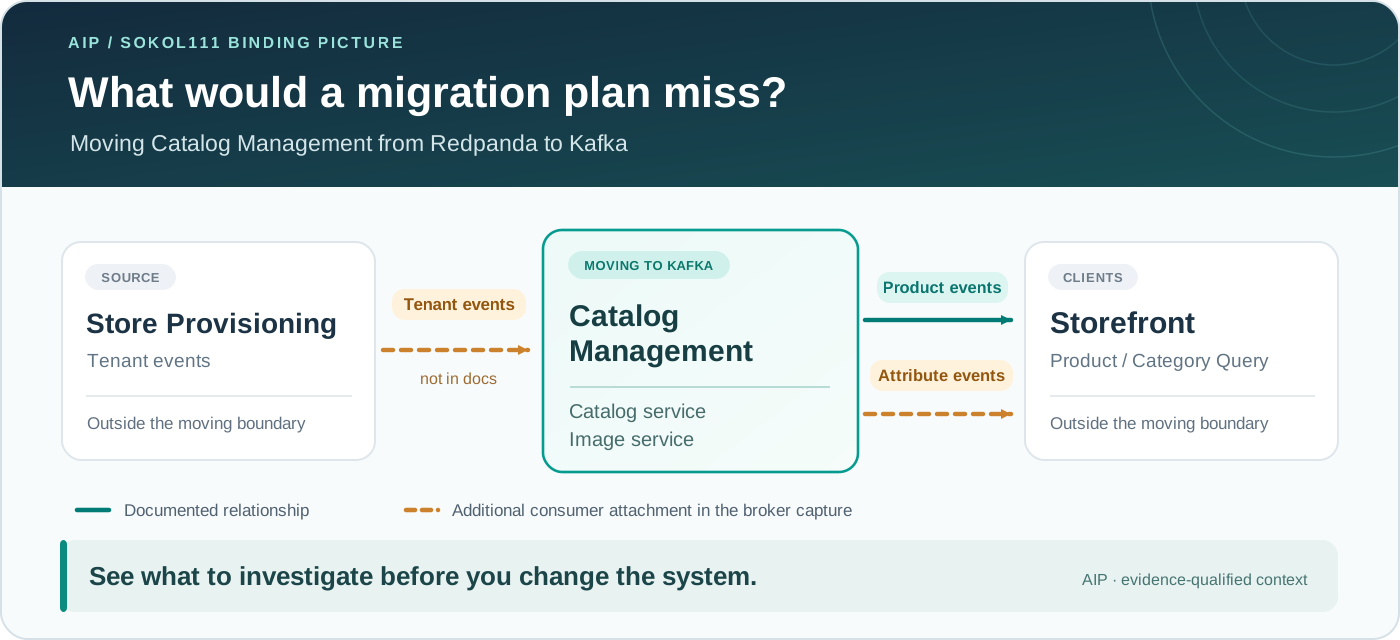
AIP makes the bigger picture visible before the change starts. By combining documented event relationships with observed broker attachments, its binding picture helps architects and coding agents identify which services to investigate—and where the documented view is incomplete.
Explore the hosted binding picture · Follow the v0.8 migration showcase
Try AIP
Sokol111 hosted MCP demo
The public, read-only endpoint serves the frozen v0.8.0 Sokol111 C1 dataset, not live
monitoring. It requires no local AIP server or server credentials. With Claude Code installed,
connect to seven read-only tools, including the experimental get_binding_picture:
claude mcp add --transport http aip-hosted https://mcp.daip.io/mcp
In Claude Code, check /mcp and ask:
Which bindings cross the Catalog Management boundary in environment
localon brokerkafka:sokol111-local? Show which are promised and observed, which remain unresolved, and resolve the relevant evidence at the same snapshot.
Use get_binding_picture with bounded_context_id: catalog-management and
broker_ids: [kafka:sokol111-local]. See the hosted walkthrough
for the exact request, expected findings, limitations, and troubleshooting.
Quick Start
For an introductory, deterministic declared-versus-observed demo, install Docker with Compose,
plus curl and jq. No LLM API key is needed:
git clone https://github.com/michaelegner/architecture-intelligence-platform.git
cd architecture-intelligence-platform
cp .env.example .env
examples/runtime-demo/mcp-demo.sh
This separate example demonstrates get_architecture_drift and get_evidence.
Clean up with examples/runtime-demo/mcp-demo.sh --down.
For the full platform, see the development guide.
Real-system showcases: Sokol111 (Redpanda/Kafka), Pitstop (.NET/RabbitMQ) and Quarkus Super Heroes. The MCP client setup guide covers Codex, Claude Code, Cursor, and VS Code; previous end-to-end client qualification was performed against v0.4.2, not re-qualified for v0.8.0.
How AIP works
AIP combines independent sources without treating declarations, observations, and promises as interchangeable. It projects only what is relevant to a selected architectural question.
AIP's deterministic architecture service uses Neo4j and makes qualified results available
through read-only REST and MCP interfaces. Six MCP tools are enabled by default;
get_binding_picture is an experimental seventh tool behind
architecture_intelligence.experimental.binding-picture: true (enabled on the hosted demo).
No LLM key is required to produce these answers.
Declared vs observed
For direct dependency/drift answers, AIP retains these distinctions:
| Qualification | Meaning |
|---|---|
CONFIRMED | Declared and observed in the relevant context. |
OBSERVED_ONLY | Observed but not declared in the ingested sources. |
NOT_OBSERVED_IN_WINDOW | Declared but not observed in the specified window—not proof it is absent or unused. |
These older dependency qualifications are not the same as the experimental v0.8 binding-picture assessment statuses.
Boundaries matter: A frozen broker capture establishes a group's topic attachment at capture time, not the event types a service handles; producer declarations are not observed production; an absent promise is not a proven violation; and the two-broker picture does not establish cross-broker delivery. AIP keeps these limits explicit in its answers.
The public hosted endpoint is a constrained demo behind an HTTP edge; the AIP MCP server itself is not a general authenticated, multi-tenant public service. Keep self-hosted MCP access local or on a trusted network. See the security model.
Documentation
Try and integrate: Hosted walkthrough · MCP reference · Client setup · Architecture · Development
Evidence and limitations: v0.8 release notes · Showcase evidence · v0.8 comparison · Security
Project: Product doctrine · Roadmap · Contributing · Discussions · Security reports
Current status: v0.8.0 is a shipped demonstration release. The binding-picture contract remains experimental. In a controlled 12-session comparison, AIP reduced information requests in the team-scoped setting, but did not show a robust improvement in migration-planning quality. Real customer value and the effort of maintaining attributable promises remain to be validated.
Apache-2.0 licensed. See LICENSE and third-party licenses.
Reviews
No reviews yet
Be the first to review this server!
More Developer Tools MCP Servers
Rea
Freeby Morluto · Developer Tools
Reverse engineer anything from your terminal or agent with one CLI and MCP server.
Paperclip
Freeby Paperclipai · Developer Tools
Trending hip-hop artist momentum scores across four cultural dimensions.
Fetch
Freeby Modelcontextprotocol · Developer Tools
Web content fetching and conversion for efficient LLM usage
Git
Freeby Modelcontextprotocol · Developer Tools
Read, search, and manipulate Git repositories programmatically
Toleno
Freeby Toleno · Developer Tools
Toleno Network MCP Server — Manage your Toleno mining account with Claude AI using natural language.
MCP Marketplace
Freeby mcp-marketplace · Developer Tools
Search and install MCP servers from inside your AI client.