
Server data from the Official MCP Registry
Swiss school & public holidays, 26 cantons, by Schulart (OpenHolidays + Nager.Date)
About
Swiss school & public holidays, 26 cantons, by Schulart (OpenHolidays + Nager.Date)
Security Report
Valid MCP server (1 strong, 2 medium validity signals). No known CVEs in dependencies. Package registry verified. Imported from the Official MCP Registry. Trust signals: trusted author (35/36 approved).
3 files analyzed · 1 issue found
Security scores are indicators to help you make informed decisions, not guarantees. Always review permissions before connecting any MCP server.
How to Install
Add this to your MCP configuration file:
{
  "mcpServers": {
    "io-github-malkreide-swiss-holidays-mcp": {
      "args": [
        "swiss-holidays-mcp"
      ],
      "command": "uvx"
    }
  }
}Documentation
View on GitHubFrom the project's GitHub README.
🇨🇭 Part of the Swiss Public Data MCP Portfolio
This is a private project. It is independent of any employer or institutional affiliation and represents no official position of any authority.
📅 swiss-holidays-mcp






A Swiss holiday calendar for AI agents — public holidays, school holidays and long weekends for all 26 cantons, with cross-cantonal comparison. School holidays are differentiated by Schulart (school type), which matters more than it first appears. No API key required.
Overview
swiss-holidays-mcp is a Swiss holiday calendar for AI assistants like Claude — public holidays, school holidays and long weekends for all 26 cantons, no API keys required. Public holidays are cantonal (Berchtoldstag, Fronleichnam & co. differ by canton, not just the federal minimum). School holidays are set cantonally, sometimes at district level, and — in six cantons — separately per school type. A single federal calendar does not exist; anyone planning across cantonal borders is otherwise reduced to opening 26 PDF pages.
The server covers two thematic clusters: public holidays / long weekends and school holidays (with Schulart differentiation). Each cluster maps to a group of purpose-built tools that translate raw agency data into clean, provenance-tagged JSON responses. All data comes from the OpenHolidays API (CC BY 4.0) and Nager.Date (MIT).
Mnemonic: A duplicate in Swiss school data is usually a school type in disguise. The underlying API publishes the same holiday period several times when a canton differentiates by school type. That looks like duplicated data and invites naive de-duplication — which would destroy exactly the distinction a school authority needs.
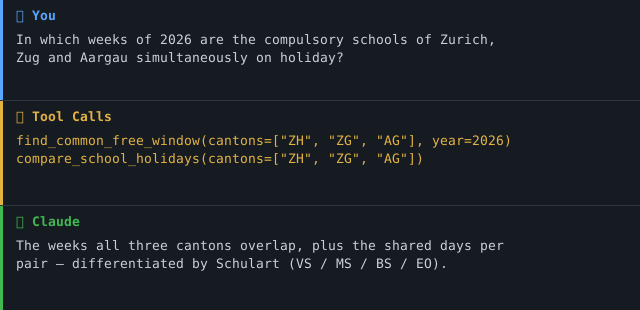
Anchor demo query: "In which weeks of 2026 are the compulsory schools of Zurich, Zug and Aargau simultaneously on holiday — and how many overlapping days does each pair share?"
→ This exercises find_common_free_window, compare_school_holidays and list_school_types in a single conversation, and answers a question that recurs every planning cycle in inter-cantonal coordination.
→ More use cases by audience →
Demo
Features
- 🏫 School holidays — periods per canton and date range, differentiated by Schulart (
VS/MS/BS/EO) - 🎌 Public holidays — cantonal holiday sets, not just the federal minimum (Berchtoldstag & friends)
- 🔍 Date check — is a given date a school or public holiday in a canton?
- 🔗 Cross-cantonal comparison — pairwise overlap matrix of holiday days between cantons
- 🪟 Common free windows — date ranges where all listed cantons are simultaneously on holiday
- 🌉 Long weekends & bridge days — computed from federal public holidays (Nager.Date)
- 🏘️ Local & municipal holidays — district- and municipality-level specifics such as Zurich's Sechseläuten and Knabenschiessen, with a
scopemarker so they are never mistaken for canton-wide - 📆 iCal / ICS export — a canton's holidays for a year as a ready-to-import
.icscalendar - 🔖 Holiday feed resource —
holidays://<canton>/<year>MCP resource with a Markdown summary - 📌 "Is today a holiday?" — one-call convenience for the everyday question
- 🩺 Source health — reachability and latency of both upstreams, always evaluable
- 🔑 No authentication required — both data sources are publicly accessible
- ☁️ Dual transport — stdio for Claude Desktop, Streamable HTTP/SSE for cloud deployment
- 🧾 Provenance on every response —
live_api|cached|degraded, never a silent empty list
Data Sources
| Source | Data | Licence |
|---|---|---|
| OpenHolidays API | Cantons, Schularten, school holidays, public holidays | CC BY 4.0 |
| Nager.Date | Long weekends and required bridge days | MIT |
Both sources are publicly accessible, no authentication required. Attribution required: OpenHolidays (CC BY 4.0) and Nager.Date must be cited as the source when using their data.
Tools
| Tool | Purpose | Data Source |
|---|---|---|
list_cantons | The 26 cantons with ISO codes and official languages | OpenHolidays |
list_school_types | Schulart groups per canton (CH-ZH-VS etc.) | OpenHolidays |
get_school_holidays | School holidays for one canton and date range | OpenHolidays |
get_public_holidays | Public holidays for one canton and year | OpenHolidays |
get_local_holidays | Public holidays for one municipality or district, incl. local specifics | OpenHolidays |
check_date | Is a given date a school or public holiday? | OpenHolidays |
compare_school_holidays | Pairwise overlap matrix across cantons | OpenHolidays |
find_common_free_window | Windows where all listed cantons are on holiday | OpenHolidays |
next_school_holidays | The next upcoming holiday periods | OpenHolidays |
get_long_weekends | Long weekends and required bridge days | Nager.Date |
export_holidays_ics | A canton's holidays for a year as an iCalendar (.ics) document | OpenHolidays |
is_holiday_today | Is today a school or public holiday in a canton? | OpenHolidays |
source_status | Reachability and latency of both upstreams | Built-in |
Resources
| Resource URI | Content |
|---|---|
holidays://{canton}/{year} | Markdown summary of all public + school holidays, e.g. holidays://CH-ZH/2026 |
All tools carry the full annotation set — readOnlyHint: true, destructiveHint: false, idempotentHint: true, openWorldHint: true (they reach an external API). No tool writes anywhere. Inputs are schema-validated (canton codes against the 26 known cantons, dates as YYYY-MM-DD, year bounded, language/school_type whitelisted).
Example Use Cases
| Query | Tool |
|---|---|
| "Which cantons are there, and what are their codes?" | list_cantons |
| "Show Zurich's compulsory-school holidays for spring 2026" | get_school_holidays |
| "Is 3 April 2026 a public holiday in Ticino?" | check_date |
| "Do Zurich and Zug school holidays overlap this year?" | compare_school_holidays |
| "When can all of ZH, ZG, AG plan a joint week off school?" | find_common_free_window |
| "What are the next holidays for Basel-Stadt schools?" | next_school_holidays |
| "Which long weekends does 2026 have, and which bridge days do they need?" | get_long_weekends |
| "Which local holidays does the city of Zurich keep that the rest of the canton doesn't?" | get_local_holidays |
| "Export Zurich's 2026 holidays as an .ics calendar I can import" | export_holidays_ics |
| "Is today a holiday in Aargau?" | is_holiday_today |
🛡️ Safety & Limits
| Aspect | Details |
|---|---|
| Access | Read-only (readOnlyHint: true) — the server cannot modify or delete any data |
| Personal data | No personal data — all sources are aggregated, public holiday calendars |
| Caching | 12-hour in-memory TTL (holiday tables change a handful of times per year) |
| Retry | Exponential backoff 2s / 4s / 8s; 4xx except 429 are not retried |
| Timeout | 20 seconds per API call (8 seconds for health probes) |
| Authentication | No API keys required — both upstreams are publicly accessible |
| Degradation | Upstream failure yields a degraded envelope with an explanatory note, never a silent empty list |
| Terms of Service | Subject to the ToS of the respective data sources: OpenHolidays, Nager.Date |
Architecture
This server uses Architecture A (live API only, with in-memory cache).
                    ┌──────────────────────────┐
   Claude / any ───▶│  swiss-holidays-mcp      │
   MCP host         │  (MCPServer · 13 tools)  │
                    └────────┬─────────────────┘
                             │  retry 2s/4s/8s · 12h cache
                    ┌────────┴─────────┐
                    ▼                  ▼
          OpenHolidays API        Nager.Date
          (CC BY 4.0)             (MIT)
          cantons · Schularten    long weekends
          school + public         bridge days
Rationale (verified live on 2026-07-19):
- All ten documented OpenHolidays endpoints answered HTTP 200 with plausible payloads;
/Subdivisions?countryIsoCode=CHreturns exactly 26 cantons, matching the official count. - No public bulk dump could be verified at build time (
openpotato/openholidays.dataraw access returned 404), so Architecture B was not available. - Holiday tables change a handful of times per year, so a 12-hour in-memory TTL removes almost all upstream load without risking staleness.
Consequences:
- Every response carries
provenance(live_api|cached|degraded). - Upstream failure yields a
degradedenvelope with an explanatorynote, never a silent empty list. source_statusalways returns an evaluable health report.
Live-probe findings (2026-07-19)
| Endpoint | HTTP | Status | Records | Note |
|---|---|---|---|---|
/Countries | 200 | ✅ works | 36 | |
/Subdivisions?countryIsoCode=CH | 200 | ✅ works | 26 | matches official canton count |
/Groups?countryIsoCode=CH | 200 | ✅ works | 11 | Schulart groups, only 6 cantons |
/PublicHolidays (CH, 2026) | 200 | ✅ works | 39 | cantonal scope included |
/SchoolHolidays (CH, 2026) | 200 | ✅ works | 193 | 183 distinct after school-type split |
/SchoolHolidaysByDate | 200 | ✅ works | – | |
/SchoolHolidays?countryIsoCode=XX | 200 | ⚠️ silently empty | 0 | invalid country ≠ error |
/Subdivisions?languageIsoCode=ZZ | 200 | ⚠️ silent EN fallback | 26 | invalid language ≠ error |
/SchoolHolidays without date range | 400 | ✅ correct error | – | RFC 9110 problem+json |
Nager /PublicHolidays/2026/CH | 200 | ✅ works | 33 | 29 rows carry counties |
Nager /LongWeekend/2026/CH | 200 | ✅ works | 3 | |
Nager /PublicHolidays/2026/XX | 404 | ✅ correct error | – | stricter than OpenHolidays |
Known findings
- Apparent duplicates are school types. Zurich returns Frühlingsferien 2026 twice: once for
CH-ZH-VS(Volksschulen, taggedRecommended) and once forCH-ZH-BS+CH-ZH-MS(Berufsfach- and Mittelschulen). Use theschool_typeparameter (VS/MS/BS/EO) rather than de-duplicating. - Only six cantons differentiate by school type (AI, AR, BE, GR, SO, ZH). Elsewhere
groupsis absent and one table covers everything. The filter therefore treats an absentgroupsfield as "applies to all". - Subdivision codes mix levels. Records may carry
CH-AI-APorCH-BE-TH-BL. Always match on theCH-XXprefix, never on string equality. - An empty list is not an answer. An unknown country or canton code yields HTTP 200 with
[]. This server sets an explanatorynoteso that "no holidays" and "bad filter" stay distinguishable.
Prerequisites
- Python 3.10 or higher
- uv / uvx (recommended) or pip
- Internet access (both APIs are publicly available)
Installation
Run via uv's uvx — no clone or manual install needed:
uvx swiss-holidays-mcp
Development
git clone https://github.com/malkreide/swiss-holidays-mcp
cd swiss-holidays-mcp
pip install -e ".[dev]"
Configuration
Claude Desktop
Add to claude_desktop_config.json:
macOS: ~/Library/Application Support/Claude/claude_desktop_config.json
Windows: %APPDATA%\Claude\claude_desktop_config.json
{
  "mcpServers": {
    "swiss-holidays": {
      "command": "uvx",
      "args": ["swiss-holidays-mcp"]
    }
  }
}
Restart Claude Desktop — the server starts automatically on first use.
Cloud Deployment (SSE / Streamable HTTP for browser access)
For use via claude.ai in the browser (e.g. on managed workstations without local software):
MCP_TRANSPORT=sse PORT=8000 python -m swiss_holidays_mcp
The SDK exposes SSE at /sse, not /mcp.
| Variable | Default | Description |
|---|---|---|
MCP_TRANSPORT | stdio | Transport: stdio, sse, streamable-http (aka http) |
PORT / MCP_PORT | 8000 | Port for HTTP transports |
MCP_HOST | 127.0.0.1 | Bind address for HTTP transports. Loopback by default; 0.0.0.0 is opt-in and logs a warning — run behind an authenticating reverse proxy. |
MCP_CORS_ORIGINS | (empty) | Comma-separated extra CORS origins for browser clients (audit SDK-004). Loopback origins are always allowed; add the public origin your UI is served from, e.g. https://ui.example.ch. Never *. |
The HTTP transports attach an explicit CORS layer that exposes the
Mcp-Session-Id header, so a browser MCP client can read the session id and
make follow-up requests. The allow-list is never a wildcard.
Running more than one HTTP instance behind a load balancer requires sticky
sessions keyed on Mcp-Session-Id — see docs/scaling.md
for nginx/Traefik/Kubernetes examples. A single instance (the common case) needs
no affinity configuration.
💡 "stdio for the developer laptop, SSE for the browser."
Project Structure
swiss-holidays-mcp/
├── src/
│   └── swiss_holidays_mcp/
│       ├── __init__.py       # Package init
│       ├── __main__.py       # Entry point: stdio / SSE / Streamable HTTP
│       ├── server.py         # MCPServer: lifespan, 13 tools, 1 resource, op_* logic
│       ├── client.py         # Shared HTTP client: retry, 12h cache, egress guard
│       ├── guard.py          # Egress / SSRF guard (HTTPS + allow-list + IP blocklist)
│       ├── pinning.py        # DNS-pinning transport (TOCTOU-free connect, SEC-005)
│       ├── ical.py           # RFC 5545 iCalendar (.ics) writer
│       ├── settings.py       # Pydantic-Settings config (loopback default)
│       ├── logging_setup.py  # Structured logging to stderr
│       ├── constants.py      # Canton codes, Schulart suffixes, API bases, allow-list
│       └── models.py         # Pydantic v2 response envelopes
├── tests/
│   ├── conftest.py           # respx fixtures
│   ├── test_tools.py         # Tool unit tests (mocked, no network)
│   ├── test_resilience.py    # Degradation / retry / cache behaviour
│   └── test_live.py          # Live smoke tests (marker: live)
├── docs/                     # roadmap.md, security.md, network-egress.md
├── deploy/                   # Network-layer egress manifests (Cilium / NetworkPolicy)
├── audits/                   # mcp-audit run artifacts
├── Dockerfile                # Non-root multi-stage container
├── .github/
│   ├── dependabot.yml        # Weekly dependency / action update PRs
│   └── workflows/            # ci.yml, live-tests.yml, publish.yml
├── pyproject.toml
├── CHANGELOG.md
├── CONTRIBUTING.md           # Contributing guide (English)
├── CONTRIBUTING.de.md        # Contributing guide (German)
├── SECURITY.md               # Security policy (English)
├── SECURITY.de.md            # Security policy (German)
├── EXAMPLES.md               # Use cases by audience
├── server.json               # MCP registry manifest
├── LICENSE
├── README.md                 # This file (English)
└── README.de.md              # German version
On the single-file server.py (audit ARCH-011). The 13 tools deliberately
live in one module rather than a tools/ package. Each tool is a thin, uniform
wrapper (@mcp.tool → @_safe_tool → op_*) over a transport-agnostic op_*
operation, and every operation shares the same small set of helpers
(_to_period, _matches_school_type, _require_known_canton, …) and the one
HolidayClient. Splitting these across files would scatter that shared core and
duplicate imports for no isolation benefit — the file is uniformly sectioned
(aliases → helpers → op_* logic → tool wrappers → resource) and every op_*
is unit-tested directly without a transport. A tools/ split is the planned
step only if Phase 2 pushes the tool count materially higher.
Lifecycle Phase
This server is in Phase 1 (read-only) — all tools read-only, no auth, no side
effects. The 13-tool budget (of the 15–20 recommended maximum) still leaves
headroom. Local and municipal specifics — including Zurich's Sechseläuten and
Knabenschiessen — are covered directly from OpenHolidays via get_local_holidays
(a live probe showed they are published upstream at Gemeinde level), so no
separate city data source is required for them.
MCP Primitives & Protocol Version
-
Primitives — Tools + Resources. The 13 tools are idempotent, side-effect-free
GETs. A Resource exposes a stable URI feed (holidays://<canton>/<year>) so clients can read a canton's calendar as cacheable context without a tool call. There are no recurring templated workflows, so Prompts are not used (revisited if that changes). -
MCP protocol version — two eras.
mcp2.x serves both over the same server, and the client's first request on a connection decides which applies: theinitializehandshake caps at2025-11-25, the per-request envelope reaches2026-07-28.source_statussurfaces one of them in itsmcp_protocol_versionfield — a single string cannot name both — and it surfaces the handshake ceiling, because that is what a client reaching this server overinitializeactually negotiated. Measured, not inferred from a constant name: a client asking the handshake for2026-07-28gets2025-11-25back.MCP_PROTOCOL_VERSIONis derived from the SDK'sLATEST_HANDSHAKE_VERSIONrather than written down, so it cannot drift the way it once did — it stood at2025-06-18for two revisions while every call reported it as fact.tests/test_protocol_version.pyholds both eras against the SDK and checks the delivered field against the SDK too, not against the constant it came from. The wire version is negotiated by the pinnedmcpSDK (mcp>=2.0.0,<3). -
Update policy. SDK and dependency bumps land via Dependabot (weekly); protocol-version or tool-definition changes are recorded in
CHANGELOG.mdwith a version bump.
Data classification
All data is Öffentlich / Public Open Data — aggregated holiday calendars,
no personal data (DSG/DSGVO). This is the highest classification the server
handles; the full model is in docs/security.md.
Known Limitations
- Unofficial source. OpenHolidays aggregates cantonal publications. For legally binding dates, the cantonal authority remains authoritative. Every response says so.
- Municipal coverage depends on the upstream. OpenHolidays does carry district- and municipality-level public holidays (e.g. Sechseläuten, Knabenschiessen at
CH-ZH-ZH-ZH), exposed throughget_local_holidays. Completeness at Gemeinde level is only as good as the upstream data, which varies by canton. Municipal school holidays are not separately modelled. - Nager long weekends ignore cantonal holidays. They are computed from nationwide holidays only.
- No historical depth guarantee. Coverage of years before roughly 2020 is uneven.
Testing
# Unit tests (no network required — respx-mocked)
PYTHONPATH=src pytest tests/ -m "not live"

# Live smoke tests (hits the real upstream APIs)
PYTHONPATH=src pytest tests/ -m "live"

# Linting
ruff check src/ tests/ scripts/
ruff format --check src/ tests/ scripts/
Contributing
Contributions are welcome! Please read CONTRIBUTING.md (English) · CONTRIBUTING.de.md (German) for guidelines on reporting bugs, setting up the development environment, code style and test requirements.
This project follows the conventions of the Swiss Public Data MCP Portfolio.
Security
To report a vulnerability, please follow the responsible disclosure process in SECURITY.md (English) · SECURITY.de.md (German). The server is read-only and requires no API key; see the Safety & Limits section above for the security model.
Changelog
See CHANGELOG.md
Deployment for Swiss Public Administration
If you self-host this server for a Swiss school authority or municipal use case:
- Data residency: the query patterns themselves (which cantons a civil servant compares) may reveal ongoing planning and are best kept on Swiss or trusted infrastructure.
- Upstream calls go to OpenHolidays (EU-hosted OGD project) and Nager.Date. No personal data leaves your environment; only holiday calendars are requested.
- Logging: logs are written to stderr; configure your IT retention policy accordingly.
- HTTP transport should run behind a reverse proxy with authentication and per-IP rate limits — the server has no built-in authentication.
License
MIT License — see LICENSE
Source data is subject to the terms of OpenHolidays (CC BY 4.0) and Nager.Date (MIT); attribution to these sources is required when using their data.
Author
Hayal Oezkan · github.com/malkreide
Credits & Related Projects
- Data: OpenHolidays API (CC BY 4.0) · Nager.Date (MIT)
- Protocol: Model Context Protocol — Anthropic / Linux Foundation
- Built following the
mcp-data-source-probemethodology: live probe before design, dump fallback before API dependency, retry before defeatism. - Portfolio: Swiss Public Data MCP Portfolio
| Server | Description |
|---|---|
zh-education-mcp | Canton of Zurich education data |
zurich-opendata-mcp | City of Zurich Open Data |
swiss-statistics-mcp | BFS STAT-TAB — Swiss federal statistics |
swisstopo-mcp | Swiss federal geodata (swisstopo) |
MIT licensed. Public money, public code.
Reviews
No reviews yet
Be the first to review this server!
More Developer Tools MCP Servers
Git
Freeby Modelcontextprotocol · Developer Tools
Read, search, and manipulate Git repositories programmatically
Fetch
Freeby Modelcontextprotocol · Developer Tools
Web content fetching and conversion for efficient LLM usage
Toleno
Freeby Toleno · Developer Tools
Toleno Network MCP Server — Manage your Toleno mining account with Claude AI using natural language.
mcp-creator-python
Freeby mcp-marketplace · Developer Tools
Create, build, and publish Python MCP servers to PyPI — conversationally.
MCP Marketplace
Freeby mcp-marketplace · Developer Tools
Search and install MCP servers from inside your AI client.
MarkItDown
Freeby Microsoft · Content & Media
Convert files (PDF, Word, Excel, images, audio) to Markdown for LLM consumption