
Server data from the Official MCP Registry
BFE energy dashboard, ElCom tariffs, public consumption data
About
BFE energy dashboard, ElCom tariffs, public consumption data
Security Report
Valid MCP server (1 strong, 2 medium validity signals). No known CVEs in dependencies. Package registry verified. Imported from the Official MCP Registry. Trust signals: trusted author (60/61 approved).
4 files analyzed · 1 issue found
Security scores are indicators to help you make informed decisions, not guarantees. Always review permissions before connecting any MCP server.
Permissions Required
This plugin requests these system permissions. Most are normal for its category.
How to Install
Add this to your MCP configuration file:
{
  "mcpServers": {
    "io-github-malkreide-swiss-electricity-mcp": {
      "args": [
        "swiss-electricity-mcp"
      ],
      "command": "uvx"
    }
  }
}Documentation
View on GitHubFrom the project's GitHub README.
swiss-electricity-mcp
MCP server for Swiss electricity data — three official sources, twelve tools, zero authentication.




🌍 Read this in your language: 🇩🇪 Deutsch
Part of the Swiss Public Data MCP Portfolio — a coordinated set of MCP servers for Swiss public administration.
Anchor demo query
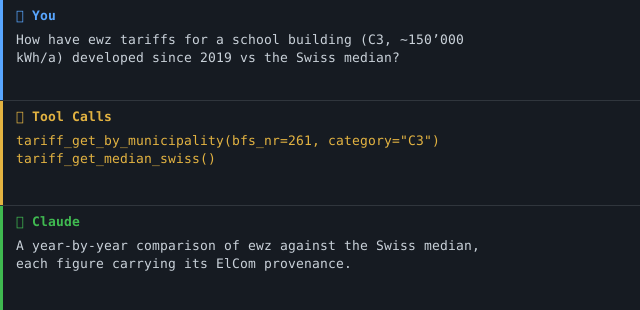
"How have ewz electricity tariffs for a typical school building (consumption category C3, ≈150'000 kWh/a) developed since 2019, and how do they compare to the Swiss median?"
A single conversation calls tariff_get_by_municipality (bfs_nr=261, category="C3") + tariff_get_median_swiss and returns a year-by-year comparison with full provenance — ready for a Geschäftsleitung slide.
Demo
What's inside
Three official Swiss data sources combined into one MCP server, each with its own dedicated tool group:
| Source | What it provides | Provenance |
|---|---|---|
| Energiedashboard.ch (Bundesamt für Energie) | National production mix, consumption forecast, storage-lake fill, consumer price index | live_api |
| ElCom electricity-price cubes (via LINDAS SPARQL) | Tariffs per municipality, category, year, with full breakdown (energy + grid usage + KEV + Abgaben) | sparql |
| opendata.swiss + Stadt Zürich OGD (CKAN) | Dataset discovery for raw time series (e.g. quarter-hour NE5/NE7 consumption) | live_api |
No authentication required. All endpoints are public Swiss OGD.
Tools (12)
dashboard_* — Energiedashboard.ch (BFE)
dashboard_get_production_mix— Production mix by year (TWh + %): Kernkraft, Wasserkraft, PV, Wind, thermal.dashboard_get_consumption_forecast— Current consumption forecast + 5-day outlook + 5-year envelope.dashboard_get_storage_lakes— Speichersee fill level (CH or per region: Wallis, Tessin, Graubünden, Zentral/Ost) — critical winter-supply indicator.dashboard_get_consumer_price_index— Endverbraucher-Strompreis-Index (2020-01-01 = 100).
tariff_* — ElCom (via LINDAS SPARQL)
tariff_list_categories— H1–H8 (households) and C1–C7 (commercial). C3 ≈ 150'000 kWh/a is the typical reference for school buildings.tariff_get_by_municipality— Tariffs for a BFS-Nr + category + year range, broken into energy / grid usage / KEV / Abgaben.tariff_get_median_swiss— National median benchmark.tariff_get_median_canton— Cantonal median (e.g. for Kanton Zürich).tariff_compare_municipalities— Compare up to 20 municipalities side-by-side.
consumption_* — opendata.swiss + Stadt Zürich OGD
consumption_search_bfe_datasets— CKAN search across BFE-published datasets.consumption_search_zurich— CKAN search across Stadt Zürich OGD (includes quarter-hour NE5/NE7 consumption).
Status
electricity_check_status— Liveness probe across all four upstreams (HTTP status + latency + overall-healthy flag).
Installation
From PyPI
pip install swiss-electricity-mcp
From source
git clone https://github.com/malkreide/swiss-electricity-mcp.git
cd swiss-electricity-mcp
pip install -e ".[dev]"
Use with Claude Desktop
Add to claude_desktop_config.json:
{
  "mcpServers": {
    "swiss-electricity": {
      "command": "swiss-electricity-mcp"
    }
  }
}
Cloud deployment (Streamable HTTP)
SWISS_ELECTRICITY_TRANSPORT=streamable-http \
SWISS_ELECTRICITY_HOST=0.0.0.0 \
SWISS_ELECTRICITY_PORT=8000 \
swiss-electricity-mcp
Works on Render.com, Railway, Fly.io.
Host binding (security). In HTTP mode the host defaults to
127.0.0.1(loopback only). Bind to all interfaces withSWISS_ELECTRICITY_HOST=0.0.0.0only inside a container, where the network boundary is the container, not the host. Setting0.0.0.0on a developer machine exposes the server to the local network (NeighborJack).
Docker
A multi-stage Dockerfile is provided. It runs as a non-root user (UID 10001)
and sets SWISS_ELECTRICITY_HOST=0.0.0.0 explicitly for the containerised case.
docker build -t swiss-electricity-mcp .
docker run --rm -p 8000:8000 swiss-electricity-mcp
Observability & configuration
| Env var | Default | Purpose |
|---|---|---|
SWISS_ELECTRICITY_TRANSPORT | stdio | stdio or streamable-http |
SWISS_ELECTRICITY_HOST | 127.0.0.1 | HTTP bind host (0.0.0.0 in containers only) |
SWISS_ELECTRICITY_PORT | 8000 | HTTP port |
SWISS_ELECTRICITY_LOG_LEVEL | INFO | Log level (DEBUG/INFO/WARNING/ERROR) |
SWISS_ELECTRICITY_CORS_ORIGINS | (empty) | Comma-separated allowed CORS origins (browser clients); never * |
OTEL_EXPORTER_OTLP_ENDPOINT | (unset) | Enables OpenTelemetry tracing when set |
SWISS_ELECTRICITY_ENV | unknown | deployment.environment resource attribute for traces |
-
Logging is structured JSON on stderr (stdout is reserved for the stdio JSON-RPC channel). Upstream failures are logged in full server-side but masked in client-facing responses.
-
Tracing is opt-in. Install the extra and point it at a collector:
pip install "swiss-electricity-mcp[otel]"
OTEL_EXPORTER_OTLP_ENDPOINT=http://localhost:4318 swiss-electricity-mcp
You get one span per tool call (
mcp.tool.<name>) plus automatic httpx child spans for each upstream request. No argument values or PII are recorded.
Architecture
          ┌────────────────────────── MCP client (Claude etc.) ──────────────────────────┐
          │                          stdio  or  Streamable HTTP                           │
          └───────────────────────────────────────┬──────────────────────────────────────┘
                                                   │  12 read-only tools (annotated)
                                          ┌────────▼─────────┐
                                          │  FastMCP server   │  egress allow-list + HTTPS gate
                                          │  + structlog/OTel │  per-source TTL cache + retry
                                          └───┬────────┬───┬──┘
                  dashboard_* │ tariff_*      │        │   │   consumption_*
                              ▼               ▼        ▼   ▼
                  ┌───────────────────┐ ┌───────────┐ ┌──────────────┐ ┌─────────────────────┐
                  │ Energiedashboard  │ │  LINDAS   │ │ opendata.swiss│ │ data.stadt-zuerich.ch│
                  │ .admin.ch (BFE)   │ │  SPARQL   │ │   CKAN        │ │   CKAN (OGD)         │
                  └───────────────────┘ └───────────┘ └──────────────┘ └─────────────────────┘
Hybrid (live API + SPARQL + CKAN discovery), no authentication. Three reasons this is the right shape:
- Different latency profiles per source: Energiedashboard responds in ~200 ms (great live); LINDAS SPARQL is slower and occasionally returns 504 (longer timeout + 3 retries); CKAN is metadata-only and inherently safe.
- Different update cadences: Dashboard updates intraday; ElCom tariffs update once per year; OGD datasets are stable for months. Per-source TTL caching (600 s / 3600 s) reflects this.
- Domain separation from
swiss-energy-mcp: that server covers geo and infrastructure data (power plants, grid lines).swiss-electricity-mcpcovers time-series and tariffs. Both compose cleanly.
Provenance discipline
Every tool response is a Pydantic envelope carrying:
source— full attribution string (e.g. "Daten: Bundesamt für Energie (BFE)…").provenance— exactly one oflive_api/sparql/cached/weekly_dump/stale_cache_fallback.retrieved_at— ISO-8601 UTC timestamp.
This makes accidental misattribution structurally impossible.
Resilience
- Retry: 3 attempts with exponential backoff (2 s / 4 s / 8 s).
- 5xx + 429: retried. 4xx (except 429): raised immediately (permanent client error).
- In-memory TTL cache: per-source TTLs reduce upstream load and round-trip during multi-step agent workflows.
MCP primitives — why Tools only
This server intentionally exposes only Tools, not Resources or Prompts. The
data is parametric and query-driven (a municipality BFS number, a category, a
year), which maps naturally to tool calls; there is no stable, enumerable set of
documents to expose as Resources, and no curated prompt templates to ship. If a
future use case needs, say, a fixed "national production mix" document, the
read-only dashboard_* tools are the obvious Resource-migration candidates.
Project phase
Phase 1 — read-only. All 12 tools are read-only (readOnlyHint=true) with no
write or destructive operations. Phase-transition criteria and the longer-term
plan live in docs/roadmap.md. Security posture (egress,
supply-chain, lethal-trifecta assessment) is documented in
docs/security-posture.md.
MCP Protocol Version
This server speaks two protocol eras over the same endpoint. The client's first request on a connection decides which one applies; a later claim from the other era is refused.
| Era | Revision | Who reaches it |
|---|---|---|
initialize handshake | 2024-11-05 … 2025-11-25 | What today's clients speak. The server answers with the revision asked for, or with the 2025-11-25 ceiling when the request asks for something newer. |
| Per-request envelope | 2026-07-28 | A request carrying the 2026-07-28 _meta envelope opens a modern connection. |
Both revisions are pinned in
tests/test_protocol_version.py and asserted
against the installed SDK, so a Dependabot bump of mcp cannot move either one
silently. The handshake ceiling is measured against a live initialize through
the assembled ASGI stack, not read off a constant name.
Note that the SDK's LATEST_PROTOCOL_VERSION is an alias for the modern
era, not for the handshake era — pinning against it alone would leave the era
that current clients actually negotiate free to drift.
Update policy. When the gate fails, do not edit the constant blindly: read
the spec changelog between the two revisions, verify the server still behaves,
then move the constant, this section, README.de.md and
CHANGELOG.md together.
Testing
# Unit tests (mocked, fast, CI default) — tests/test_unit.py + tests/test_security.py
PYTHONPATH=src pytest -m "not live" -v

# Live tests (hits real upstreams) — tests/test_live.py
PYTHONPATH=src pytest -m live -v
Unit tests cover the contract layers: Happy (response parsing), Retry
(5xx, 429, 4xx), Timeout (network errors → clean UpstreamUnreachableError),
envelope/attribution invariants, plus security (egress allow-list, SPARQL
escaping, tool-definition lock). CI runs ruff + pytest -m "not live" on
Python 3.11–3.13.
Auditing the ruff pin across the portfolio
scripts/pin_audit.py checks whether a server's own pin guards actually hold.
It is not a CI gate — it needs the sibling repositories on disk — but it is
worth running whenever a pin convention changes or a new server joins:
python scripts/pin_audit.py ../*-mcp
It measures black-box: prepend an ordinary second pre-commit hook with its own
rev:, run the guard, read the exit code, restore the file. Two guards in the
portfolio used to report that hook's version as the ruff pin, turning CI red
with a number nobody had written. A positive control (misconfigure the ruff
hook's own rev) separates "correctly scoped" from "never reads the file" —
without it, a guard that ignores the config looks like a clean bill of health.
Where the test data comes from
The fixtures under tests/fixtures/ are recorded from the live sources and
dated. Source, retrieval date, selection rule and SHA-256 for every file:
tests/fixtures/PROVENANCE.md.
python scripts/record_fixtures.py # re-record
The requests are built by the production code. The script calls
ElComSparqlClient and EnergyDashboardClient and captures the answer through
an httpx transport, rather than retyping the SPARQL alongside. A fixture that
answers a slightly different question than the server asks proves the wrong
answer — quietly, because it looks plausible. At 40 lines of SPARQL, "slightly
different" is the normal case, not the exception.
Two selection rules are deliberately more than "the first N":
- The storage-lake series runs into the future. After the last measured day
come rows with a
nullmeasurement — 94 of them on the recording day. They are kept on purpose: without them, no test could show that the tool skips them. - What counts as a measurement is named per file, not guessed. The first
version of this used "any field other than
dateis non-null", which is wrong: those future rows do carry values — the five-year reference curves — just no measurement.
Where a search is trimmed, count keeps its real value: it says how much is
not in the file.
MCP protocol version
This server is built on the official MCP Python SDK (mcp[cli]), pinned to
>=1.2.0,<2.0.0. The MCP protocol version is negotiated by the SDK at the
initialize handshake; the supported spec version tracks the pinned SDK
(currently MCP spec 2025-11-25).
Update policy: SDK updates arrive as weekly Dependabot PRs. A protocol-spec
bump is only adopted via an explicit SDK minor/major bump, recorded in
CHANGELOG.md, and verified against the tool-definition lock
(tool-definitions.lock.json).
Known limitations
- LINDAS SPARQL 504 timeouts: the LINDAS public endpoint occasionally returns 504 under load. The 3-retry policy handles transient cases; persistent unavailability surfaces as
UpstreamUnreachableError. - No historical PV/wind detail: Energiedashboard exposes only aggregated production mix at year level. For sub-yearly PV or wind, use
consumption_search_bfe_datasets. - No FHIR or smart-meter data: out of scope. Future work may add a
swiss-prosumer-mcpor similar. - Year coverage: ElCom tariff data starts in 2009. Energiedashboard mix starts in 2014.
Portfolio synergy
This server composes naturally with other portfolio servers:
- +
swiss-energy-mcp— combine geo/asset data (power plants) with time-series and tariffs for full energy-infrastructure analysis. - +
meteoswiss-mcp— correlate consumption forecasts with weather (temperature drives heating/cooling load). - +
fedlex-mcp— pair tariff data with the Stromversorgungsgesetz (StromVG) for compliance/legal context. - +
zh-education-mcp— Schulamt-relevant queries combining tariffs, school counts, infrastructure budgets.
Data sources & licensing
All upstream data is Open Government Data Switzerland (OGD-CH):
- Energiedashboard.ch © Bundesamt für Energie BFE — Open data, free to use.
- ElCom / LINDAS © Eidgenössische Elektrizitätskommission ElCom — CC BY 4.0.
- opendata.swiss © Various Swiss public bodies — Mostly CC0 / CC BY 4.0.
- Stadt Zürich OGD © Stadt Zürich — CC0.
This MCP server is MIT-licensed (see LICENSE). Always cite the original data source — the response envelope includes the proper attribution string automatically.
Contributing
See CONTRIBUTING.md.
Security
See SECURITY.md for the security policy and how to report a vulnerability.
License
MIT License — see LICENSE. The upstream data keeps the licences listed under Data sources & licensing above.
Author
Hayal Oezkan · github.com/malkreide
Changelog
See CHANGELOG.md.
Installation
Run via uv's uvx — no clone or manual install needed. Add to your MCP client config (mcpServers for Claude Desktop, Cursor and Windsurf; use a top-level servers key for VS Code in .vscode/mcp.json):
{
  "mcpServers": {
    "swiss-electricity-mcp": {
      "command": "uvx",
      "args": [
        "swiss-electricity-mcp"
      ]
    }
  }
}
Reviews
No reviews yet
Be the first to review this server!
More Developer Tools MCP Servers
Fetch
Freeby Modelcontextprotocol · Developer Tools
Web content fetching and conversion for efficient LLM usage
Git
Freeby Modelcontextprotocol · Developer Tools
Read, search, and manipulate Git repositories programmatically
Toleno
Freeby Toleno · Developer Tools
Toleno Network MCP Server — Manage your Toleno mining account with Claude AI using natural language.
mcp-creator-python
Freeby mcp-marketplace · Developer Tools
Create, build, and publish Python MCP servers to PyPI — conversationally.
MCP Marketplace
Freeby mcp-marketplace · Developer Tools
Search and install MCP servers from inside your AI client.
MarkItDown
Freeby Microsoft · Content & Media
Convert files (PDF, Word, Excel, images, audio) to Markdown for LLM consumption