
Server data from the Official MCP Registry
MCP server for I14Y — Switzerland's national open-data metadata catalogue (DCAT-AP-CH)
About
MCP server for I14Y — Switzerland's national open-data metadata catalogue (DCAT-AP-CH)
Security Report
Valid MCP server (1 strong, 3 medium validity signals). No known CVEs in dependencies. Package registry verified. Imported from the Official MCP Registry. Trust signals: trusted author (43/43 approved).
4 files analyzed · 1 issue found
Security scores are indicators to help you make informed decisions, not guarantees. Always review permissions before connecting any MCP server.
Permissions Required
This plugin requests these system permissions. Most are normal for its category.
How to Install
Add this to your MCP configuration file:
{
  "mcpServers": {
    "io-github-malkreide-i14y-mcp": {
      "args": [
        "i14y-mcp"
      ],
      "command": "uvx"
    }
  }
}Documentation
View on GitHubFrom the project's GitHub README.
Part of the Swiss Public Data MCP Portfolio — a collection of open-source MCP servers connecting AI agents to Swiss public and open data. This is a private project. It is not affiliated with, endorsed by, or operated on behalf of any employer or public authority.
i14y-mcp



MCP server for the I14Y interoperability platform — Switzerland's national metadata catalogue.
Why this server exists
The other servers in this portfolio answer «what does the data say?». This one answers the question that comes first: «who publishes data on this topic, through which interface, under which licence?»
I14Y is the national data catalogue maintained by the Federal Statistical Office. It describes datasets, registered APIs, public services and harmonised concepts from the Confederation, cantons and communes, using the DCAT-AP-CH profile (eCH-0200).
Mnemonic: «Catalogue before shelf.» Without a catalogue, an agent has to already know a data source exists. With one, it can find it.
🎯 Anchor Demo Query
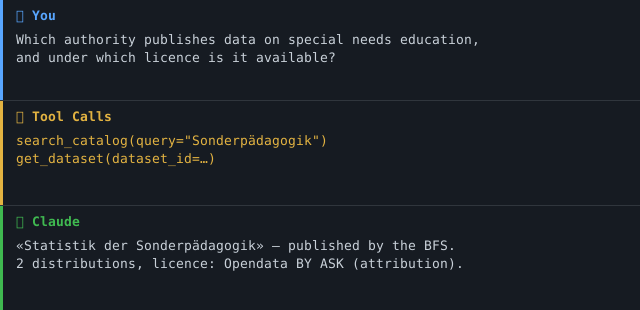
«Which authority publishes data on special needs education, through which interface is it available, and under which licence?»
search_catalog(query="Sonderpädagogik")
  → «Statistik der Sonderpädagogik» — Federal Statistical Office (BFS), theme: Bildung

get_dataset(dataset_id=...)
  → 2 distributions, licence: «Opendata BY ASK — attribution required,
    commercial use only with permission from the data supplier»
  → contact: auskunftsdienst@bfs.admin.ch
Two tool calls turn a vague topic into a named authority, a download URL and a
licence you can act on — get_dataset aggregates the distributions, licences
and contact point into one record.
Demo
Architecture
                 ┌──────────────────────────────┐
                 │      MCP Host (Claude)       │
                 └───────────────┬──────────────┘
                                 │ stdio | streamable-http
                 ┌───────────────▼──────────────┐
                 │          i14y-mcp            │
                 │  ┌────────────────────────┐  │
                 │  │ server.py  (13 tools)  │  │
                 │  ├────────────────────────┤  │
                 │  │ mappers.py             │  │  DCAT → flat, one language
                 │  ├────────────────────────┤  │
                 │  │ models.py  (Pydantic)  │  │  source + provenance envelope
                 │  ├────────────────────────┤  │
                 │  │ client.py              │  │  retry 2s/4s/8s, no-retry 4xx
                 │  └────────────────────────┘  │
                 └───────────────┬──────────────┘
                                 │ HTTPS, no auth
                 ┌───────────────▼──────────────┐
                 │  api.i14y.admin.ch/api       │
                 │  datasets · dataservices ·   │
                 │  concepts · publicservices · │
                 │  catalogs · agents · search  │
                 └──────────────────────────────┘
Architecture decision
This server uses Architecture A (live API only).
Rationale (verified live on 2026-07-21):
- All read endpoints respond without authentication and paginate correctly.
- No bulk download of catalogue metadata is offered, and none is needed.
- Error responses follow RFC 7807, so failure modes are distinguishable.
Consequences:
- Every HTTP call retries transient failures with 2 s / 4 s / 8 s backoff.
search_catalogcaps results client-side because the upstream ignores paging.api_statusalways returns an evaluable state instead of empty records.
Full probe report: docs/probe-i14y.md.
Project phase
This server is in Phase 1 (read-only) of the portfolio's «Read-only First»
phase architecture: all tools are read-only, there is no authentication and no
personal data. See docs/roadmap.md for the phase model and
the prerequisites for any future write capability.
Tools
| Tool | Purpose |
|---|---|
search_catalog | Free-text search across the catalogue. Entry point. |
list_datasets | Paginated dataset register (complete, unlike search). |
get_dataset | Full metadata record for one dataset. |
get_dataset_distributions | Download URLs, formats and licences. |
list_data_services | Register of official Swiss APIs with endpoint URLs. |
get_data_service | Full record for one registered interface. |
list_public_services | Administrative services for citizens. |
list_concepts | Harmonised concepts and code lists. |
get_concept | One concept definition. |
search_codelist_entries | Individual codes of a code list. |
list_publishers | Publishing bodies, with Swiss UID. |
list_catalogs | Contributing catalogues. |
api_status | Reachability check with graceful degradation. |
All tools are annotated readOnlyHint: true. Write operations exist in the
upstream API but are deliberately not exposed.
MCP primitives
This server exposes Tools only — no Resources, no Prompts. That is a deliberate choice, not an omission: I14Y is queried by free-text search and by opaque UUIDs, so there is no small, stable set of addressable URIs that would map cleanly onto MCP Resources, and the server ships no opinionated prompt templates. Every tool is read-only and idempotent; if a future stable entry point emerges (e.g. a fixed theme list) it is a candidate for a Resource.
MCP protocol version
Built against the MCP Python SDK (mcp >= 1.28.1), which negotiates the protocol
version with the client at initialize time. The tested SDK floor is pinned in
pyproject.toml; Dependabot opens monthly SDK-update
PRs, and any change that bumps the negotiated spec version is called out in
CHANGELOG.md.
MCP Protocol Version
This server speaks two protocol eras over the same endpoint. The client's first request on a connection decides which one applies; a later claim from the other era is refused.
| Era | Revision | Who reaches it |
|---|---|---|
initialize handshake | 2024-11-05 … 2025-11-25 | What today's clients speak. The server answers with the revision asked for, or with the 2025-11-25 ceiling when the request asks for something newer. |
| Per-request envelope | 2026-07-28 | A request carrying the 2026-07-28 _meta envelope opens a modern connection. |
Both revisions are pinned in
tests/test_protocol_version.py and asserted
against the installed SDK, so a Dependabot bump of mcp cannot move either one
silently. The handshake ceiling is measured against a live initialize through
the assembled ASGI stack, not read off a constant name.
Note that the SDK's LATEST_PROTOCOL_VERSION is an alias for the modern
era, not for the handshake era — pinning against it alone would leave the era
that current clients actually negotiate free to drift.
Update policy. When the gate fails, do not edit the constant blindly: read
the spec changelog between the two revisions, verify the server still behaves,
then move the constant, this section, README.de.md and
CHANGELOG.md together.
Installation
uvx i14y-mcp
Or from source:
git clone https://github.com/malkreide/i14y-mcp
cd i14y-mcp
pip install -e ".[dev]"
Claude Desktop
{
  "mcpServers": {
    "i14y": {
      "command": "uvx",
      "args": ["i14y-mcp"]
    }
  }
}
Remote deployment (Render, Railway)
I14Y_MCP_TRANSPORT=sse HOST=0.0.0.0 PORT=8000 i14y-mcp
I14Y_MCP_TRANSPORT accepts stdio (default), sse or streamable-http. The
HTTP transports bind to HOST, which defaults to 127.0.0.1 (loopback); set
HOST=0.0.0.0 to expose the port on a PaaS (the Docker image already does).
CORS exposes the Mcp-Session-Id header so browser MCP clients keep their session.
Which browser origins may call the server comes from I14Y_MCP_CORS_ORIGINS, a
comma-separated list — unset means no browser client is permitted at all,
which is the default. * is still accepted and logs a warning. stdio and other
non-browser clients are unaffected either way.
Docker
docker compose up --build # SSE transport on http://localhost:8000
The image is a hardened multi-stage build: it runs as a non-root user, ships no
build tools, and needs no secrets (the API is unauthenticated). See
Dockerfile and compose.yaml.
Join keys
I14Y is a connector layer. Two identifiers make it composable with the rest of the portfolio:
| Key | Field | Joins to |
|---|---|---|
| Swiss UID | Publisher.uid | register-mcp (Zefix) |
| Endpoint URL | DataServiceSummary.endpoint_urls | any portfolio server wrapping that API |
Known limitations
Verified live on 2026-07-21.
- The search index covers roughly half the register.
search_catalogreturns at most 1013 records;list_datasetsreaches about 2003. Uselist_datasetswhen completeness matters. - Search returns Datasets only. Filtering by
types=["Concept"]ortypes=["DataService"]yields zero results even though those entities exist. Uselist_conceptsandlist_data_servicesinstead. - The upstream ignores paging on search. The full result set is always
returned; this server caps it at 200 records and sets
truncated: true. - Licences vary per distribution, not per dataset. Most carry
«Opendata BY ASK», which requires attribution and restricts commercial use.
Always read the
licencefield before reuse. - Some metadata fields are simply empty. Frequency, temporal coverage and distribution format are optional and frequently unset by publishers. This is a data-quality property of the catalogue, not a bug in this server.
- Not every entry with an endpoint has a URL. Entries labelled only
«OpenAPI Spezifikation» without a URI are surfaced as
(no URI) <label>rather than dropped.
Testing
PYTHONPATH=src pytest tests/ -m "not live"   # offline, used in CI
PYTHONPATH=src pytest tests/ -m "live"       # hits the real API
PYTHONPATH=src pytest tests/                 # everything
python -m ruff check src tests
The live tests are not decoration: fundstück 4 in the probe report — keywords
nesting their language object under label — was caught by a live test after
the unit tests were already green.
Contributing
See CONTRIBUTING.md for the ground rules (read-only, one
egress host, no secrets) and the local dev loop. Maintainers: PUBLISHING.md
covers the PyPI / MCP Registry release process.
Security
See SECURITY.md for the security posture and how to report a
vulnerability.
License
MIT License — see LICENSE. The catalogue data remains subject to the terms declared by each publisher.
Author
Hayal Oezkan · github.com/malkreide
Credits & related projects
- Data: I14Y Interoperability Platform, Federal Statistical Office (BFS)
- Standard: eCH-0200 / DCAT-AP-CH
- Source discovery inspired by rnckp/awesome-ogd-switzerland
- Portfolio: swiss-public-data-mcp
- Protocol: Model Context Protocol
Licence: MIT. The catalogue data remains subject to the terms declared by each publisher.
MCP Registry
Ownership marker used by the MCP Registry to link this PyPI package to the GitHub namespace:
mcp-name: io.github.malkreide/i14y-mcp
Reviews
No reviews yet
Be the first to review this server!
More Developer Tools MCP Servers
Git
Freeby Modelcontextprotocol · Developer Tools
Read, search, and manipulate Git repositories programmatically
Fetch
Freeby Modelcontextprotocol · Developer Tools
Web content fetching and conversion for efficient LLM usage
Toleno
Freeby Toleno · Developer Tools
Toleno Network MCP Server — Manage your Toleno mining account with Claude AI using natural language.
mcp-creator-python
Freeby mcp-marketplace · Developer Tools
Create, build, and publish Python MCP servers to PyPI — conversationally.
MCP Marketplace
Freeby mcp-marketplace · Developer Tools
Search and install MCP servers from inside your AI client.
MarkItDown
Freeby Microsoft · Content & Media
Convert files (PDF, Word, Excel, images, audio) to Markdown for LLM consumption