
Server data from the Official MCP Registry
BAG public-health open data: indicators, programmes, statistics
About
BAG public-health open data: indicators, programmes, statistics
Security Report
Valid MCP server (1 strong, 1 medium validity signals). No known CVEs in dependencies. Package registry verified. Imported from the Official MCP Registry. Trust signals: trusted author (49/50 approved).
3 files analyzed · 1 issue found
Security scores are indicators to help you make informed decisions, not guarantees. Always review permissions before connecting any MCP server.
Permissions Required
This plugin requests these system permissions. Most are normal for its category.
How to Install
Add this to your MCP configuration file:
{
  "mcpServers": {
    "io-github-malkreide-bag-health-mcp": {
      "args": [
        "bag-health-mcp"
      ],
      "command": "uvx"
    }
  }
}Documentation
View on GitHubFrom the project's GitHub README.
bag-health-mcp



Part of the Swiss Public Data MCP Portfolio — connecting AI models to Swiss public data sources.
MCP server for Swiss public health data. Its core is the Swiss Federal Office of Public Health (BAG) Infectious Disease Dashboard (IDD) — epidemiological surveillance for 51 pathogens (influenza, COVID-19, measles, wastewater surveillance, and more) — extended with a multi-source health-indicator layer over the Swiss Health Observatory (Obsan), the Versorgungsatlas (health-care supply atlas, with cantonal series) and Sucht Schweiz (HBSC youth survey). All read-only, public Open Government Data.
What You Can Do
"Wie ist die aktuelle Grippesituation im Kanton Zürich verglichen mit den letzten Wochen?"
→ bag_health_mcp__get_canton_situation(canton="ZH")

"Gibt es aktuell einen Masernausbruch in der Schweiz?"
→ bag_health_mcp__get_disease_data(series_id="measles/cases/incValue/year", canton="all")

"Wie entwickelt sich das SARS-CoV-2-Signal im Abwasser?"
→ bag_health_mcp__list_series(topic="wastewater_viral_load")
→ bag_health_mcp__get_disease_data(series_id="wastewater_viral_load/NA/value/date", ...)

"Welche Krankheitsdaten stellt das BAG aktuell bereit?"
→ bag_health_mcp__list_diseases()

"Wie hat sich der Alkoholkonsum bei 15-Jährigen seit 2010 entwickelt?"   # 🎯 anchor query
→ bag_health_mcp__search_health_indicators(source="suchtschweiz", topic="alkohol")
→ bag_health_mcp__get_indicator_series(source="suchtschweiz",
      indicator_id="monam/alkoholkonsum-alter-11-15", region="ZH", year_from=2010)
→ More use cases by audience →
🎯 Anchor demo query — «Wie hat sich der Alkoholkonsum bei 15-Jährigen im Kanton Zürich seit 2010 entwickelt, und wie steht der Kanton im Schweizer Vergleich da?» The HBSC youth series (via Obsan) answers the Switzerland-wide trend since 2010 with 95% confidence intervals. This particular indicator is national only, so the response includes a
region_notesaying so (HBSC is not cantonally representative). Most other Obsan indicators are published by canton — see the note on cuts below. These are aggregated population statistics — not individual advice. Seedocs/tool-design-health-indicators.md.
Tools
Infectious-disease surveillance (BAG IDD):
| Tool | Description |
|---|---|
bag_health_mcp__list_diseases | List all 51 disease topics, grouped by category |
bag_health_mcp__list_series | List data series for a specific disease |
bag_health_mcp__get_series_details | Get available filter dimensions (canton, age, sex) |
bag_health_mcp__get_disease_data | Fetch time-series surveillance data |
bag_health_mcp__get_canton_situation | Situational overview for a canton (Schulamt use case) |
bag_health_mcp__list_export_files | List available complete export datasets |
bag_health_mcp__download_export | Download raw CSV/JSON export |
bag_health_mcp__get_data_version | Current data version (updated every Wednesday) |
Health indicators — Obsan, Versorgungsatlas & Sucht Schweiz (multi-source):
| Tool | Description |
|---|---|
bag_health_mcp__search_health_indicators | Search indicators by source (obsan / versorgungsatlas / suchtschweiz), topic, region, year range |
bag_health_mcp__get_indicator_series | Fetch one indicator's time series, naming which cut it is (variant: national / by canton / by age class / by social position / distribution) and which others exist. Pass region='ZH' for the cantonal cut; 95% CIs throughout |
⚠️ Aggregated population statistics only. The indicator tools serve population-level aggregates (prevalences/metrics by age/sex/region) — not individual advice, diagnosis or case assessment, and no personal data. This is stated in both tool descriptions and every response (
aggregate_statistics_notice), and matters especially forsuchtschweiz(HBSC), which touches prevention topics in a school context. Sources: Obsanind.obsan.admin.ch(clean JSON API); Sucht Schweiz HBSC via the Obsan mirror (national); Versorgungsatlas returns a cantonal year/value series (26 cantons + aCHnational total, with 95% CIs and a canton-vs-CH ratio) from the Tarifpool. See the per-source probe notes.
Obsan publishes an indicator in several cuts, not one series. Measured over 60 catalogue entries on 2026-08-08: 50 have a cantonal cut (
kg), 49 one by age class (ag), 24 one by social position (sd) — and only 3 the plain national one (g). They are different measurements with different units, soget_indicator_seriesnames the cut it returned invariantand lists the rest invariants_available, rather than presenting one as a stand-in for another. Eight of the 60 publish no series at all; that case fails with its reason instead of returning an empty result. The census is recorded and dated intests/fixtures/obsan_variant_census.json.
Tool annotations
All tools carry MCP tool annotations so a host can reason about them without calling. Every tool is identical here — it only ever reads from the public, allow-listed data sources (BAG IDD, Obsan, Versorgungsatlas):
| Annotation | Value | Meaning |
|---|---|---|
readOnlyHint | true | No tool mutates any state. |
destructiveHint | false | No destructive side effects. |
idempotentHint | true | Repeating a call has no additional effect. |
openWorldHint | true | Tools reach an external system (the upstream data APIs). |
A host may therefore treat all calls as safe, cacheable reads. The values are
declared once as READ_ONLY in server.py and applied to all 10 tools.
MCP Primitives
This server uses all three MCP primitives, each for what it is best at:
Tools (10) — live, parameterised actions that call the IDD API (above).
Resources — static, read-only reference data a host can fetch and cache, no arguments or upstream call needed:
| Resource URI | Description |
|---|---|
bag://reference/cantons | Canton codes accepted by the tools (incl. FL, all) |
bag://reference/disease-categories | Disease-topic taxonomy by category |
bag://reference/data-licence | Source, attribution and licence terms |
Prompts — reusable, parameterised workflows a host can surface (e.g. as slash-commands):
| Prompt | Arguments | Purpose |
|---|---|---|
canton_situation_brief | canton | Draft a Schulamt public-health situation brief |
outbreak_check | disease, canton | Check whether a disease is currently elevated |
Live surveillance data stays behind Tools (it is parameterised and changes weekly); fixed reference data is exposed as Resources; recommended multi-tool workflows are packaged as Prompts.
Relevance for Schools & City Administration
Schulamt / Kreisschulbehörden:
- Monitor influenza and ARI incidence in your canton
- Single measles case → alert for schools with low vaccination coverage
- Pertussis tracking → protect unvaccinated infants (siblings of school children)
Stadtverwaltung / KI-Fachgruppe:
- Public Health Reporting with structured weekly data
- Wastewater surveillance as 1-week lead indicator before clinical cases
Synergy with portfolio:
bag-epl-mcp→ "What treatments are listed?" (EPL medication database)bag-health-mcp→ "What is currently spreading?" (surveillance data)
Data Source
- IDD API:
https://api.idd.bag.admin.ch— No authentication required - Update cycle: Every Wednesday
- Coverage: Switzerland + Liechtenstein (FL), 26 cantons
- Topics: 51 pathogens, 1386 data series
Datenquellen & Lizenzen / Data sources & licences
| Source | Provider | Licence | Attribution required |
|---|---|---|---|
| Infectious Disease Dashboard (IDD) | Federal Office of Public Health (FOPH / BAG) | opendata.swiss Open Government Data — free use, source attribution required (Swiss OGD terms, CC BY-equivalent) | Yes |
| Health indicators | Obsan — Swiss Health Observatory (ind.obsan.admin.ch) | No explicit machine-readable licence; treat as Swiss OGD practice — free use, cite the per-indicator source | Yes |
| Health-care supply atlas | Versorgungsatlas (BAG/Obsan, versorgungsatlas.ch) | Same (Swiss OGD practice, cite source) | Yes |
| HBSC youth survey | Sucht Schweiz — HBSC, obtained via the Obsan mirror | Same (Swiss OGD practice, cite «Sucht Schweiz — HBSC») | Yes |
Required citation: Federal Office of Public Health FOPH — Infectious Disease
Dashboard (IDD), open data via opendata.swiss. For the indicator tools, each
response's provenance.source names the concrete upstream (e.g. «Sucht Schweiz —
HBSC» via Obsan). Every tool response carries attribution in a provenance block
(attribution + license fields) so downstream consumers can surface it
automatically.
Architecture:
                    ┌─────────────────┐    api.idd.bag.admin.ch (IDD API, no auth)
  MCP Host          │  bag-health-mcp │──▶ ind.obsan.admin.ch   (Obsan JSON API)
  (Claude, etc.) ──▶│  MCP SDK        │──▶ versorgungsatlas.ch  (indicator catalogue)
                    │  10 Tools       │    all HTTPS, egress allow-listed, no auth
                    └─────────────────┘
Installation
Claude Desktop (stdio)
{
  "mcpServers": {
    "bag-health": {
      "command": "uvx",
      "args": ["bag-health-mcp"]
    }
  }
}
Cloud / HTTP
pip install bag-health-mcp
python -m bag_health_mcp.server --http --port 8000
Transport, host and port are set via environment variables — MCP_TRANSPORT
(http/stdio), MCP_HOST, MCP_PORT — which is the recommended way for
deployments (the --http flag still works for local use). The server binds to
127.0.0.1 by default so a local HTTP server is not exposed to the network.
Container/cloud deployments bind all interfaces by setting MCP_HOST=0.0.0.0
explicitly — the provided Dockerfile does this.
⚠️ Security: HTTP transport exposes the server on the network. Only bind beyond
127.0.0.1in a network-isolated environment — never directly on a public/shared network. Binding to a non-localhost host logs a warning at startup. The default stdio transport has no network surface. Seedocs/security-posture.md.
HTTP auth (optional): set MCP_AUTH_TOKEN to require
Authorization: Bearer <token> on every HTTP request (401 otherwise). Unset =
no auth (fine for stdio/local). This gates who may invoke the server; for real
user identity, front it with a gateway.
CORS (browser clients): set MCP_CORS_ORIGINS to a comma-separated origin
allow-list to enable cross-origin browser access; the Mcp-Session-Id header is
exposed so stateful sessions work. Empty = no cross-origin (never a wildcard).
Host allow-list (DNS rebinding): set MCP_ALLOWED_HOSTS to a comma-separated
list of the names this server is reachable under, including the port, e.g.
bag.example.ch:8000. Requests arriving under any other Host are rejected
with 421; loopback stays allowed so container health checks keep working.
Unset on a non-localhost bind, the check is left off and a warning is logged —
that is the gateway-fronted deployment, where the gateway validates Host. It
is not guessed: on 0.0.0.0 the reachable name is unknowable here, and a wrong
guess would reject the very deployment it is meant to protect.
This is independent of MCP_AUTH_TOKEN. The token says who is asking; this
says under which name the server is addressed. A rebinding attack runs in a
browser that already holds the token.
For running at scale (session affinity, resource limits, MCP gateway), see the
deployment & scaling guide and the reference
manifests in deploy/.
Logging: the server emits structured JSON logs (one object per line, with an
RFC 5424 severity) to stderr — stdout is reserved for the stdio JSON-RPC
transport. Set the level with MCP_LOG_LEVEL (default INFO).
Tracing (optional): install the telemetry extra and point the server at an OTLP collector to get OpenTelemetry spans per tool-call plus instrumented outbound HTTP:
pip install "bag-health-mcp[telemetry]"
export OTEL_EXPORTER_OTLP_ENDPOINT="http://otel-collector:4318"
# optional: OTEL_SERVICE_NAME=bag-health-mcp
Tracing is a no-op unless both the extra is installed and an OTEL_*
endpoint is set. Spans carry only the tool name and (on error) the exception
class — never tool arguments, cantons or surveillance data.
Available Disease Topics
| Category | Topics |
|---|---|
| Respiratory | influenza, covid19, acute_respiratory_infection, respiratory_pathogens |
| Enteric | campylobacteriosis, salmonellosis, ehec, listeriosis, hepatitis_a/e |
| STI & Bloodborne | hiv, aids, syphilis, gonorrhea, hepatitis_b/c, chlamydiosis |
| Vaccine-preventable | measles, pertussis, rubella, tetanus, diphtheria, ipd, meningo |
| Vector-borne | lyme_borreliosis, tick-borne_encephalitis, dengue, malaria, zika |
| Wastewater | wastewater_viral_load, wastewater_sequencing |
Demo
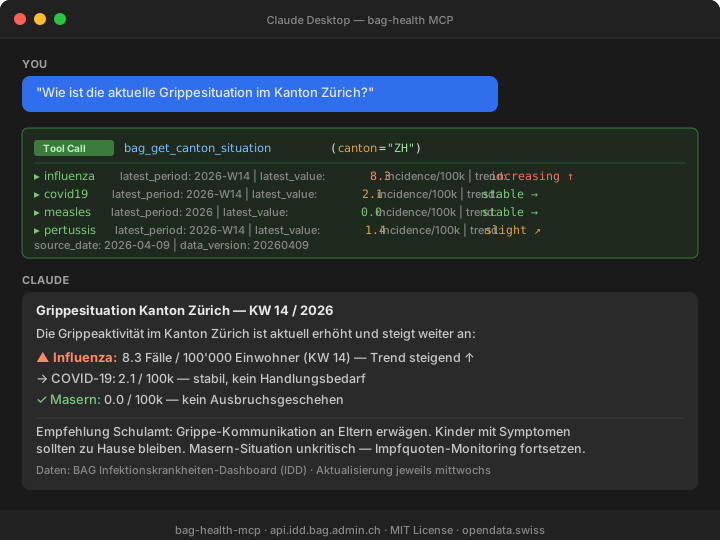
Claude asking about the influenza situation in canton Zurich — single tool call, structured result, actionable German-language summary.
MCP Protocol Version
This server speaks two protocol eras over the same endpoint. The client's first request on a connection decides which one applies; a later claim from the other era is refused.
| Era | Revision | Who reaches it |
|---|---|---|
initialize handshake | 2024-11-05 … 2025-11-25 | What today's clients speak. The server answers with the revision asked for, or with the 2025-11-25 ceiling when the request asks for something newer. |
| Per-request envelope | 2026-07-28 | A request carrying the 2026-07-28 _meta envelope opens a modern connection. |
Both revisions are pinned in
tests/test_protocol_version.py and asserted
against the installed SDK, so a Dependabot bump of mcp cannot move either one
silently. The handshake ceiling is measured against a live initialize through
the assembled ASGI stack, not read off a constant name.
Note that the SDK's LATEST_PROTOCOL_VERSION is an alias for the modern
era, not for the handshake era — pinning against it alone would leave the era
that current clients actually negotiate free to drift.
Update policy. When the gate fails, do not edit the constant blindly: read
the spec changelog between the two revisions, verify the server still behaves,
then move the constant, this section, README.de.md and
CHANGELOG.md together.
Safety & Limits
| Aspect | Details |
|---|---|
| Access | Read-only — no write operations possible |
| Egress | Code-layer allow-list: the server only contacts three public data hosts (api.idd.bag.admin.ch, ind.obsan.admin.ch, www.versorgungsatlas.ch), HTTPS-only, enforced on every request incl. redirect hops (SSRF/SEC-004 + SEC-021). Network-layer companion policy in deploy/networkpolicy.yaml |
| Personal data | None — all sources are aggregated/anonymised (BAG IDD at canton level by law; indicators are population aggregates by age/sex/region) |
| Rate limits | No published IDD API rate limit; server caps responses at 104 data points per call by default (limit_weeks param) |
| Timeout | 30 s per API call |
| Authentication | No API keys required — all data publicly accessible |
| Data licence | opendata.swiss OGD — free use, source attribution required (CC BY-equivalent). FOPH IDD must be cited; see Data sources & licences |
| Terms of Service | Subject to BAG IDD API ToS |
Known Limitations
- Beta API: IDD API is labelled
v0.1 beta— schema may change without notice - Weekly cadence: Data is not real-time; updated Wednesdays only
- Canton granularity: Some rare diseases have insufficient cases for canton-level data (suppressed for privacy)
- Age groups: Available dimensions vary by disease series; use
bag_health_mcp__get_series_detailsto check
Compliance
- ISDS (Stadt Zürich): a draft information-security protection-needs
classification (Schutzbedarfsanalyse per Grundwert + measures mapping) is in
docs/isds-klassifikation.md. It is a technically-grounded draft pending ISBO/OIZ sign-off — not a binding classification. - Data classification (Schulamt): the data is classified ÖFFENTLICH / BUI
(public OGD, no personal data, aggregated at canton level with small cells
suppressed at source). Draft scheme + aggregation-risk note in
docs/datenklassifikation-schulamt.md; the aggregatingbag_health_mcp__get_canton_situationtool surfaces this in its response. - Security posture: lethal-trifecta assessment (the server is strictly
read-only → not affected), secret-management decision (no secrets — public
data), and network-exposure notes are in
docs/security-posture.md. - Phase architecture: this is a Phase 1 (read-only) server; write/send
capabilities are deferred behind documented prerequisites. See
docs/roadmap.md. - Reporting vulnerabilities: see the security policy for how to report security issues privately.
Contributing
See CONTRIBUTING.md (Deutsch).
Security
See SECURITY.md (Deutsch) for the security posture and how to report a vulnerability confidentially.
License
Code: MIT (see LICENSE).
Data: BAG IDD is Open Government Data on opendata.swiss under free use with mandatory source attribution (Swiss OGD terms, CC BY-equivalent) — not public domain. Cite the Federal Office of Public Health FOPH (IDD) when reusing the data; see Data sources & licences.
Author
Hayal Oezkan · github.com/malkreide
Related Portfolio Servers
swiss-statistics-mcp— BFS demographic databag-epl-mcp— BAG medication reimbursement listzurich-opendata-mcp— City of Zurich open data
Installation
Run via uv's uvx — no clone or manual install needed. Add to your MCP client config (mcpServers for Claude Desktop, Cursor and Windsurf; use a top-level servers key for VS Code in .vscode/mcp.json):
{
  "mcpServers": {
    "bag-health-mcp": {
      "command": "uvx",
      "args": [
        "bag-health-mcp"
      ]
    }
  }
}
Reviews
No reviews yet
Be the first to review this server!
More Developer Tools MCP Servers
Fetch
Freeby Modelcontextprotocol · Developer Tools
Web content fetching and conversion for efficient LLM usage
Git
Freeby Modelcontextprotocol · Developer Tools
Read, search, and manipulate Git repositories programmatically
Toleno
Freeby Toleno · Developer Tools
Toleno Network MCP Server — Manage your Toleno mining account with Claude AI using natural language.
mcp-creator-python
Freeby mcp-marketplace · Developer Tools
Create, build, and publish Python MCP servers to PyPI — conversationally.
MCP Marketplace
Freeby mcp-marketplace · Developer Tools
Search and install MCP servers from inside your AI client.
MarkItDown
Freeby Microsoft · Content & Media
Convert files (PDF, Word, Excel, images, audio) to Markdown for LLM consumption