
Server data from the Official MCP Registry
Google News headlines, sources, and links via the Apify Google News API, hosted MCP.
About
Google News headlines, sources, and links via the Apify Google News API, hosted MCP.
Remote endpoints: streamable-http: https://mcp.apify.com/?tools=johnvc/GoogleNewsAPI
Security Report
Valid MCP server (1 strong, 1 medium validity signals). 1 known CVE in dependencies Imported from the Official MCP Registry. Trust signals: trusted author (12/12 approved).
Endpoint verified · Requires authentication · 2 issues found
Security scores are indicators to help you make informed decisions, not guarantees. Always review permissions before connecting any MCP server.
Permissions Required
This plugin requests these system permissions. Most are normal for its category.
What You'll Need
Set these up before or after installing:
How to Connect
Remote Plugin
No local installation needed. Your AI client connects to the remote endpoint directly.
Add this to your MCP configuration to connect:
{
  "mcpServers": {
    "io-github-johnisanerd-google-news": {
      "url": "https://mcp.apify.com/?tools=johnvc/GoogleNewsAPI"
    }
  }
}Documentation
View on GitHubFrom the project's GitHub README.
📰 Google News API: News Search Results in Clean JSON
The efficient, reliable, and developer-friendly way to use the Google News API.
Actor page: apify.com/johnvc/GoogleNewsAPI Input schema: apify.com/johnvc/GoogleNewsAPI/input-schema
The Google News API searches Google News and returns clean, structured JSON, one item per page of results. Each item carries the search parameters, search metadata (total results, pages processed), and a news_results array where every article includes title, link, source, snippet, and ranking position. Supports location targeting, country and language filtering, safe search, duplicate filtering, and pagination control.
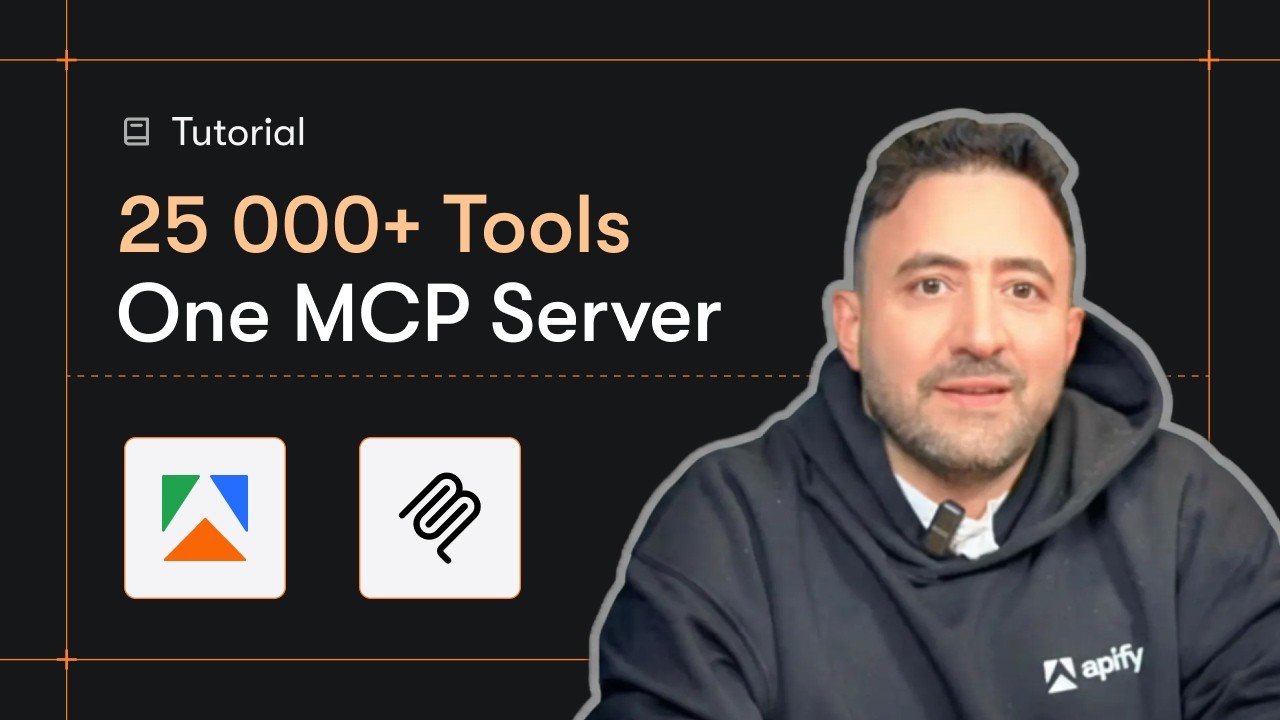
Video Walkthrough
Quick Start
Prerequisites
- Python 3.11 or higher
- An Apify account and API key (get a free key here)
-
Clone the repository
git clone https://github.com/johnisanerd/Apify-Google-News-Scraper.git cd Apify-Google-News-Scraper -
Install dependencies with UV
# Install UV if you do not have it: curl -LsSf https://astral.sh/uv/install.sh | sh # Install project dependencies: uv sync -
Configure your API key
cp .env.example .env # Edit .env and add your Apify API key # Get your free API key at: https://apify.com?fpr=9n7kx3 -
Run the example
uv run python google-news-scraper.py
Alternative: set the API key directly
export APIFY_API_TOKEN="your_api_key_here"
uv run python google-news-scraper.py
Why Use This Google News API?
Real-time coverage at scale. Google News aggregates tens of thousands of publishers. Instead of maintaining a client for each outlet, you query the aggregated index and get ranked results across all of them in a single call.
Geo-targeted results. Filter by country code (gl), language (hl), Google domain, and location string for precise control over the geographic and linguistic scope.
Configurable depth. Set max_pages for a quick headline snapshot or a deeper sweep. Each page is returned as a discrete item, easy to stream, filter, or load into a pipeline.
Predictable, pay-per-use pricing. A small per-run setup fee plus a per-page fee, with no subscription. You control cost with the page limit.
Consistent JSON output. Every article comes back with the same fields (title, link, source, snippet, position), so there is no schema variance between publishers.
Easy to automate. Call it from Python in a few lines, or load it as an MCP tool so assistants like Claude and Cursor can pull fresh news for you on demand.
Features
Core Capabilities
- Aggregated news search across thousands of publishers in one call
- Location targeting by country code (
gl), language (hl), and Google domain - Safe search and duplicate filtering toggles
- Auto-correction control with
nfprfor exact-match queries - Pagination control with a configurable page cap
Data Quality
- One item per page with a stable structure
news_resultsarray with title, link, source, snippet, and position per article- Search metadata (total results, pages processed) on every item
- Echoed search parameters so each item is self-describing
- Consistent JSON shape across every query
Usage Examples
Basic search
{
  "q": "artificial intelligence",
  "max_pages": 1
}
Geo-targeted search with language filtering
{
  "q": "artificial intelligence breakthroughs",
  "google_domain": "google.com",
  "gl": "us",
  "hl": "en",
  "safe": "off",
  "max_pages": 2
}
Input Parameters
| Parameter | Type | Required | Default | Description |
|---|---|---|---|---|
q | string | Yes | - | Search query, e.g. artificial intelligence, coffee. |
location | string | No | - | Location string for localized results, e.g. Austin, TX, Texas, United States. |
google_domain | string | No | google.com | Google domain to search, e.g. google.co.uk. |
gl | string | No | - | Country code (ISO 3166-1 alpha-2), e.g. us, gb. |
hl | string | No | - | Language code (ISO 639-1), e.g. en, fr. |
lr | string | No | - | Language restriction, e.g. lang_en. |
safe | string | No | off | Safe search: active or off. |
nfpr | string | No | 0 | Exclude auto-corrected results: 0 or 1. |
filter | string | No | 0 | Filter duplicate results: 0 or 1. |
max_pages | integer | No | 1 | Maximum pages to fetch (~10 articles each); 0 = unlimited. Each page is billed separately. |
output_file | string | No | - | Optional filename to save results. |
Output Format
A real result for artificial intelligence (one item per page; the news_results array is trimmed to a single article here, and search_information carries additional fields).
{
  "search_parameters": {
    "q": "artificial intelligence",
    "gl": "us",
    "hl": "en",
    "safe": "off",
    "nfpr": "0",
    "filter": "0",
    "max_pages": 1
  },
  "search_metadata": {
    "total_results": 9,
    "news_count": 9,
    "pages_processed": 1,
    "max_pages_set": 1,
    "pagination_limit_reached": false
  },
  "search_information": {
    "query_displayed": "artificial intelligence"
  },
  "search_timestamp": "2026-05-29T11:27:03",
  "page_number": 1,
  "news_results": [
    {
      "position": 1,
      "title": "Improving multimodal wearable sensing for healthcare with artificial intelligence",
      "link": "https://www.nature.com/articles/s41587-026-03134-z",
      "source": "Nature",
      "snippet": "This Comment explores artificial intelligence-driven strategies to accelerate the clinical translation of multimodal wearable sensors."
    }
  ]
}
Each page item echoes the search_parameters you sent, reports search_metadata (total results and pages processed), and lists every article in news_results with its ranking position, title, link, source, and snippet.
Use as an MCP tool
You can load the Google News API as an MCP tool so assistants call it for you. The MCP server URL preloads just this one Actor:
https://mcp.apify.com/?tools=actors,docs,johnvc/GoogleNewsAPI
Authenticate with OAuth in the browser when offered, or with your Apify API token (the same APIFY_API_TOKEN used by the Python example). Get a token at https://console.apify.com/settings/integrations and a free Apify account at https://apify.com?fpr=9n7kx3 .
Install in Claude Cowork Desktop
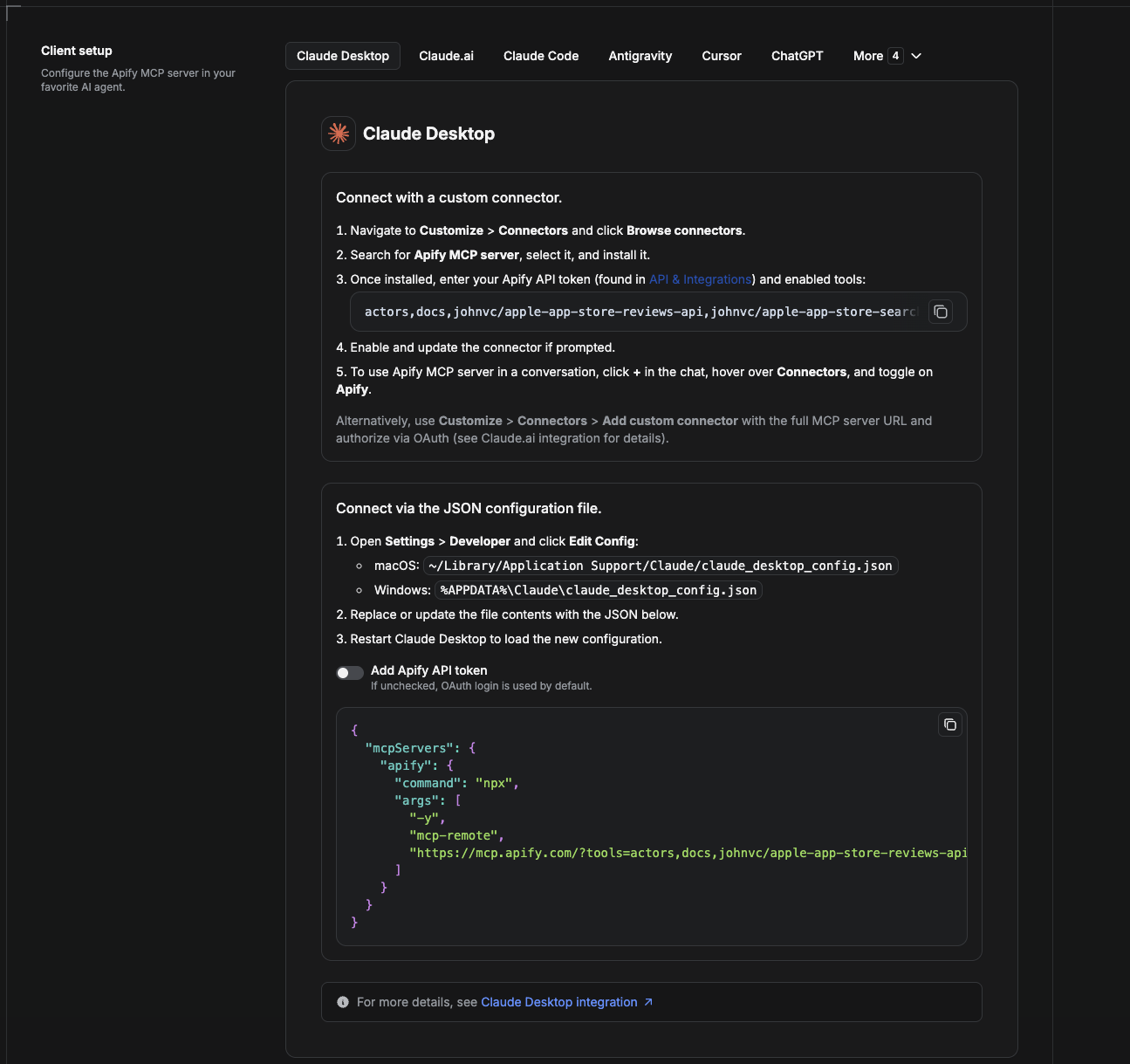
Cowork is the desktop app's automation mode. To give it the Google News API as a tool, add the Apify MCP server as a connector.
- Open the Claude desktop app and go to Settings → Connectors (or Settings → Developer → Edit Config to edit
claude_desktop_config.jsondirectly).- macOS:
~/Library/Application Support/Claude/claude_desktop_config.json - Windows:
%APPDATA%\Claude\claude_desktop_config.json
- macOS:
- Add the Apify MCP server, preloaded with only this Actor:
{
  "mcpServers": {
    "apify": {
      "command": "npx",
      "args": [
        "-y",
        "mcp-remote",
        "https://mcp.apify.com/?tools=actors,docs,johnvc/GoogleNewsAPI"
      ]
    }
  }
}
- Restart the app. When Cowork first calls the tool, complete the OAuth prompt in your browser, or add your Apify API token in the connector settings to skip OAuth.
- In a Cowork chat, confirm the tool is available and ask it to run the Google News API.
Download the desktop app and start a free trial: https://claude.ai/referral/uIlpa7nPLg More help: https://docs.apify.com/platform/integrations/claude-desktop
Install in Claude Code
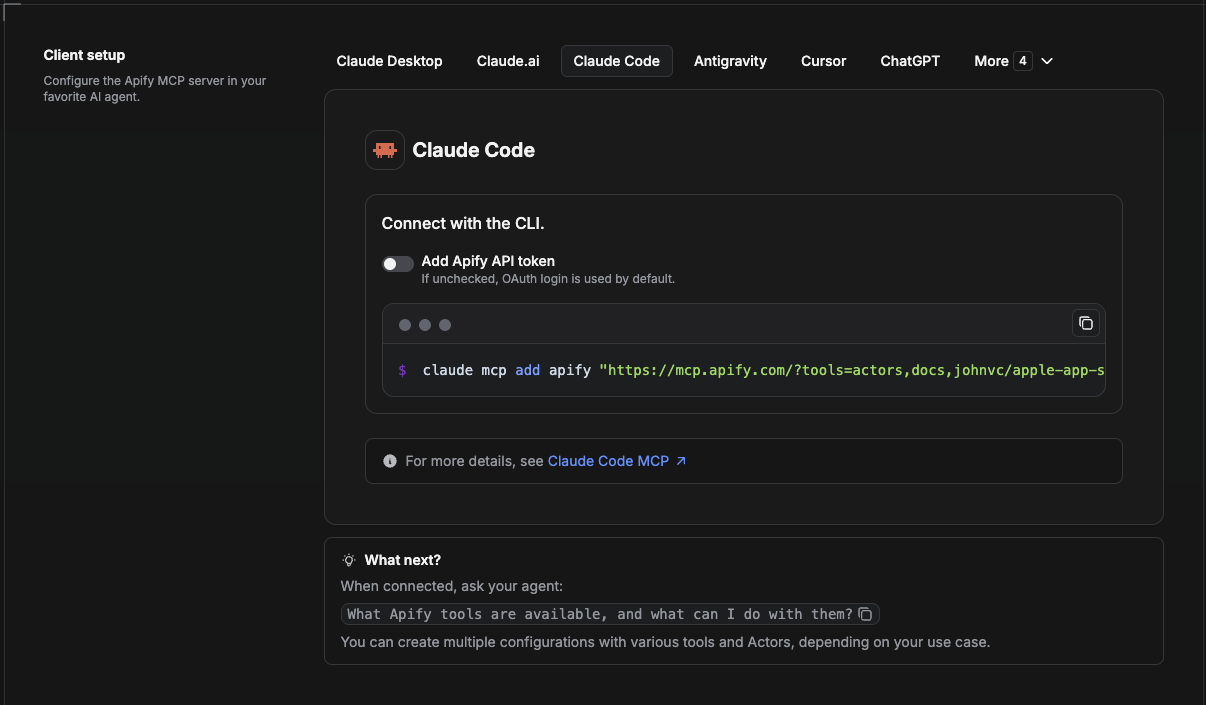
Claude Code is the command-line tool. Add the Actor's MCP server with one command:
claude mcp add --transport http apify \
  "https://mcp.apify.com/?tools=actors,docs,johnvc/GoogleNewsAPI"
To use a token instead of browser OAuth:
claude mcp add --transport http apify \
  "https://mcp.apify.com/?tools=actors,docs,johnvc/GoogleNewsAPI" \
  --header "Authorization: Bearer YOUR_APIFY_TOKEN"
Then verify with claude mcp list, or run /mcp inside a session. Ask Claude Code to call the Google News API.
Try Claude Code free: https://claude.ai/referral/uIlpa7nPLg Claude Code MCP docs: https://code.claude.com/docs/en/mcp
Install in Claude (website)
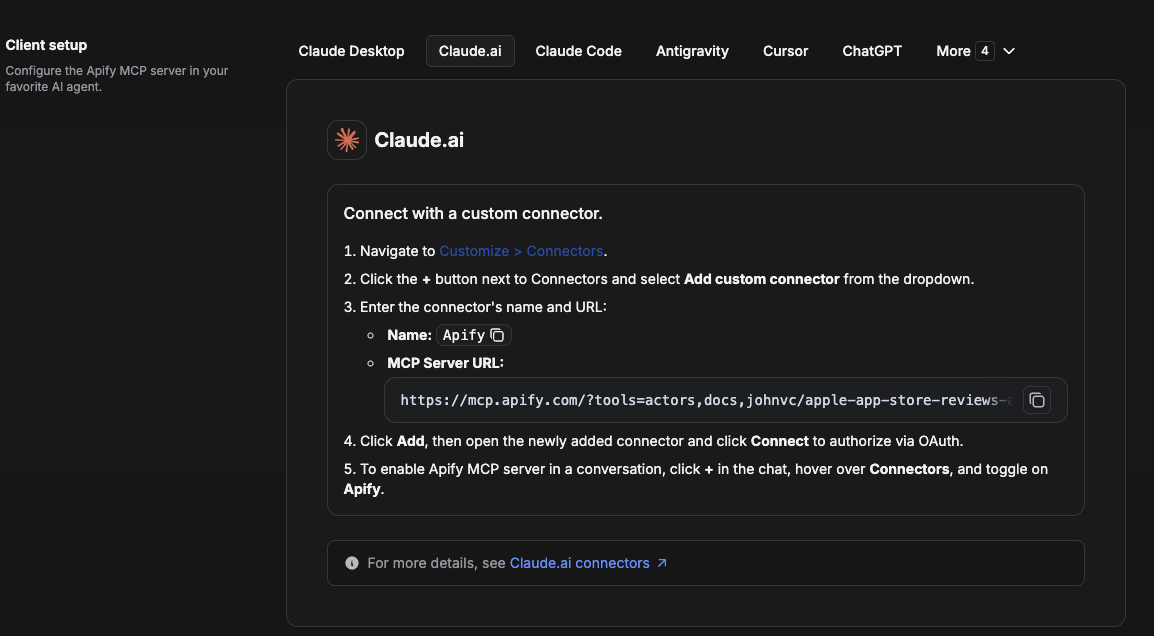
On claude.ai you add Apify as a connector, then enable just this Actor's tool.
- Go to Settings → Connectors → Browse connectors and search for Apify MCP server. Install it (enable or update if prompted).
- When connecting, authenticate with your Apify API token, and enable the tool
johnvc/GoogleNewsAPI. - In any chat, open + → Connectors and turn on Apify.
- Alternatively, choose Add custom connector and paste the full MCP URL
https://mcp.apify.com/?tools=actors,docs,johnvc/GoogleNewsAPI, using OAuth when prompted. - Ask Claude to run the Google News API.
Open Claude on the web: https://claude.ai/referral/uIlpa7nPLg
Install in Cursor
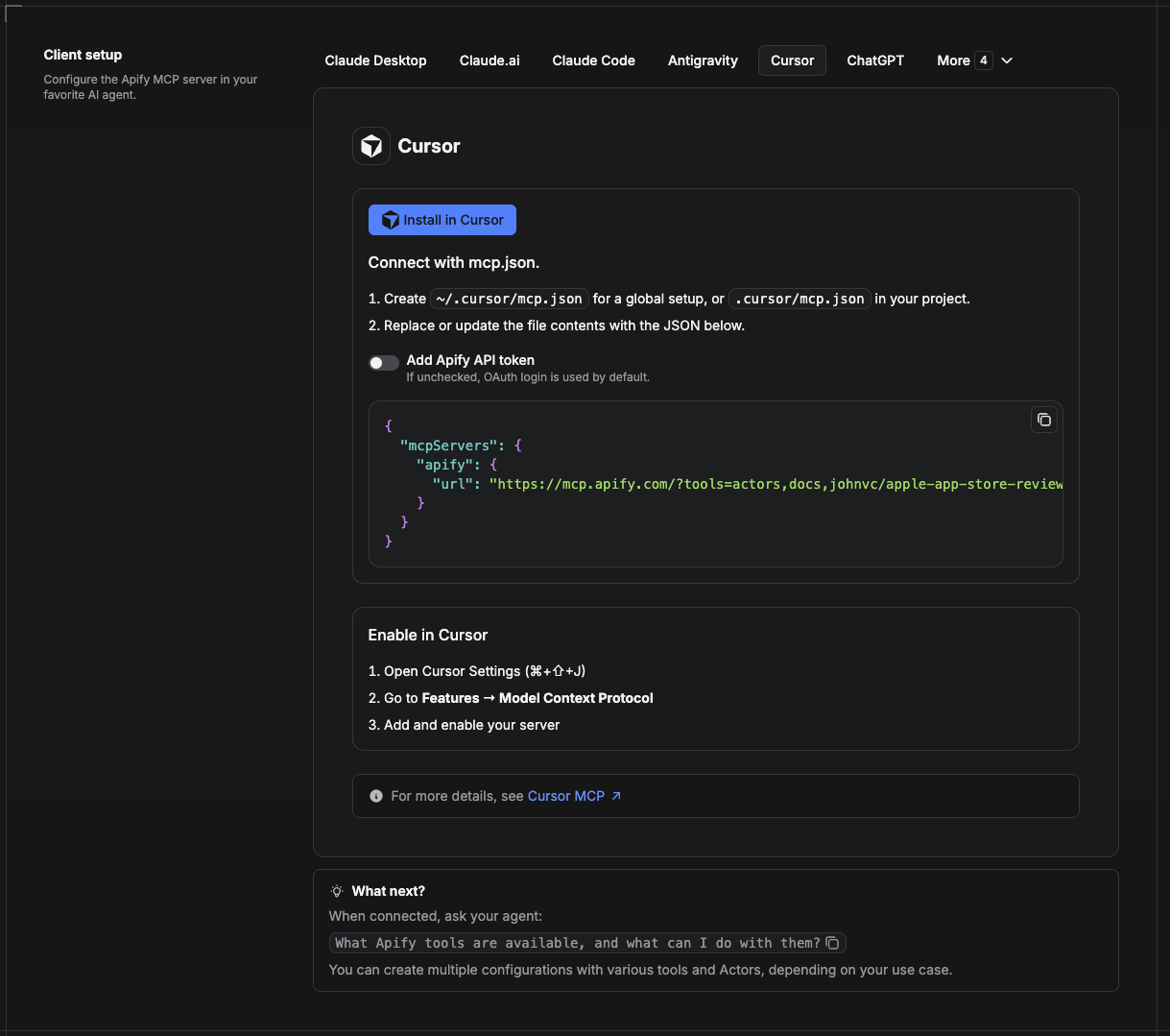
Cursor reads MCP servers from a project file at .cursor/mcp.json.
- In your project, create
.cursor/mcp.json:
{
  "mcpServers": {
    "apify": {
      "url": "https://mcp.apify.com/?tools=actors,docs,johnvc/GoogleNewsAPI"
    }
  }
}
- If you prefer token auth over browser OAuth, add a header:
{
  "mcpServers": {
    "apify": {
      "url": "https://mcp.apify.com/?tools=actors,docs,johnvc/GoogleNewsAPI",
      "headers": { "Authorization": "Bearer YOUR_APIFY_TOKEN" }
    }
  }
}
- Open Cursor → Settings → MCP and confirm the apify server is connected (green dot).
- In Composer or Chat, ask Cursor to call the Google News API.
New to Cursor? Get it here: https://cursor.com/referral?code=XQP4VBLI3NNX
Install in ChatGPT
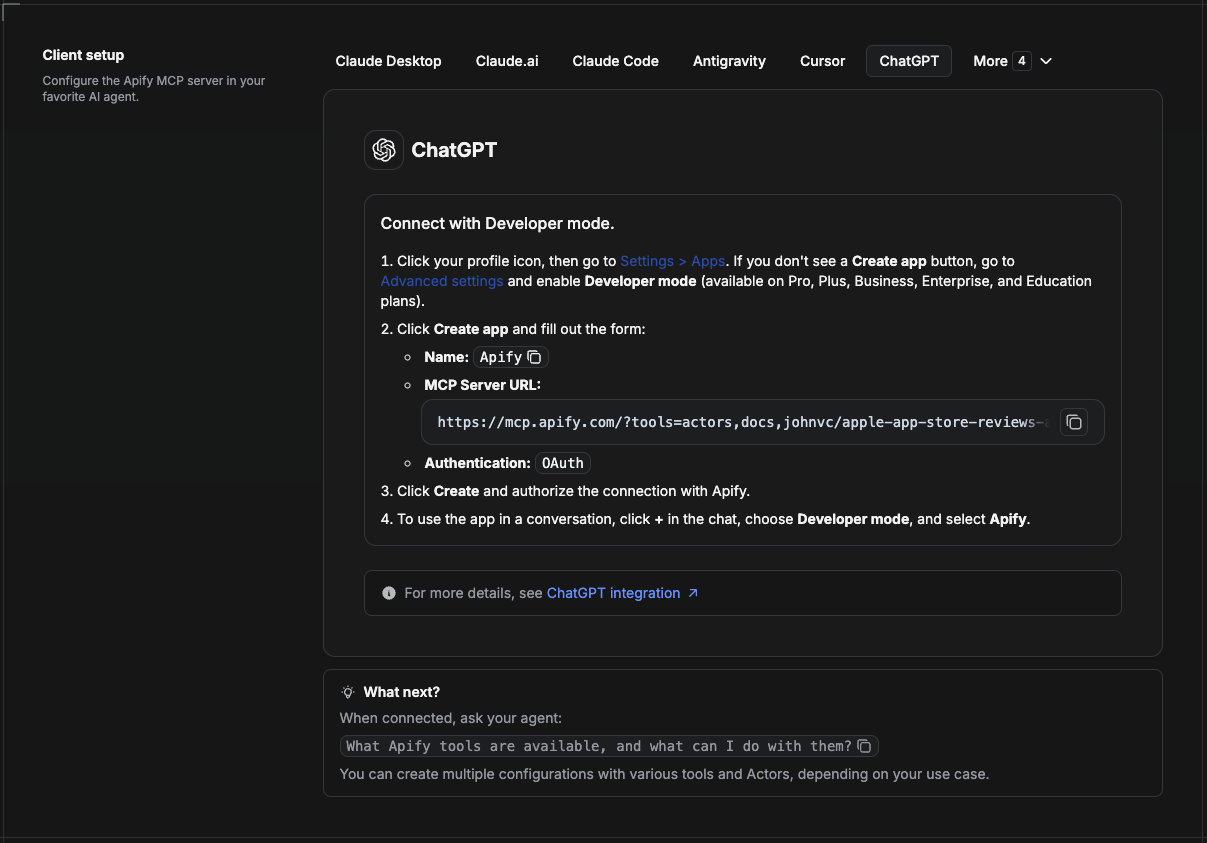
ChatGPT connects to the Apify MCP server through Developer mode (available on ChatGPT Pro, Plus, Business, Enterprise, and Education plans).
- Click your profile icon, then go to Settings > Apps. If you do not see a Create app button, open Advanced settings and enable Developer mode.
- Click Create app and fill out the form:
- Name: Apify
- MCP Server URL:
https://mcp.apify.com/?tools=actors,docs,johnvc/GoogleNewsAPI - Authentication: OAuth
- Click Create and authorize the connection with Apify.
- To use the app in a conversation, click + in the chat, choose Developer mode, and select Apify.
More help: https://docs.apify.com/platform/integrations/mcp
Use the Google News API to power media monitoring, competitive intelligence, trend detection, and LLM context pipelines with reliable, structured results.
Featured Tasks
Ready-to-run examples on the Apify Store.
Last Updated: 2026.08.30
Reviews
No reviews yet
Be the first to review this server!
More Developer Tools MCP Servers
Git
Freeby Modelcontextprotocol · Developer Tools
Read, search, and manipulate Git repositories programmatically
Fetch
Freeby Modelcontextprotocol · Developer Tools
Web content fetching and conversion for efficient LLM usage
Toleno
Freeby Toleno · Developer Tools
Toleno Network MCP Server — Manage your Toleno mining account with Claude AI using natural language.
mcp-creator-python
Freeby mcp-marketplace · Developer Tools
Create, build, and publish Python MCP servers to PyPI — conversationally.
MCP Marketplace
Freeby mcp-marketplace · Developer Tools
Search and install MCP servers from inside your AI client.
MarkItDown
Freeby Microsoft · Content & Media
Convert files (PDF, Word, Excel, images, audio) to Markdown for LLM consumption