
Server data from the Official MCP Registry
Your real, logged-in Chrome as an MCP server: 63 token-efficient web-dev tools. ChromeOS included.
About
Your real, logged-in Chrome as an MCP server: 63 token-efficient web-dev tools. ChromeOS included.
Security Report
Chrome Bridge is a well-architected MCP server for browser automation with generally sound security practices. The codebase demonstrates proper authentication token handling, reasonable permission scoping, and good defensive coding patterns. However, there are notable concerns: sensitive data (screenshots, storage, HAR exports, cookies) is intentionally not redacted before sending to Claude, the extension accepts connections from localhost without strong origin validation in certain scenarios, and there is potential for token leakage if misconfigured. These are documented trade-offs rather than hidden vulnerabilities, but users should be aware of the data exposure risks. Supply chain analysis found 5 known vulnerabilities in dependencies (0 critical, 4 high severity). Package verification found 1 issue.
3 files analyzed · 15 issues found
Security scores are indicators to help you make informed decisions, not guarantees. Always review permissions before connecting any MCP server.
Permissions Required
This plugin requests these system permissions. Most are normal for its category.
How to Install
Add this to your MCP configuration file:
{
  "mcpServers": {
    "io-github-frsorrentino-chrome-bridge": {
      "args": [
        "-y",
        "chrome-bridge-mcp"
      ],
      "command": "npx"
    }
  }
}Documentation
View on GitHubFrom the project's GitHub README.
Chrome Bridge




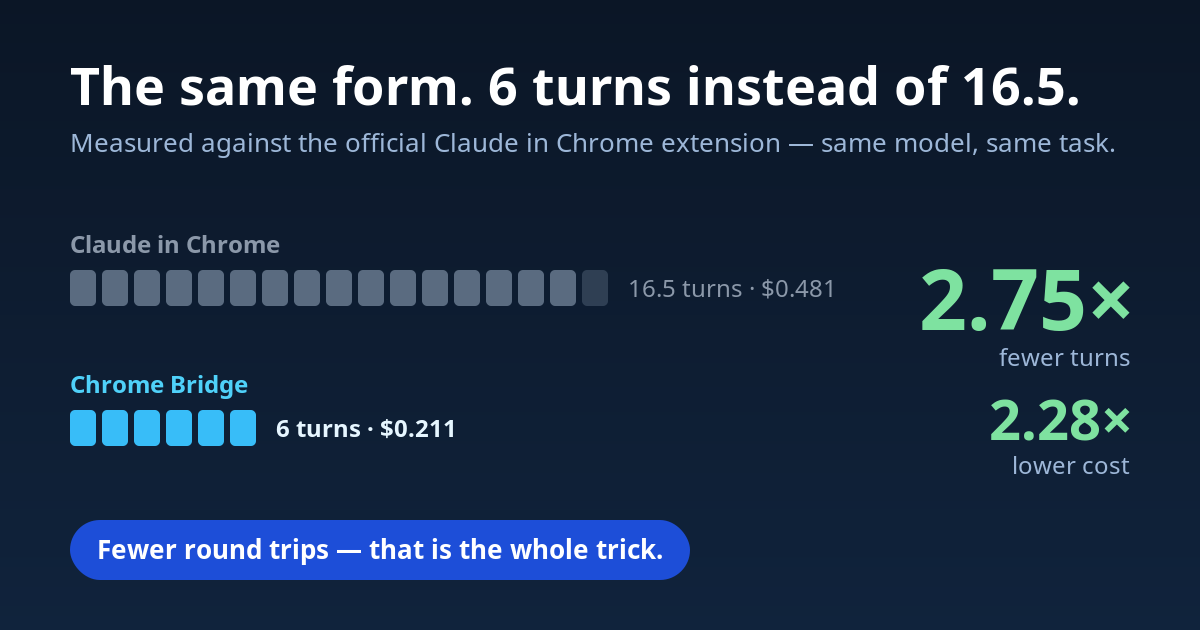
An MCP server that gives Claude Code your real, logged-in Chrome — measured 2.75× fewer turns and 2.28× lower cost than the official "Claude in Chrome" extension on a form-filling task, with ~3× the toolset and no paid plan.
63 web-development tools (navigation, DOM inspection, visual regression, audits, network mocking) over a local WebSocket bridge, plus a headless instance for CI. Self-hosted, local-only.
Quickstart
Requires Node.js 18+ and Chrome 135+.
git clone git@github.com:frsorrentino/chrome-bridge.git
cd chrome-bridge && ./install.sh
- Open
chrome://extensions, enable Developer mode, click Load unpacked, select theextension/folder. - Restart Claude Code.
Then ask for something like "open localhost:3000, run an accessibility audit
and find the Sign Up button": Claude Code calls navigate,
accessibility_audit and find_text. Because navigate already returns
element refs, click(ref="n1") follows with no discovery turn in between.
On ChromeOS/Crostini install from the Chrome Web Store instead: an unpacked extension is dropped on every reboot, because the container isn't mounted when Chrome starts.
install.sh registers the MCP server with --scope user. To do it by hand:
claude mcp add --scope user chrome-bridge node /path/to/server/index.js.
For execute_js, enable Allow user scripts in chrome://extensions →
Chrome Bridge → Details (on Chrome 135-137, enable Developer Mode instead).
Why Chrome Bridge?
| Chrome Bridge | Claude in Chrome | Chrome DevTools MCP | Playwright MCP | |
|---|---|---|---|---|
| ChromeOS / Crostini | Yes (real host) | No | Container only | Container only |
| Tools | 63 (34 core) | ~20 | ~50 | 23 core (71 total) |
| Requires paid plan | No | Yes (Pro+) | No | No |
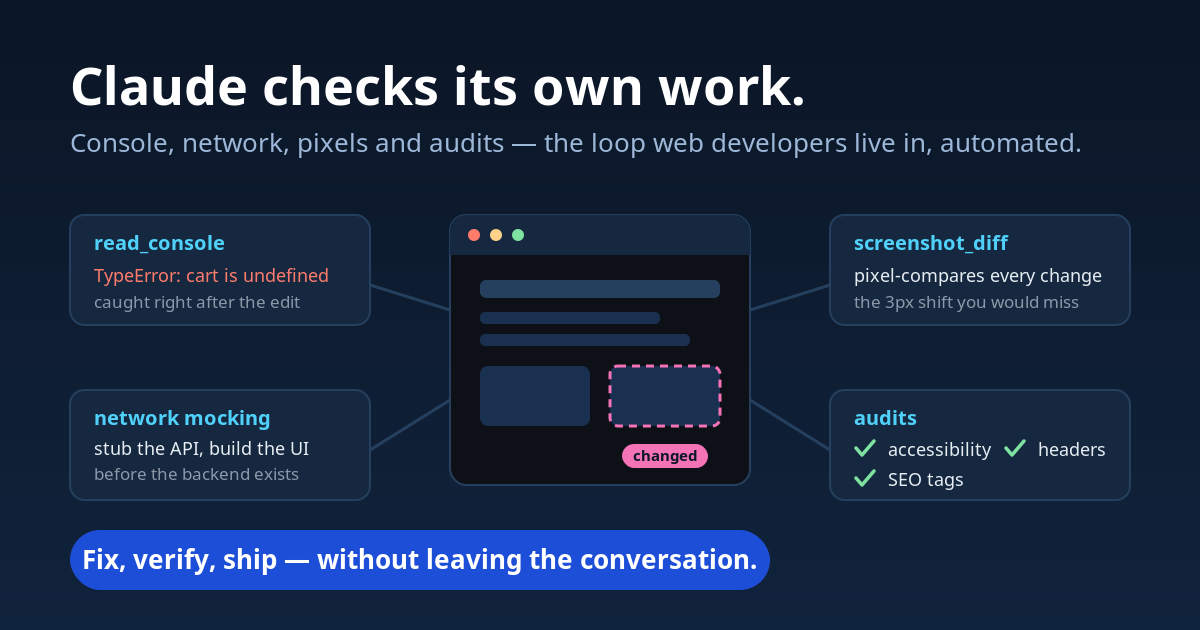
| Network mocking | Yes (stub/headers) | No | No | Yes |
| Visual regression | Yes (screenshot_diff) | No | No | No |
| Audits (a11y/SEO/sec) | Yes (full suite) | No | Partial | No |
| Headless / CI | Yes | No | Yes | Yes |
| GIF / video | No | Yes | Partial | No |
| Breakpoints / heap | No | No | Yes | No |
It wins on round trips, not payload size: short element refs instead of the
screenshot-and-click loop, fill_form filling N fields in one call, table
filtering done server-side. Per single turn it actually costs slightly more.
The full benchmark — method, every raw run including the unfavourable ones, and what the harness can't measure — is in docs/EFFICIENCY.md.
Using it
Beyond the MCP tools, two lanes keep work away from the model entirely.
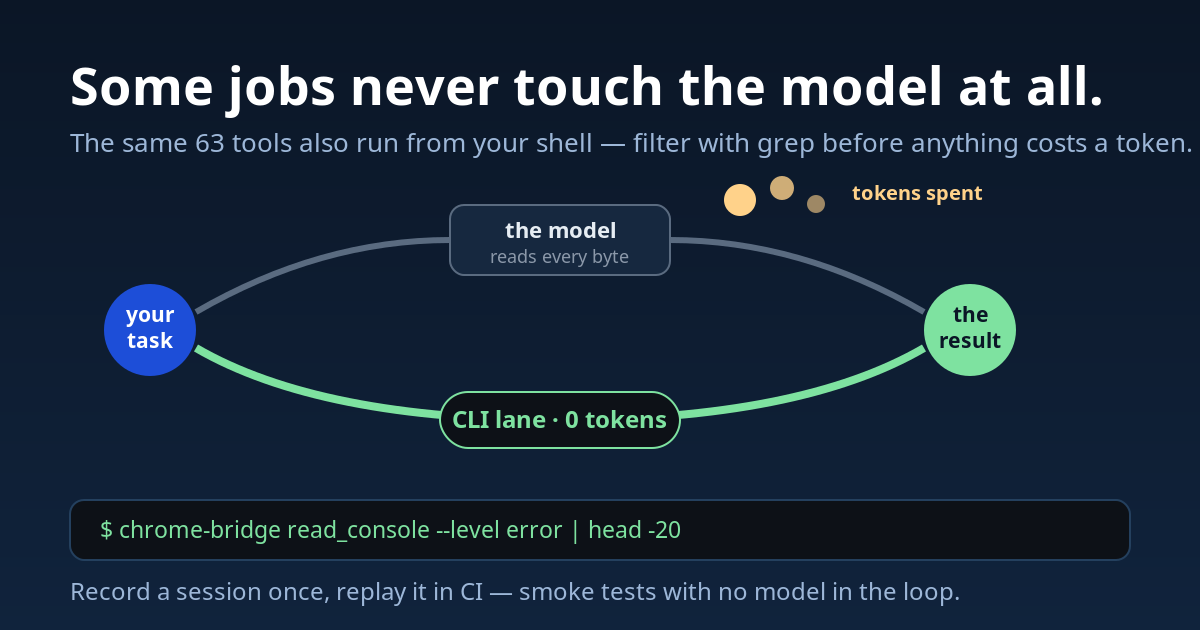
CLI — batch operations, piped through grep or jq before anything reaches
the context:
chrome-bridge navigate --url https://example.com
chrome-bridge read_console --level error | head -20
chrome-bridge assert --selector "#success" --text "Done"
chrome-bridge replay --file ./recordings/login.jsonl
Launch mode — a dedicated Chromium instance with an ephemeral profile, for isolated sessions or CI:
node server/index.js --launch --headless
Pair it with session_record + replay for smoke tests with no model in the
loop. In launch mode execute_js falls back to new Function when the
user-script toggle isn't available.
Tools
63 in total, in seven groups. Only core (34 tools) loads by default; the rest
are opt-in via --caps.
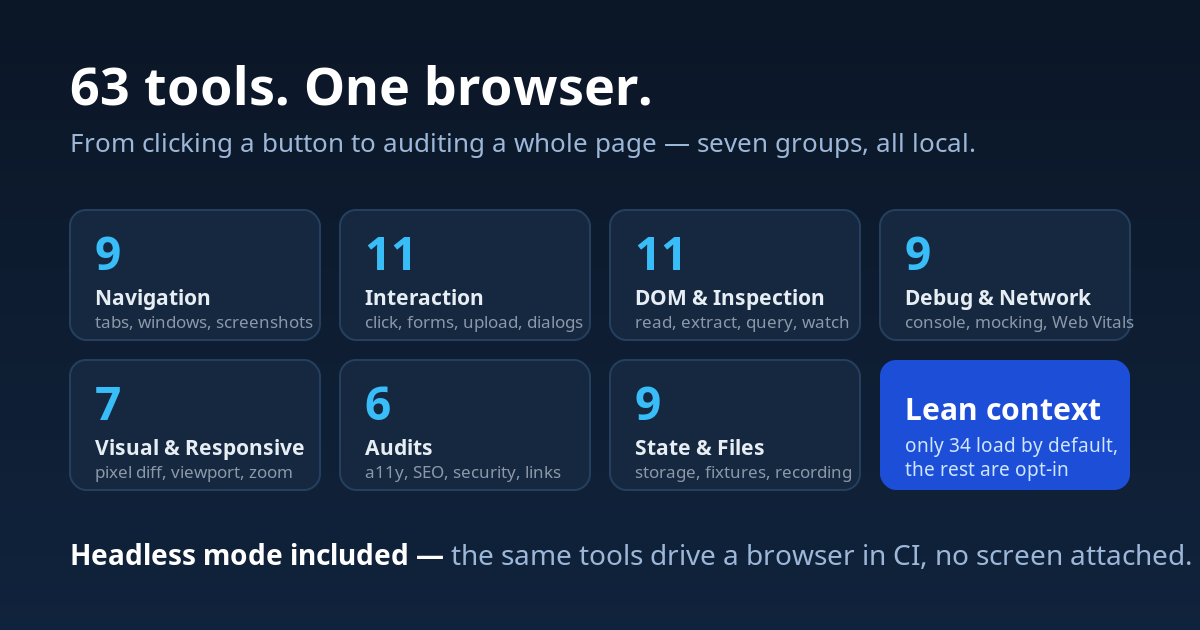
| Group | N | What's in it |
|---|---|---|
| Core & Navigation | 9 | tabs, windows, navigate, screenshot, tile_windows |
| Interaction | 11 | click, fill_form, upload_file, dialogs, clipboard |
| DOM & Inspection | 11 | read_page, extract, query_dom, watch_dom |
| Debugging & Network | 9 | execute_js, console, network log, mocking, Web Vitals |
| Visual & Responsive | 7 | screenshot_diff, viewport, zoom, media emulation |
| Audits | 6 | a11y, SEO, security headers, links, extract_table |
| State, Storage & Files | 9 | storage, fixtures, MHTML, recording, assert |
Every tool, with the notes that matter: docs/TOOLS.md.
How it works
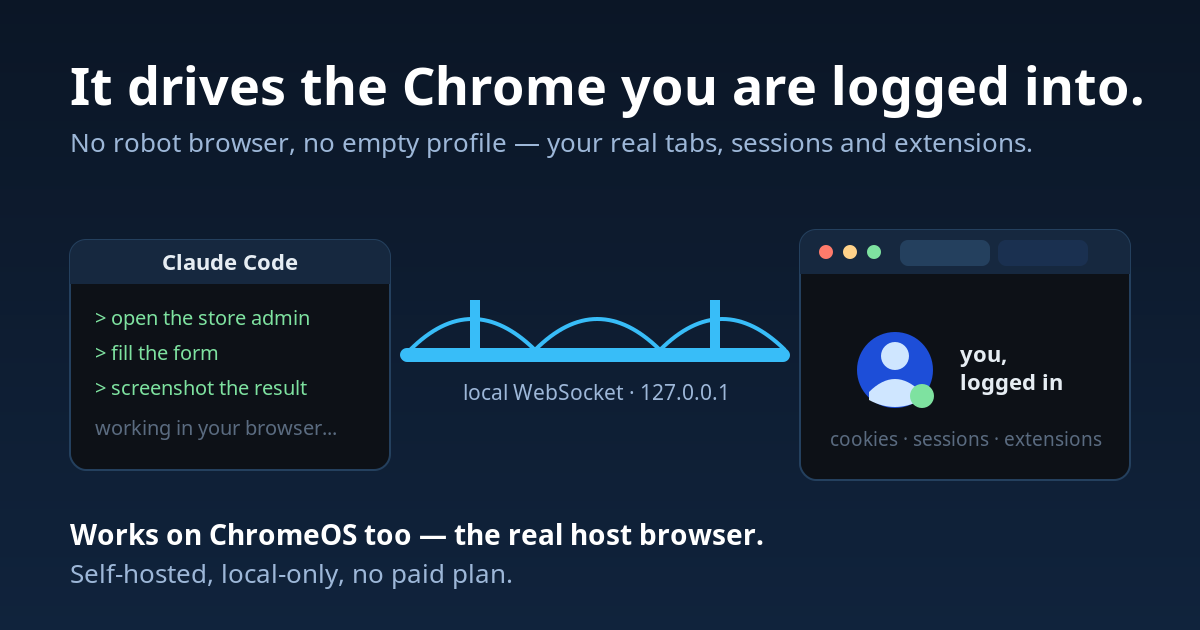
Claude Code  <--stdio-->  MCP Server  <--WebSocket :8765-->  Chrome Extension
                          (server/)                          (extension/, MV3)
The Node.js server handles the protocol and tool logic; the MV3 extension
executes commands through Chrome APIs. User scripts (execute_js) run via
chrome.userScripts.execute().
Configuration and security
Environment variables, each with a matching CLI flag:
| Variable | Default | Notes |
|---|---|---|
CHROME_BRIDGE_PORT | 8765 | |
CHROME_BRIDGE_HOST / --host | 127.0.0.1 | 0.0.0.0 only where the browser lives outside the container (ChromeOS/Crostini port-forward) — and only with a token |
CHROME_BRIDGE_TOKEN | unset | Required on both ext_init and relay_init. Strongly recommended whenever the bind isn't loopback |
CHROME_BRIDGE_CAPS / --caps | core | core, audits, visual, network, storage, dom, files, all. install.sh uses all |
The bridge binds loopback, accepts extension connections only from a
chrome-extension:// origin, and — when a token is set — requires it on both
handshakes. Without one, any local process could act as a relay and reach
execute_js inside your authenticated browser session. Secondary MCP instances
connect via loopback and are acknowledged with relay_init_ok, so a foreign
process holding the port fails fast instead of timing out per command.
What is not protected: page content reaches the model unfiltered, so a
hostile page's text is untrusted input. get_storage, session_fixture, HAR
exports and screenshots are not redacted and may carry cookies, tokens or
personal data. Don't point the automation at pages holding secrets you wouldn't
paste into a chat.
Troubleshooting
| Symptom | Cause / fix |
|---|---|
Chrome extension not connected | Extension disabled, or its port differs from the server's. The error names the actual host/port; check them in the popup (⚙). |
| Port 8765 already in use | Expected: a second MCP session becomes a relay and shares the one bridge. Set CHROME_BRIDGE_PORT for a separate one. |
Port N is held by a process that is not chrome-bridge | Something else owns the port. Free it or change CHROME_BRIDGE_PORT. |
execute_js fails | Enable Allow user scripts in chrome://extensions → Chrome Bridge → Details (Chrome 138+; on 135-137 enable Developer Mode). |
read_console returns note=Instrumentation not loaded | The page was opened before the extension, "Capture console & metrics" is off, or the page isn't injectable (chrome://). Reload it. |
| Screenshot times out | On ChromeOS a fully occluded window stops producing frames; captures fail after 10s. Bring the window forward. |
| Commands work, then stop | The MV3 service worker restarted and in-memory state (network log, diff baselines, HTTP auth) was reset. Re-run the monitoring call. |
| Extension dropped on every ChromeOS reboot | Install from the Web Store instead of Load unpacked. |
| Tool missing from the list | It's in an opt-in group. Check get_status → caps_available, then set CHROME_BRIDGE_CAPS=all. |
Documentation
- docs/TOOLS.md — all 63 tools, by group
- docs/EFFICIENCY.md — the benchmark and the design behind it
- bench/RESULTS.md — raw runs and inclusion rule
- CHANGELOG.md
Tests
npm test (Chrome-free, ~22s) · npm run test:e2e (needs Chrome and a
connected extension) · npm run measure (schema cost).
License
MIT
Reviews
No reviews yet
Be the first to review this server!
More Developer Tools MCP Servers
Fetch
Freeby Modelcontextprotocol · Developer Tools
Web content fetching and conversion for efficient LLM usage
Git
Freeby Modelcontextprotocol · Developer Tools
Read, search, and manipulate Git repositories programmatically
Toleno
Freeby Toleno · Developer Tools
Toleno Network MCP Server — Manage your Toleno mining account with Claude AI using natural language.
mcp-creator-python
Freeby mcp-marketplace · Developer Tools
Create, build, and publish Python MCP servers to PyPI — conversationally.
MCP Marketplace
Freeby mcp-marketplace · Developer Tools
Search and install MCP servers from inside your AI client.
MarkItDown
Freeby Microsoft · Content & Media
Convert files (PDF, Word, Excel, images, audio) to Markdown for LLM consumption