
Server data from the Official MCP Registry
GPU rental prices checked daily, with price history and change feed; stack optimizer; AI-infra deals
About
GPU rental prices checked daily, with price history and change feed; stack optimizer; AI-infra deals
Remote endpoints: streamable-http: https://lantern-works-mcp.lantern-works.workers.dev/mcp?ref=mcp-registry
Security Report
Lantern Works is a read-only GPU rental price comparison MCP server that needs no API key, and its network, file-cache, and env-var access matches that purpose. The telemetry is opt-in and sends only aggregate tool-call counts, and no data exfiltration, shell execution, or hardcoded secrets appear in the reviewed files. The main limits are that core/ modules and several files were truncated, so their full behavior could not be verified. Supply chain analysis found 6 known vulnerabilities in dependencies (0 critical, 5 high severity). Package verification found 1 issue.
13 files analyzed · 12 issues found
Security scores are indicators to help you make informed decisions, not guarantees. Always review permissions before connecting any MCP server.
Permissions Required
This plugin requests these system permissions. Most are normal for its category.
What You'll Need
Set these up before or after installing:
Environment variable: LANTERN_DEALS_FILE
Environment variable: LANTERN_GPU_PRICES_FILE
How to Install & Connect
Available as Local & Remote
This plugin can run on your machine or connect to a hosted endpoint. during install.
Documentation
View on GitHubFrom the project's GitHub README.
Lantern Works — GPU price comparison for agents, checked daily
Lantern Works compares GPU rental prices and estimates job costs for agents, with vendor source links, check times and quote receipts. Prices refresh daily; "cheapest" means among tracked providers. Referral links are labeled and never affect ranking.
Get your first quote — no installation or API key
Python 3.10+, standard library only. Read the example, then download and run it:
curl --fail --location https://raw.githubusercontent.com/connormatthewdouglas/agent-work-stack-deals/main/examples/first_quote.py --output first_quote.py
python3 first_quote.py --gpu 'H100 SXM' --hours 100 --ref readme
This calls the public hosted MCP: three on-demand rates checked within 24 hours, then a 100-hour, one-GPU compute estimate with sources, assumptions, missing costs and a receipt. It creates no purchase or watch. Use --qa for internal tests.
Client setup · Quickstart · Agent manifest · Small per-model JSON feeds · Add this to your README or dataset
- GPU prices: thelanternworks.com · /gpu/ · JSON api/v1/gpu-prices.json · history api/v1/gpu-prices/history.json · what moved since yesterday api/v1/gpu-price-changes.json (RSS)
- GPU coverage: which GPU models each vendor is tracked for (in stock, priced, not listed): /coverage/ · JSON api/v1/coverage.json
- Deals directory: thelanternworks.com/deals/ · About
- Agent feed (JSON, no auth): thelanternworks.com/api/v1/deals.json (same bytes as
/deals.json) · mirror: gist - Stack pricing: api/v1/stack-pricing.json
- Query CLI:
python3 query_deals.py --category unblock --max-price 20(filter contract: USAGE.md) - MCP test summaries: /receipts/ · JSON (dated findings, separate from job-price receipts)
Contact: lanternworks@agentmail.to
MCP server (v0.6.2, read-only, stdio)
Free, read-only, no API key. Package lantern-works-deals-mcp on PyPI; MCP Registry name io.github.connormatthewdouglas/lantern-works-deals. Built on the official Python MCP SDK.
Tools
Tool counts: 9 in the local package (stdio, below); 13 on the hosted endpoint (the same 9 plus create_watch_key, watch_price, list_watches, delete_watch).
| Tool | What it does |
|---|---|
compare_gpu_prices | Hourly rental prices for a GPU model (e.g. H100, A100 SXM, RTX 4090) across tracked providers, cheapest first, each with source_url and checked_at. "Cheapest" means cheapest among tracked providers, not the whole market. include_history=true adds each rate's price history and recent price changes (daily snapshots since 2026-10-27). Each rate has tier_class (on-demand, community, marketplace, interruptible, reserved, dedicated-monthly; also in the public JSON feed); on_demand_only=true keeps on-demand rates only. reserved = reservation/commitment "starting from" prices (e.g. Hyperstack reservations): they need a term contract, so they are left out of results and never called "cheapest" unless you pass include_reserved=true (even then they sort after pay-as-you-go rates). Each result carries report_issue_url, a prefilled "wrong price" issue link. Returns mode="brief" by default since 0.5.0; pass mode="full" for every field. |
get_price_changes | GPU price moves among tracked providers, newest first: old and new hourly price, change_pct, direction and the vendor source_url. since (YYYY-MM-DD) returns every move on or after that date; without it, the latest day's moves. Optional gpu and kinds filters. Each change has a stable event_id (dedupe key) and rate_id; pass cursor=next_cursor to page every change after it, oldest first, until has_more is false. |
optimize_stack | Given monthly usage (pages scraped, proxy GB, emails, search queries, GPU hours/model), pick the cheapest tracked plan per line and total the monthly cost, with the calculation, sources and alternatives; unpublished prices are reported as unknown. |
optimize_agent_stack | Describe the agent in plain text (e.g. "scrapes 20k JS pages via 5 GB proxies, 3k searches, summarizes with an LLM, budget $300/mo"); a deterministic keyword parse (no LLM) maps it to components and returns the cheapest cited option per component with the math, source_url, verified_at and a referral disclosure where applicable. Components with no cited price say "no sourced price tracked". |
estimate_job_cost | Cost of one GPU job (not per hour) among tracked providers, cheapest first. You give job_hours, or work_units plus your own throughput_units_per_gpu_hour; for inference workloads with no throughput given, a cited closed-division MLPerf Inference figure for the exact GPU is used (throughput_basis="published_benchmark", with source and caveats), and training returns "missing: throughput". Whole-instance billing; reserved and held rates never ranked; spot only with allow_interruptible. Returns per-rate rate_id, source_url, verified_at, assumptions, missing_costs and a quote_id. |
rebuild_quote | Reopen a past quote: pass the receipt from optimize_stack, optimize_agent_stack or estimate_job_cost. Returns receipt_intact, reproduced (true only when each line's arithmetic recomputes AND its rate_id and price match the pinned feed revision or that date's published daily snapshot; "arithmetic_only" with provenance_verified: false when that can't be confirmed), per-line provenance, and revalidation against today's feed (unchanged, price_changed, evidence_changed, held_today, not_in_feed_today). Nothing is re-ranked; no server key. |
search_deals | Search the deals feed by text, category, offer_type, max_price and tags; paginated summaries (limit 1-25, cursor). |
compare_deals | Compare 2-5 deals by id side by side, best customer value first. |
get_deal | Return the full public record for one deal id. |
Note on rebuild_quote: a receipt issued from an earlier feed generation on a day whose daily snapshot was later re-cut can come back reproduced: "arithmetic_only" (price_mismatch) even though its price was genuine at the time. That is a safe false negative; it never verifies a forged price.
Install
uvx lantern-works-deals-mcp
Quickstart: ask for compare_gpu_prices(gpu="H100"), then the next day call get_price_changes(since="<data_checked_at date>") to see what moved. Prices refresh daily at about 10:23 UTC; compare_gpu_prices and optimize_agent_stack return data_checked_at and next_refresh_utc.
Claude Code:
claude mcp add lantern-works-deals -- uvx lantern-works-deals-mcp
Cursor (.cursor/mcp.json) and Cline (cline_mcp_settings.json, via MCP Servers → Configure) use the same entry:
{ "mcpServers": { "lantern-works-deals": { "command": "uvx", "args": ["lantern-works-deals-mcp"] } } }
Docker: docker build -t lantern-works-deals-mcp . && docker run -i --rm lantern-works-deals-mcp (the root Dockerfile installs the pinned PyPI release and runs the stdio server). Without uv: pip install lantern-works-deals-mcp, then use "command": "lantern-works-deals-mcp". Other clients: https://thelanternworks.com/install/?ref=readme · Skill: npx skills add connormatthewdouglas/agent-work-stack-deals.
Telemetry is off by default. LANTERN_TELEMETRY=1 opts in to an anonymous daily count of tool calls: tool name, version, day and count only. No arguments, IDs or IPs are sent or stored. See PRIVACY.md.
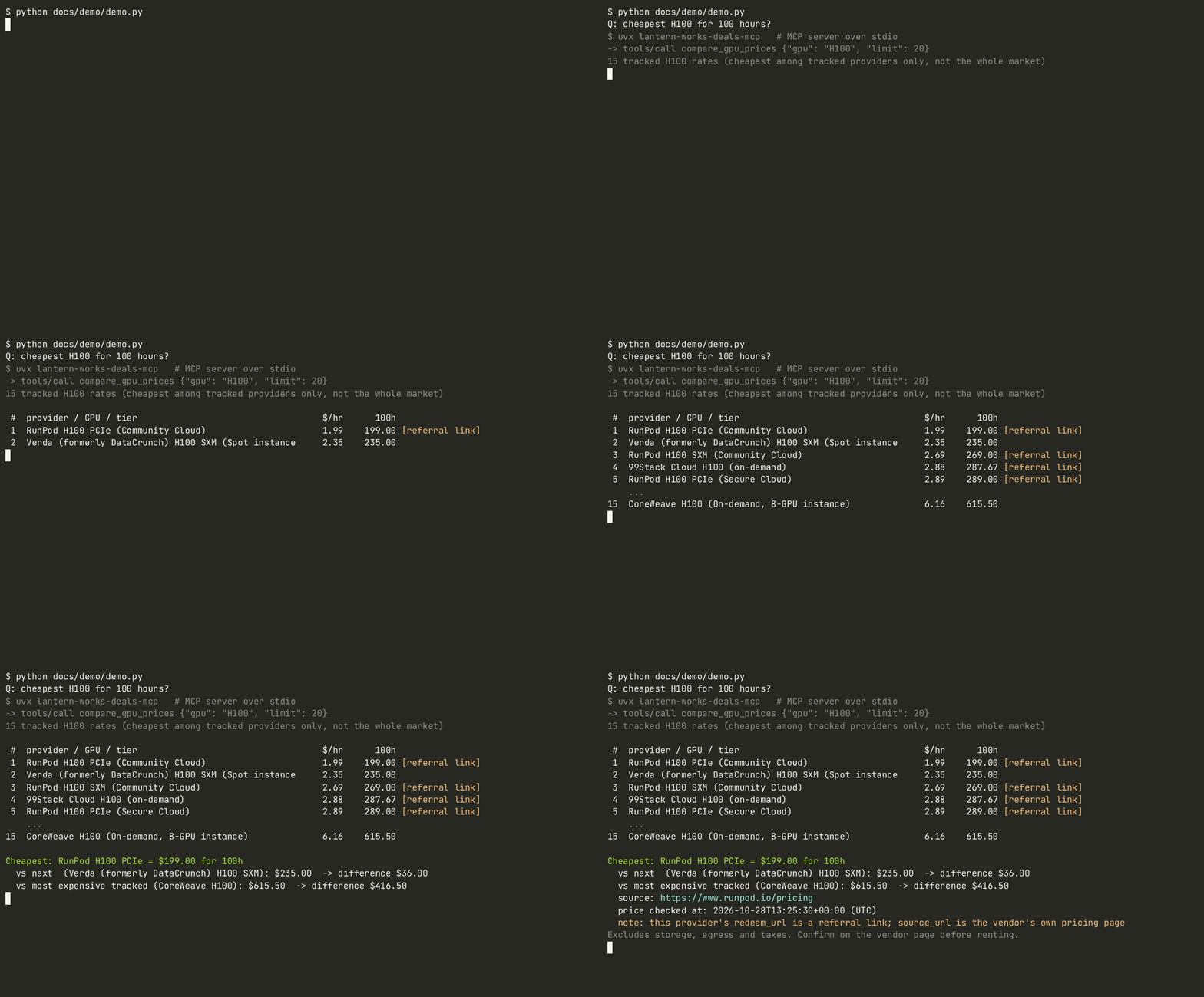
Demo (live data, 2026-10-28): the MCP server answers "cheapest H100 for 100 hours?". It shows 100-hour totals for the cheapest, next and most expensive tracked rates, each with its source and check time, and labels referral links. Recording: docs/demo/cheapest-h100-100h.cast · script: docs/demo/demo.py.
Framework examples: LangGraph (cheapest H100), CrewAI and OpenAI Agents SDK (cheapest GPU for a described job), Stack optimizer (describe your agent, get the cheapest cited stack via optimize_agent_stack), GPU price watcher (what moved since a date via get_price_changes, cron-ready), GPU price monitor (price-drop alerts from the history API). All examples: examples/. Some tool results include referral links (affiliate: true).
Arguments, errors, data sources and tests: mcp_server/README.md.
Hosted endpoint (no install)
Streamable HTTP, same read-only tools: https://lantern-works-mcp.lantern-works.workers.dev/mcp?ref=readme
(claude mcp add --transport http lantern-works-deals https://lantern-works-mcp.lantern-works.workers.dev/mcp?ref=readme). Free Cloudflare Worker; it stores only anonymous call counts per tool per day (no IPs, user agents or arguments), public at https://lantern-works-mcp.lantern-works.workers.dev/stats. ?ref= only tags which link was used.
Alert delivery (hosted watches)
- At-least-once. An alert counts as delivered on any 2xx. Dedupe on
x-lantern-event-id+x-lantern-watch-id. - 408, 425, 429, 5xx and network errors retry with backoff: 15 min, then x4 each time, capped at 24 h.
Retry-Afteris honoured up to 24 h. At most 6 attempts, and none after 72 h from the first; then the alert isexpired. - Any other status (3xx are not followed, 4xx) is
rejectedand not retried. - Fair continuation: never-tried alerts go first, then the least recently tried; at most 10 POSTs per receiver host per run, and a host that fails is skipped for the rest of that run. Work left over is
backlog, sent on the next push. stats.deliveryshowslast_push_at,last_success_at,pending_retriesand the last outcome counts. The push job fails when any delivery fails or D1 cannot record results.- Local alternative:
examples/gpu-price-watcher/watch_prices.py --state FILEpages every event after a saved cursor and saves it atomically after each page, so a crash or missed day re-reads and never skips.
Eligibility (region, memory, tier, stock)
compare_gpu_prices, estimate_job_cost, hosted price watches and the calculator share one contract (core/eligibility.py). Each result carries eligibility {eligible, applied, unmet, unknown}.
gpu="A100 80GB"(orvram_gb=80) never matches a 40GB row;tiers=["on-demand"]never matches spot.region="US"(country/area: US, CA, EU, APAC, ...) matches every zone in it: 'US-MD-1 (United States)', 'us-east-1'. A zone (region="us-ne-1") matches exactly, any case, ignoring the '(...)' suffix. Published rows carryavailable_regions_normalized({label, zone, country, group}) beside the original labels. The summary starts with what the region filter found, and names a cheapest "regardless of region" when no confirmed row leads.- GPU names fold form-factor generations: 'A100 SXM4' = 'A100 SXM', 'H100 PCIe5' = 'H100 PCIe'. A form no tracked rate has is not_found in compare, estimate and watches.
region="US"drops rows whose unexpired published regions exclude it. Rows with no region evidence are kept, marked unresolved and ranked last; a watch never alerts on them.- Unknown stock is not confirmed availability. A row confirmed sold out never alerts.
Stale prices
By default no tool or page ranks a GPU price older than 168 hours (7 days) or names it cheapest. Such rows are listed separately as "stale price (N days old)" in stale_prices. If every matching price is stale, no current cheapest is named and the summary says so. Pass max_data_age_hours to set a different limit (for example 1000 to rank older quotes anyway; confirm them on the vendor page).
Published GPU throughput data (T20 Phase B, data only)
data/gpu_throughput.json (schema lantern-works-gpu-throughput/1) holds published throughput and peak-spec figures for H100 (SXM, PCIe 80GB, NVL), A100 (40/80GB, SXM vs PCIe), L40S and RTX 4090, from NVIDIA spec sheets and MLPerf Inference results (closed division, Offline). Each figure carries gpu, variant, workload, metric, unit, value, conditions (precision, sparsity, scenario, batch, gpu_count, per_gpu), source_url, source_title, publication_date, retrieved_at (UTC) and a verbatim quote.
Rules: values are copied from the quote, never estimated or derived. Multi-GPU MLPerf results are whole-system numbers (per_gpu: false) and are not divided per GPU. Vendor TFLOPS are theoretical peaks, not job throughput. Missing combinations are listed in gaps with gap: true and a reason. tests/test_gpu_throughput.py enforces this. estimate_job_cost reads it (since 0.3.21): for inference workloads with no user throughput it uses a directly applicable cited figure and reports throughput_basis="published_benchmark" with the source; training and uncovered GPU/model pairs still need a user-supplied throughput.
Report a wrong price
See a price that doesn't match the vendor's page, or an offer you can't rent? Open a wrong-price report. Agents can prefill it from a feed row; see docs/REPORT-WRONG-PRICE.md.
Feed contract, validation and deploy gate
- Schema:
schema.json(JSON Schema 2020-12).deals.jsoncarriesschema_version; prices are nullable (null= unknown,0= free tier), with explicitcurrency,unit,billing_period,verified_at,updated_at. - Stable feed:
https://thelanternworks.com/api/v1/deals.jsonis byte-identical to/deals.json(both written byscripts/generate_seo_pages.py). The gist is a byte-identical mirror. - Private data: commission, payout and compliance data live only in a private file outside this repo (path set by
LANTERN_PRIVATE_FIELDS). The generator reads it only for local sanity checks and leak detection and fails the build if any private key or commission-like text reaches public output. - Validation:
pip install jsonschema && python3 scripts/validate_feed.py --gist --linkschecks schema, private-leak scan, api/v1 parity, sitemap host, old-host hardcodes, gist parity and redeem URLs (403/429/timeouts warn; 404/410/DNS/persistent 5xx fail, exit 1). - Deploy gate: GitHub Actions runs schema validation, the test suite, a clean PyPI install check and a Docker build/stdio check; Pages deploys only after they pass, then live checks run.
- Migration test:
python3 scripts/test_url_migration.pychecks old GitHub Pages project URLs 301 to the new domain, key pages return 200, and the feeds match. - Compliance gate: when the private registry (path set by
LANTERN_COMPLIANCE_REGISTRY) is present, the generator publishes only deals whose status isapproved; others move to a private held file and come back automatically once approved. Absent registry (CI) = feed published as-is. - For agents: https://thelanternworks.com/for-agents/?ref=readme documents endpoints, schema and offer types.
License
- Code: MIT, see LICENSE.
- Field reference for
canonical_modelandform_factoringpu-prices.json: docs/GPU-PRICES-FIELDS.md. - Price and deal data (
deals.json,api/v1/*.jsonincludinggpu-prices.json, the price history and change feed,data/gpu_pricing/): CC BY 4.0, see LICENSE-DATA. Attribution: "Lantern Works" with a link to https://thelanternworks.com. Every JSON feed carries these terms in itslicensefield.
Reviews
No reviews yet
Be the first to review this server!
More Developer Tools MCP Servers
Rea
Freeby Morluto · Developer Tools
Reverse engineer anything from your terminal or agent with one CLI and MCP server.
Paperclip
Freeby Paperclipai · Developer Tools
Trending hip-hop artist momentum scores across four cultural dimensions.
Fetch
Freeby Modelcontextprotocol · Developer Tools
Web content fetching and conversion for efficient LLM usage
Git
Freeby Modelcontextprotocol · Developer Tools
Read, search, and manipulate Git repositories programmatically
Toleno
Freeby Toleno · Developer Tools
Toleno Network MCP Server — Manage your Toleno mining account with Claude AI using natural language.
MCP Marketplace
Freeby mcp-marketplace · Developer Tools
Search and install MCP servers from inside your AI client.