
About
Operate an Enoch control plane through MCP tools
Security Report
Valid MCP server (1 strong, 3 medium validity signals). 1 known CVE in dependencies Package registry verified. Imported from the Official MCP Registry.
12 files analyzed · 2 issues found
Security scores are indicators to help you make informed decisions, not guarantees. Always review permissions before connecting any MCP server.
Permissions Required
This plugin requests these system permissions. Most are normal for its category.
What You'll Need
Set these up before or after installing:
Environment variable: ENOCH_API_URL
Environment variable: ENOCH_API_TOKEN
How to Install
Add this to your MCP configuration file:
{
  "mcpServers": {
    "io-github-alias8818-enoch": {
      "env": {
        "ENOCH_API_URL": "your-enoch-api-url-here",
        "ENOCH_API_TOKEN": "your-enoch-api-token-here"
      },
      "args": [
        "enoch-mcp"
      ],
      "command": "uvx"
    }
  }
}Documentation
View on GitHubFrom the project's GitHub README.
enoch-mcp
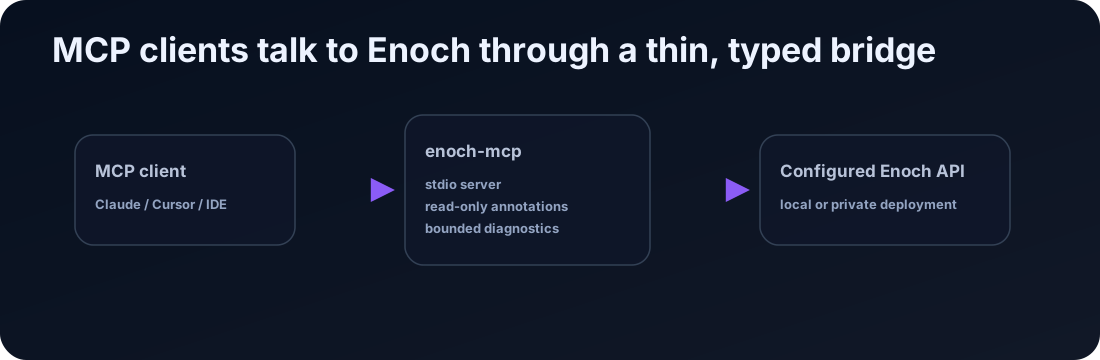
enoch-mcp is a local Model Context Protocol stdio server for a configured Enoch FastAPI control-plane API. It lets MCP clients inspect and operate Enoch through typed tools without exposing a raw shell or reimplementing Enoch business logic.
What it does
- Registers MCP tools for Enoch control-plane, Dashboard V1, and core endpoints.
- Sends requests to a configured Enoch API URL.
- Adds
Authorization: Bearer <token>to API requests using the configured token. - Returns Enoch API responses to the MCP client.
- Marks read-only tools with MCP read-only annotations.
- Marks mutating tools as non-read-only and adds approval metadata.
- Keeps safe defaults for dry-run operations.
- Optionally probes configured CPU/GPU workers directly through worker APIs or allowlisted SSH diagnostics.
What it does not do
- It does not expose a raw shell tool.
- It does not accept arbitrary SSH commands.
- It does not read or write local artifact files directly.
- It does not call language models.
- It does not cache, retry, queue, or schedule work.
- It does not bypass Enoch authentication or authorization.
Requirements
- Python 3.11 or newer
- A running Enoch API, normally at
http://localhost:8787 - An Enoch API bearer token
- An MCP client that can run local stdio servers
Installation
Run from PyPI with uvx:
uvx enoch-mcp --api-url http://localhost:8787 --api-token '<token>'
Or configure with environment variables:
export ENOCH_API_URL='http://localhost:8787'
export ENOCH_API_TOKEN='<token>'
uvx enoch-mcp
For local development from a checkout:
git clone https://github.com/alias8818/enoch-mcp.git
cd enoch-mcp
uv sync --dev
uv run enoch-mcp --api-url http://localhost:8787 --api-token '<token>'
Configuration
| Option | Environment variable | Default | Description |
|---|---|---|---|
--api-url | ENOCH_API_URL | http://localhost:8787 | Base URL for the Enoch API. |
--api-token | ENOCH_API_TOKEN | none | Bearer token for the Enoch API. |
--worker-probes-json | ENOCH_WORKER_PROBES_JSON | none | Optional JSON map for direct worker diagnostics. |
--worker-probes-file | ENOCH_WORKER_PROBES_FILE | none | Optional path to a JSON map for direct worker diagnostics. |
The token is required. If it is missing, tool calls fail before making an HTTP request.
Optional worker probes
Worker probes are disabled unless ENOCH_WORKER_PROBES_JSON or ENOCH_WORKER_PROBES_FILE is configured. This keeps the default package a thin control-plane bridge. When configured, the MCP exposes named diagnostics for worker truth: API health, worker-gate dashboard status, active process markers, bounded log tails, disk space, and expected artifact presence.
Example:
{
  "cpu": {
    "api_url": "http://127.0.0.1:18788",
    "api_token": "worker-api-token",
    "service_name": "enoch-control-plane",
    "project_root": "/srv/enoch/projects"
  },
  "gpu": {
    "api_url": "http://127.0.0.1:18789",
    "api_token": "worker-api-token",
    "ssh_host": "worker-gpu.example.internal",
    "ssh_user": "enoch",
    "service_name": "enoch-control-plane",
    "project_root": "/srv/enoch/projects",
    "log_paths": ["/var/log/enoch-control-plane.log"]
  }
}
Supported fields per lane:
api_url: worker-gate base URL. Used first for/healthz,/dashboard/api,/dashboard/api/run/{run_id}, and/project-status/{project_id}.api_token: worker bearer token. Treated as secret.ssh_host,ssh_user,ssh_port: optional SSH fallback/debug target.service_name: systemd unit name for service checks and journal tails.project_root,state_dir: fixed worker roots used for disk and artifact checks.log_paths: fixed worker-gate log paths that may be tailed.
SSH probes only run fixed diagnostic commands. They do not accept arbitrary shell input from the MCP client. User-supplied IDs are limited to safe run/project identifier characters, log output is bounded, SSH uses batch mode and no stdin, and the recommended deployment is a read-only worker user or forced-command policy.
MCP client setup
Claude Desktop
{
  "mcpServers": {
    "enoch": {
      "command": "uvx",
      "args": ["enoch-mcp"],
      "env": {
        "ENOCH_API_URL": "http://localhost:8787",
        "ENOCH_API_TOKEN": "replace-with-token"
      }
    }
  }
}
For local development, point the MCP client at the checkout:
{
  "mcpServers": {
    "enoch": {
      "command": "uv",
      "args": ["--directory", "/path/to/enoch-mcp", "run", "enoch-mcp"],
      "env": {
        "ENOCH_API_URL": "http://localhost:8787",
        "ENOCH_API_TOKEN": "replace-with-token"
      }
    }
  }
}
Use the equivalent local stdio-server settings for Cursor, Copilot, Windsurf, or other MCP clients.
Development
uv sync --dev
uv run pytest -q
gitleaks detect --no-git --redact
Public-safety note
This package is public. Examples must use placeholders and local URLs only. Do not publish private hostnames, LAN/Tailscale IPs, operator paths, or live tokens.
Reviews
No reviews yet
Be the first to review this server!
More Developer Tools MCP Servers
Git
Freeby Modelcontextprotocol · Developer Tools
Read, search, and manipulate Git repositories programmatically
Fetch
Freeby Modelcontextprotocol · Developer Tools
Web content fetching and conversion for efficient LLM usage
Toleno
Freeby Toleno · Developer Tools
Toleno Network MCP Server — Manage your Toleno mining account with Claude AI using natural language.
mcp-creator-python
Freeby mcp-marketplace · Developer Tools
Create, build, and publish Python MCP servers to PyPI — conversationally.
MCP Marketplace
Freeby mcp-marketplace · Developer Tools
Search and install MCP servers from inside your AI client.
MarkItDown
Freeby Microsoft · Content & Media
Convert files (PDF, Word, Excel, images, audio) to Markdown for LLM consumption