
Server data from the Official MCP Registry
Local Windows management, diagnostics, security, cleanup, and optimization MCP server.
About
Local Windows management, diagnostics, security, cleanup, and optimization MCP server.
Security Report
This Windows system administration MCP server exposes 96 tools for diagnostics, task management, and cleanup with clear safety warnings in documentation. However, several security concerns reduce confidence: unrestricted PowerShell execution via `execute_powershell` tool, insufficient input validation on glob patterns and registry operations, potential path traversal vulnerabilities in file deletion routines, and missing authentication/authorization controls. Permissions broadly match the server's purpose (system administration on Windows), but the combination of powerful, minimally-validated operations and lack of per-operation gating creates moderate risk if an untrusted client gains access. Supply chain analysis found 11 known vulnerabilities in dependencies (1 critical, 8 high severity). Package verification found 1 issue.
7 files analyzed · 23 issues found
Security scores are indicators to help you make informed decisions, not guarantees. Always review permissions before connecting any MCP server.
Permissions Required
This plugin requests these system permissions. Most are normal for its category.
How to Install
Add this to your MCP configuration file:
{
  "mcpServers": {
    "io-github-ahmedlaminou-windows-mcp-server": {
      "args": [
        "-y",
        "windows-mcp-extension"
      ],
      "command": "npx"
    }
  }
}Documentation
View on GitHubFrom the project's GitHub README.
Windows Management MCP Server
Windows Management MCP Server is a Python-based Model Context Protocol server for local Windows diagnostics, task management, cleanup, hardware inspection, security checks, and administrative workflows.
It exposes 96 tools over stdio and is designed for local assistants such as Claude Desktop, Cursor, VS Code extension hosts, and other MCP-compatible clients.
Important: This server runs with the privileges of the user account that starts it. Several tools can change system state, delete files, edit the Registry, manage services, install updates, or execute PowerShell. Use the read-only and dry-run tools first, and only enable destructive actions after reviewing the target paths and commands.
Demo
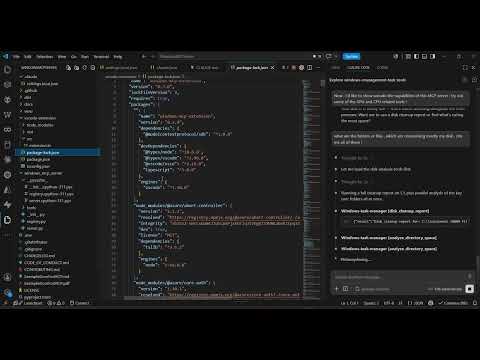
Watch the demo: https://youtu.be/1GNk_GYYkww
What It Can Do
- Task manager: CPU, GPU, memory, disk usage, top processes, process trees, process details, suspend/resume/kill.
- Storage cleanup: disk usage, largest folders/files, duplicate detection, old files, media discovery, Recycle Bin deletion, temp cleanup.
- Hardware and drivers: GPU details, NVIDIA
nvidia-smiprobes, display configuration, installed drivers, problem devices, driver update candidates. - Windows security: Defender status/scans, firewall rules, BitLocker, Secure Boot, UAC, Windows Update status.
- System administration: services, startup apps, scheduled tasks, event logs, crash diagnostics, restore points.
- Network diagnostics: interfaces, active sockets, listening ports, firewall correlation, ping latency.
- Developer environment: Python/Node discovery, environment variables, common dev ports.
- Shell helpers: Explorer open/select, screenshots, clipboard, visible windows.
- Peripherals and virtualization: printers, print queues, audio, Bluetooth, WSL, Hyper-V, optional Windows features.
For the complete tool catalog, see docs/TOOLS.md.
Requirements
- Windows 10/11 or Windows Server with PowerShell available.
- Python 3.10 or newer.
- Some tools require Administrator privileges or Windows features/modules that may not be installed on every machine.
- Optional vendor data, such as NVIDIA GPU telemetry, requires vendor tools like
nvidia-smionPATH.
Installation
From PyPI:
pip install windows-management-mcp-server
Create a virtual environment and install the package in editable mode:
python -m venv venv
.\venv\Scripts\Activate.ps1
pip install -e .
Both install paths register the windows-mcp-server command in the active environment.
MCP Client Configuration
For clients that can launch a stdio MCP server, use:
{
  "mcpServers": {
    "windows-management": {
      "command": "windows-mcp-server",
      "args": []
    }
  }
}
If the command is not on PATH, point directly at the local virtual environment:
{
  "mcpServers": {
    "windows-management": {
      "command": "C:\\path\\to\\WindowsMCPServer\\venv\\Scripts\\python.exe",
      "args": ["-m", "windows_mcp_server.server"],
      "env": {
        "PYTHONPATH": "C:\\path\\to\\WindowsMCPServer"
      }
    }
  }
}
Running Locally
windows-mcp-server
Or:
python -m windows_mcp_server.server
The server uses stdio transport and is normally launched by an MCP client rather than run interactively.
VS Code Extension
The vscode-extension/ folder contains a small VS Code extension that launches this MCP server from the repo-local virtual environment first, then falls back to a global windows-mcp-server.
cd vscode-extension
npm install
npm run compile
Open vscode-extension/ in VS Code and press F5 to start an Extension Development Host.
Safety Model
Tools are intentionally mixed across read-only, safer mutation, and sharp mutation categories.
- Prefer report tools first:
disk_cleanup_report,get_security_status,get_windows_update_status,list_scheduled_tasks,get_process_details. - Prefer safe deletion:
safe_delete_to_recycle_bin,safe_delete_many_to_recycle_bin,safe_delete_by_patternwithdry_run=true. - Treat these as sharp tools:
execute_powershell, Registry writes/deletes, permanent file deletion, service changes, update installation, process termination, restore point creation.
See docs/SECURITY_MODEL.md before exposing this server to an assistant you do not fully trust.
Development
Compile-check the Python package:
.\venv\Scripts\python.exe -m compileall windows_mcp_server
Check the registered tool count:
.\venv\Scripts\python.exe -c "from windows_mcp_server.registry import register_all_tools, registered_tools; Dummy=type('Dummy',(),{'tool':lambda self: (lambda f:f)}); register_all_tools(Dummy()); print(len(registered_tools))"
Compile the VS Code extension:
cd vscode-extension
npm run compile
Repository Structure
windows_mcp_server/        Python MCP server package
windows_mcp_server/tools/  Tool modules grouped by Windows domain
vscode-extension/          Optional VS Code extension wrapper
docs/                      Tool catalog, security model, publishing guide
server.json                MCP Registry metadata
pyproject.toml             Python package metadata
Publishing
This repository includes server.json for the MCP Registry and PyPI-compatible package metadata.
See docs/PUBLISHING.md for the full GitHub, PyPI, and MCP Registry release flow.
License
MIT. See LICENSE.
Reviews
No reviews yet
Be the first to review this server!
More Developer Tools MCP Servers
Git
Freeby Modelcontextprotocol · Developer Tools
Read, search, and manipulate Git repositories programmatically
Fetch
Freeby Modelcontextprotocol · Developer Tools
Web content fetching and conversion for efficient LLM usage
Toleno
Freeby Toleno · Developer Tools
Toleno Network MCP Server — Manage your Toleno mining account with Claude AI using natural language.
mcp-creator-python
Freeby mcp-marketplace · Developer Tools
Create, build, and publish Python MCP servers to PyPI — conversationally.
MCP Marketplace
Freeby mcp-marketplace · Developer Tools
Search and install MCP servers from inside your AI client.
MarkItDown
Freeby Microsoft · Content & Media
Convert files (PDF, Word, Excel, images, audio) to Markdown for LLM consumption