
Server data from the Official MCP Registry
OpenAI-compatible MCP gateway cataloging 22 LLM providers, with routing, failover, and tools.
About
OpenAI-compatible MCP gateway cataloging 22 LLM providers, with routing, failover, and tools.
Security Report
Valid MCP server (1 strong, 1 medium validity signals). No known CVEs in dependencies. Package registry verified. Imported from the Official MCP Registry.
7 files analyzed · 1 issue found
Security scores are indicators to help you make informed decisions, not guarantees. Always review permissions before connecting any MCP server.
How to Install
Add this to your MCP configuration file:
{
  "mcpServers": {
    "io-github-0xzr-freellmpool": {
      "args": [
        "freellmpool"
      ],
      "command": "uvx"
    }
  }
}Documentation
View on GitHubFrom the project's GitHub README.
freellmpool
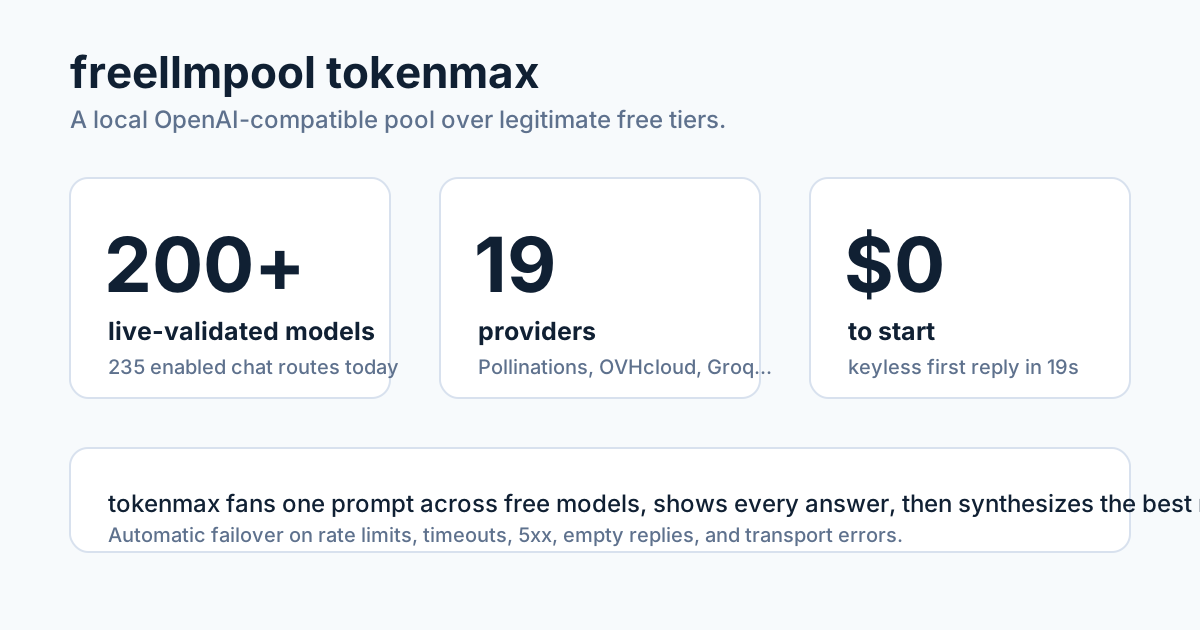
freellmpool catalogs 22 LLM providers as distinct groups spanning recurring free tiers, keyless endpoints, finite trials, pin-only routes, and disabled candidates. It exposes 178 enabled chat routes and 431 cataloged chat models, and automatically pools only enabled routes you can access behind one OpenAI-compatible endpoint — as a CLI, a Python library, or a local proxy. It can start without credentials when an enabled keyless route is available.



FAQ: where prompts go, ToS posture, failover, bans, and comparisons.
Release and distribution status
-
Latest release: 0.13.0. The GitHub release and PyPI package are both 0.13.0;
pip install freellmpoolanduvx freellmpoolinstall the audited provider catalog, bounded streaming and sentinel hardening, Hermes profile, proxy readiness/provider APIs,spreadrouting, and OpenCode registry-readiness hardening. -
Registry publication status: pending.
opencode-freellmpoolandopencode-freellmpool-tuiare tested but not published on npm as of 2026-08-29. Use their repository-local installation instructions for now.
30-second quickstart
Fresh install to first free-model reply is measured at about 19 seconds under the 30-second target on a clean Linux/Python 3.12 environment, with no API keys when a keyless provider is up:
# One command when uv is installed; no checkout or manually managed virtualenv:
uvx freellmpool ask --max-tokens 32 "Reply with one short sentence: freellmpool is ready."
Portable virtual-environment path:
python3 -m venv .venv
. .venv/bin/activate
python -m pip install --upgrade pip
python -m pip install freellmpool
freellmpool ask --max-tokens 32 "Reply with one short sentence: freellmpool is ready."
CI runs the same path from this checkout with
FREELLMPOOL_QUICKSTART_PACKAGE=. scripts/quickstart-test.sh.
The catalog covers provider-operated free tiers, keyless routes, and a few explicit finite-trial or disabled candidates. Eligibility and limits differ by provider. freellmpool automatically uses only enabled routes you can access, fails over when one is rate limited or down, and tracks local per-day usage.
Several providers (Pollinations, OVHcloud, and Kilo Gateway) need no API key, and LLM7 works without one, so the quickstart can answer without signup when a keyless provider is available.
To inspect your local provider keys, agent CLIs, proxy config, and Tailscale state before wiring tools, run the print-only init wizard:
freellmpool init --yes
freellmpool init --yes --agent opencode
freellmpool init --yes --agent metaswarm --tailnet
Add keys for the other providers to unlock more models and higher limits.
Local runtimes (explicit, pin-only)
LM Studio, Ollama, and llama.cpp can be previewed from a fixed list of literal loopback endpoints without scanning your LAN or processes:
freellmpool local discover
freellmpool local discover --name lm_studio
freellmpool local import --name lm_studio --yes
freellmpool ask --providers local_lm_studio --model "<model-from-discover>" "hello"
Discovery is read-only. Import is a separate affirmative step, writes no
credential, and keeps every imported model out of automatic routing
(auto = false). freellmpool local remove local_lm_studio --yes reverses only
the block managed by the importer. Custom endpoints must be canonical literal
loopback URLs such as http://127.0.0.1:1234/v1; hostnames, LAN addresses,
redirects, and broad network scans are rejected.
First-run setup with freellmpool init
freellmpool init inspects provider keys, installed agent CLIs, Tailscale
state, and proxy config, then prints one copy-pastable next step without editing
files. Run it detect-only first:
freellmpool init --yes
--json emits the same detection as versioned JSON for scripts and agents.
Tailnet / remote agent gateway
Serve the proxy on your Tailscale 100.x address with a generated API key:
freellmpool tailnet serve --port 8080
From a remote machine:
freellmpool tailnet connect <tailnet-ip> --port 8080
Both sides support --api-key <shared-secret> if you want to pin a key instead
of using a generated token. Tailnet serving requires auth by default; do not
run unauthenticated over non-loopback interfaces.
Metaswarm agent lanes
This project uses one Umans/Kimi K2.7 worker lane, one MiniMax M3 lane, Codex as escalation, and Claude Opus only for final pre-ship review. The installable Metaswarm profile mirrors that posture: one free/cheap worker lane through the local proxy, one larger freellmpool reviewer lane, and Codex/Opus as explicit user-owned paid escalation/final-review lanes only (never silent).
freellmpool init --yes --agent metaswarm --tailnet
freellmpool profile install metaswarm
freellmpool tailnet serve --port 8080
freellmpool profile doctor metaswarm --dry-run
Run a coding agent on free models
freellmpool's proxy speaks the OpenAI API and includes an experimental Anthropic-compatible path, so coding agents can run against pooled free tiers — just point them at the proxy:
freellmpool proxy                       # starts http://localhost:8080
freellmpool code claude                 # prints the one-line setup for Claude Code
freellmpool profile list                # richer installable profiles
freellmpool profile show metaswarm      # Tailnet-aware Metaswarm profile
freellmpool profile install hermes       # Hermes custom-endpoint config
# (also: codex, aider, cline, continue, cursor, hermes, opencode, metaswarm)
The Hermes profile prints (and never writes) this supported custom-endpoint
block; hermes model provides the interactive equivalent:
model:
  provider: custom
  default: quality
  base_url: http://localhost:8080/v1
  api_key: anything
Claude Code gateway mode can also be launched directly:
ANTHROPIC_BASE_URL=http://localhost:8080 \
ANTHROPIC_AUTH_TOKEN=dummy \
ANTHROPIC_API_KEY=dummy \
ANTHROPIC_MODEL=auto \
ANTHROPIC_SMALL_FAST_MODEL=auto \
CLAUDE_CODE_ENABLE_GATEWAY_MODEL_DISCOVERY=1 \
claude
Existing OpenAI-compatible apps work the same way: set
OPENAI_BASE_URL=http://localhost:8080/v1 and keep your code unchanged.
Anthropic-compatible tools can use the experimental bridge with
ANTHROPIC_BASE_URL=http://localhost:8080.
Text-only /v1/responses and /v1/messages requests stream incrementally from
the selected provider. Tool calls and richer content intentionally stay on the
buffered compatibility path. The browser dashboard and playground share one
public, data-free shell; when proxy auth is enabled it prompts for the bearer
token and keeps it only in page memory while protected status, inventory,
model, and battle calls continue to require the Authorization header.
OpenCode gets a deeper integration in 0.12.0: a live in-editor dashboard (routing mode,
estimated savings, tokens served free, provider race, latency), per-request
agent routing via the model picker (freellmpool/agent|spread|auto|fast|quality|fair), and freellmpool_status
/ freellmpool_models tools — see integrations/opencode-tui
and the guide.
The plugin registers its routing aliases automatically on supported OpenCode
versions without rewriting user configuration. Restart OpenCode and check
opencode models freellmpool.
The package tarballs are validated in CI, but npm publication remains pending;
the linked local-file instructions remain the working install path.
New in 0.11: capacity tools — freellmpool capacity status shows which free
tiers are usable right now, freellmpool providers health live-probes them, and
freellmpool keys add walks you through configuring more (see
Capacity & provider health and
docs/CAPACITY.md).
New in 0.10: an async API (AsyncPool), an MCP server (freellmpool mcp),
latency-aware routing with freellmpool benchmark, observability hooks, and a
plugin system for custom providers. See the changelog.
Install
pip install freellmpool # or: pipx install freellmpool
Only dependency is httpx. Python 3.11+.
Docker and Open WebUI
The published container runs the local proxy as an unprivileged user. Persist quota, stats, route-health, cache, and configuration state in a named volume:
docker volume create freellmpool-data
docker run --rm -p 127.0.0.1:8080:8080 \
  --volume freellmpool-data:/home/freellmpool/.config/freellmpool \
  --env GROQ_API_KEY \
  ghcr.io/0xzr/freellmpool:0.13.0
Omit --env GROQ_API_KEY if you want a credential-free start; the proxy can
answer only while an enabled keyless route is available. Keep the published
port on loopback. If you deliberately expose it, set
FREELLMPOOL_PROXY_KEY and require that Bearer token from clients.
For the bundled Open WebUI stack, place any provider credentials in .env and
run docker compose up -d. Compose waits for the proxy health check and keeps
both freellmpool and Open WebUI state in named volumes; open
http://localhost:3000 after both services are healthy.
Command line
freellmpool ask "Write a haiku about sqlite"
git diff | freellmpool ask "Write a commit message for this"
freellmpool tokenmax "Hardest question you've got"  # 🌈 blast models, print answers, optional synthesis
freellmpool providers        # which providers are configured
freellmpool models           # cataloged provider/model ids
freellmpool stats            # lifetime tokens served free + estimated cost avoided
freellmpool badge -o badge.svg   # a shareable SVG badge of that total
freellmpool badge --summary -o summary.svg   # a larger usage summary card
freellmpool tokenmax is the tongue-in-cheek maximum-effort mode: it fans your
prompt out to many available models at once and prints each answer. The CLI adds
a synthesized verdict by default unless you pass --no-synthesize; the MCP tool
returns the model answers for the calling agent to synthesize. (See
docs/MCP.md.)
freellmpool stats is a running, persistent lifetime total (it survives restarts
and upgrades). Embed freellmpool badge in a README, or use
freellmpool badge --summary -o summary.svg for a larger card with tokens,
requests, estimated savings, and provider mix. The proxy can serve both
/badge.svg and /summary.svg live when FREELLMPOOL_PUBLIC_BADGE=1 makes
public badges embeddable.
Pin a provider or model; common OpenAI/Anthropic model names are mapped to a free equivalent so existing scripts keep working:
freellmpool ask -m groq/openai/gpt-oss-20b "hi"
freellmpool ask -p cerebras,groq "hi"
freellmpool ask -m gpt-4o-mini "hi"      # routed to a free model
Roles
freellmpool roles lists ask-role presets (coder, critic, summarizer,
grounded-reader, long-context, cheap, fast, second-opinion, ...). Each
role sets routing, token budget, temperature, task intent, and system-prompt hints
without inventing a second routing engine. Explicit flags (--model, --providers,
--routing, --task, --max-tokens) win over role defaults.
freellmpool ask --role coder "write a pytest for this function"
freellmpool ask --role grounded-reader "read this Markdown file"
freellmpool ask --routing quality --task general "ignore automatic task classification"
FREELLMPOOL_MODE=wise freellmpool ask --role cheap "summarize this patch"
As a proxy
Run a local server that speaks the OpenAI API, then point any OpenAI-compatible
tool at it. On loopback, any placeholder API key works unless you configured
FREELLMPOOL_PROXY_KEY or passed --api-key; Tailnet/LAN serving requires a
real proxy bearer token by default.
freellmpool proxy
export OPENAI_BASE_URL=http://localhost:8080/v1
export OPENAI_API_KEY=unused
from openai import OpenAI
client = OpenAI()
print(client.chat.completions.create(
    model="auto",
    messages=[{"role": "user", "content": "hi"}],
).choices[0].message.content)

# audio → text (Whisper), same client:
print(client.audio.transcriptions.create(
    model="auto", file=open("audio.mp3", "rb"),
).text)
Or with curl (multipart upload):
curl -s http://localhost:8080/v1/audio/transcriptions \
  -F file=@audio.mp3 -F model=auto
The proxy also implements the OpenAI Responses API (for the Codex CLI) and an
experimental Anthropic Messages API path (for Claude Code), so coding agents can
run on free models too. freellmpool code <agent> prints the exact setup, while
freellmpool profile install <agent> prints the fuller copy-pastable profile
without mutating third-party config:
freellmpool code aider       # also: claude, codex, cline, continue, cursor, hermes, opencode
freellmpool profile show opencode
freellmpool profile doctor opencode --dry-run
Release 0.12.0 proxy surfaces:
/v1/chat/completions— OpenAI-compatible chat, token streaming, tool calling./v1/responses— Responses API shim with incremental text streaming; tools and rich content use the buffered compatibility path./v1/messages— experimental Anthropic-compatible Messages path with the same incremental-text / buffered-tool split./v1/embeddingsand/v1/audio/transcriptions— OpenAI-compatible embedding and Whisper-style multipart transcription./v1/models— routing aliases plus concreteprovider/modelids./v1/models?ready=true— the same shape, limited to locally ready targets./v1/providers— authenticated, secret-free provider/model readiness details./freellmpool/battleand/playground— bounded browser/JSON model comparisons./healthzand/livez— public process liveness aliases./readyz— public advisory local-capacity readiness (200 when at least one provider is ready, otherwise 503); it never live-probes an upstream./dashboard,/status,/badge.svg, and/summary.svg— local operations surfaces.
/, /dashboard, and /playground serve one public, data-free shell. When a
proxy key is set, the shell prompts for it and keeps it only in page memory;
status, provider/model inventory, battle, and model API calls remain header-auth
protected. Liveness/readiness stay public for orchestrator probes; readiness is
a local quota/cooldown snapshot, not an upstream health guarantee.
Setup snippets for specific tools are in docs/INTEGRATIONS.md
and docs/AGENTS.md. The repo also includes an experimental
metaswarm review adapter for using freellmpool as an
external-tools reviewer/second opinion. freellmpool profile show metaswarm
documents a free/cheap worker lane, a larger reviewer lane, Tailnet client setup,
and paid Codex/Opus lanes as explicit user-owned escalation paths only.
As a library
from freellmpool import Pool

pool = Pool.from_default_config()
reply = pool.ask("Summarize the plot of Hamlet in 20 words.")
print(reply.text, "—", reply.provider_id)

vectors = pool.embed(["first document", "second document"]).vectors

with open("audio.mp3", "rb") as f:
    text = pool.transcribe(f.read(), "audio.mp3").text   # Whisper, failover across providers
Async is the same API with await:
from freellmpool import AsyncPool

async with AsyncPool.from_default_config() as pool:
    reply = await pool.aask("Summarize the plot of Hamlet in 20 words.")
Pass on_event=... to either pool to receive structured routing/cache events
(attempt/success/error/cooldown/cache_hit/cache_miss/exhausted) for logging or tracing. Add
your own endpoint with register_provider(...), or a new request shape with
register_adapter(name, fn).
Benchmark your providers
freellmpool benchmark times one call per configured provider and prints
latency and success, so you can see which of your free tiers are fastest right
now. The router learns the same latency/success signal from real traffic as it
runs; set FREELLMPOOL_ROUTING=fast to prefer the lowest-latency provider
instead of the default least-used-first.
$ freellmpool benchmark
  provider/model            status   latency  note
  cerebras/gpt-oss-120b     ok        180 ms  6 tok
  groq/openai/gpt-oss-20b   ok        240 ms  6 tok
  ovh/Meta-Llama-3_3-70B-Instruct  FAIL    -  HTTP 429
Capacity & provider health
Free tiers drift through the day — keys expire, providers go down, daily caps fill. These commands tell you what's usable right now and what to set up next:
freellmpool capacity status --target 5   # who's healthy / near quota / missing a key
freellmpool capacity status --refresh    # explicitly refresh advisory provider metadata
freellmpool quota-wise status            # local headroom + recommended mode
freellmpool providers health             # send one tiny request to each, time it
freellmpool keys checklist --target 5    # which keys to add to reach N healthy providers
freellmpool keys add groq                # configure a key (and record metadata)
Protocol support is verified separately from basic provider health. Run
freellmpool conformance run to check chat, streaming, tools, JSON object/schema,
vision, Responses, and Anthropic Messages with bounded synthetic requests, then inspect
the sanitized evidence with freellmpool conformance status --json.
Feature-specific auto-routing uses only verified targets; an exact
provider/model pin is the explicit override. Full operator and privacy contract:
docs/PROTOCOL_CONFORMANCE.md.
capacity status is offline and cache-first: it reads your catalog, environment, and
per-day quota counters and labels each provider healthy, low_quota,
exhausted, invalid_key, or missing. Cached metadata from the advisory
external catalog (mnfst/awesome-free-llm-apis)
can suggest free providers you could add; only an explicit
freellmpool capacity status --refresh or freellmpool catalog sync uses the
network for that metadata. It remains advisory only; your providers.toml
stays the source of truth for routing. keys add <name> can import a
suggested provider from that catalog or create an OpenAI-compatible stub and
autodiscover its models. The proxy /dashboard shows the same capacity at a
glance. Full reference: docs/CAPACITY.md.
FREELLMPOOL_MODE=wise is the conservative quota mode: ask defaults to a
smaller output budget and spread routing, tokenmax narrows its default fan-out,
and broad multi-model calls require confirmation unless you pass --yes.
Per-command --mode normal|wise overrides the environment, and
[settings] mode = "wise" works from config.toml. The conserve role is a
quota-conscious shorthand for small, spread-routed answers.
For a bounded second opinion instead of a full tokenmax blast:
freellmpool ask --second-opinion --opinions 3 "is this implementation plan sound?"
freellmpool ask --role second-opinion --synthesize "which release note is clearer?"
The shared panel asks a few diverse providers, keeps individual failures visible,
and can append a non-fatal synthesis when you pass --synthesize.
For a side-by-side comparison you can inspect in the terminal or local browser:
freellmpool battle "which changelog entry is clearer?" --synthesize
freellmpool proxy --port 8080
freellmpool playground --port 8080
Bundled recipes wrap common workflows in JSON files you can inspect and run:
freellmpool recipe list
freellmpool recipe run second-opinion "is this launch plan clear?" --synthesize
freellmpool recipe run pr-review --input patch.diff
freellmpool recipe run repo-summary --path 'src/freellmpool/*.py'
freellmpool recipe run metaswarm-worker-review --input worker.md --validation-output-file validation.txt
Recipes use the same role presets and shared panel helper as ask and battle;
there is no separate routing engine.
Local foreground job queue
For slow, quota-aware work that should not block a live session, queue jobs to
an append-only JSONL log under your config dir (override with
FREELLMPOOL_JOBS_PATH). The queue is foreground-only: jobs run processes
one job at a time and records started/completed/failed/cancelled events.
Completed ask jobs keep their output in the job log; completed recipe jobs also
write run records and Markdown reports via the same report helpers used by
freellmpool report.
# queue a recipe job
freellmpool jobs add --recipe pr-review --input patch.diff

# queue an ask job with a role preset
freellmpool jobs add --role summarizer "summarize the latest changelog"

freellmpool jobs list            # replayed state (idempotent across restarts)
freellmpool jobs watch           # one-shot refresh render, no daemon

freellmpool jobs run --dry-run   # print execution order, mutate nothing
freellmpool jobs run --max-failures 2   # halt after N consecutive failures
freellmpool jobs cancel <job-id> # append a cancel tombstone, not a mutation

freellmpool report list
freellmpool report last --markdown
freellmpool report last --html --path
freellmpool cost show <run-id>
Cancellation is a new tombstone event, not a re-write of the earlier queued
record — a crash before jobs run finishes still leaves the queue
replayable, and cancelled jobs stay cancelled after restart. Duplicate
submissions create distinct jobs; pass --dedupe to reject re-submission of
the same recipe or role while a job is still pending.
As an MCP server
freellmpool mcp runs a Model Context Protocol server over newline-delimited
JSON-RPC stdio, so Claude Desktop, Claude Code, or Cursor can hand subtasks to
free models. It exposes ask, panel/second-opinion, battle, recipe, roles,
Tailnet-info, quota-wise, route-preview, models, quota, stats, and tokenmax
tools. See docs/MCP.md. A server.json is included
for the MCP registry.
In Simon Willison's llm CLI
There's a plugin: llm install llm-freellmpool → llm -m freellmpool "...".
It can answer without an API key while an enabled keyless route is available.
Source: plugins/llm-freellmpool.
Provider keys
freellmpool reads keys from the environment and uses whatever is set. No key is required while an enabled keyless route is available; credentials expand the set of accessible routes. Step-by-step signup links, including verification and payment-method caveats, are in docs/ACCOUNTS.md.
| Provider | Env var | Notes |
|---|---|---|
| Pollinations | — | no key needed |
| OVHcloud | — | no key needed (anonymous tier) |
| Kilo Gateway | — | no key needed |
| LLM7 | LLM7_API_KEY | optional |
| Groq | GROQ_API_KEY | current free-plan routes; exact limits vary by model |
| Cerebras | CEREBRAS_API_KEY | finite $5 trial; current routes are explicit pins, not automatic recurring capacity |
| NVIDIA NIM | NVIDIA_API_KEY | |
| OpenRouter | OPENROUTER_API_KEY | free models |
| Google Gemini | GEMINI_API_KEY | |
| Cloudflare | CLOUDFLARE_API_TOKEN + CLOUDFLARE_ACCOUNT_ID | |
| Hugging Face router | HF_TOKEN | router free tier |
| OpenCode Zen | — | cataloged, disabled by default pending opt-in |
| Aion Labs | AION_API_KEY | 20K free tokens/day, no card |
| ModelScope API Inference | MODELSCOPE_API_KEY | 2,000 free calls/day |
| Morph | MORPH_API_KEY | current priced aliases are retained disabled for explicit future verification |
| Vercel AI Gateway | AI_GATEWAY_API_KEY | automatic routing is limited to the publicly price-verified zero-price Poolside route; other routes are pin-only or disabled; set a gateway-side budget |
| SiliconFlow | SILICONFLOW_API_KEY | free models; identity verification required |
| Mistral, Cohere, SambaNova, Z.ai, Ollama Cloud | see .env.example |
A config.toml (see config.toml.example) can hold keys,
model aliases, and settings instead of env vars.
Local diagnostics and operations
Run freellmpool doctor for a no-network local check of package version, config
paths, configured provider count, routing mode, quota/cache locations, external
catalog cache age, and bundled catalog validity.
Response caching is off unless FREELLMPOOL_CACHE_TTL (seconds) or
[settings] cache_ttl is positive. When enabled, cache rows live in SQLite with
WAL mode and TTL pruning; FREELLMPOOL_CACHE_MAX_ENTRIES caps retained rows
(default 10000, set 0 to disable size pruning).
Quota counters are written immediately by default. Long-running proxy/MCP
processes can reduce file churn with FREELLMPOOL_QUOTA_FLUSH_EVERY=N, which
batches up to N successful requests before flushing. Shutdown paths and
quota.snapshot() flush pending counts, so dashboards and process exits still
see current totals.
Recent per-route health is persisted at
~/.config/freellmpool/route_health.json (override with
FREELLMPOOL_HEALTH_FILE). The bounded, atomic state contains route names,
timings, counters, and normalized failure classes only—never prompts, responses,
headers, or credentials. /status reports circuit state, sample age, and reset
time for each enabled route.
How routing works
For each request, freellmpool builds the list of (provider, model) pairs you
have access to, then orders providers least-used-first and picks a least-used
model inside that provider. This keeps providers with large catalogs, like
NVIDIA, from receiving more traffic only because they expose more models. A
provider that returns a 429 is set aside for its advertised Retry-After or
rate-limit reset window. Repeated availability failures open a per-route circuit;
after cooldown, one half-open probe can restore the route. Daily counts are kept
in ~/.config/freellmpool/quota.json and reset at UTC midnight.
Every call records latency and success per model target. A provider whose targets
are currently failing sinks to the back automatically; with
FREELLMPOOL_ROUTING=fast the fastest measured provider goes first instead.
FREELLMPOOL_ROUTING=fair spreads requests across providers to preserve daily
quota. freellmpool benchmark warms these metrics on demand. To restore the old
per-model balancing behavior, set FREELLMPOOL_ROUTING=legacy or
FREELLMPOOL_ROUTING=model (or FREELLMPOOL_ROUTING=model-fast for the old
per-model fastest-first ordering).
Quality routing (FREELLMPOOL_ROUTING=quality). Free tiers' strongest models
have the smallest daily caps, so a naive pool gets weaker as the day fills. Quality
routing matches each prompt's difficulty to each model's capability: hard
prompts (long input, code, reasoning cues) go to the strongest available model, and
easy ones go to lightweight models — which rations scarce strong-model quota so the
pool stays sharp for longer. It also recognizes high-confidence grounded Markdown
reading/extraction requests locally. When repeated evidence from the versioned,
sanitized fixture exists for a candidate's exact model identity, a bounded task-fit
term influences quality ordering. Unmeasured models remain reachable, and if no
candidate has current evidence the ordering is unchanged. Capability is grounded in
real benchmark data, not guessed from names; models that no benchmark lists cover
fall back to a name heuristic.
Use --task grounded-reading to declare that intent, --task general to suppress
automatic classification, or --task auto to classify locally. OpenAI-compatible,
Responses, and Anthropic proxy clients can send the body extension
"task": "grounded-reading" or the X-Freellmpool-Task header. Explicit intent
wins over automatic classification. Task evidence stores aggregate pass counts,
fixture hashes, and scores only—never prompts, documents, responses, or provider
secrets.
The bundled, offline scores come from LMArena Elo (an
MIT-licensed snapshot) and the Aider code-editing
leaderboard (Apache-2.0), normalized to a common percentile scale. For much
broader coverage, run freellmpool capability sync with a free
Artificial Analysis API key
(FREELLMPOOL_AA_API_KEY) — its Intelligence Index covers most current and
open-weight models and takes precedence. The fetched AA data is cached locally
under your own key (never bundled, per AA's terms). freellmpool capability status shows current coverage. Scores via LMArena and Aider; intelligence index
via Artificial Analysis when keyed.
Context windows. Free models often have small context windows. freellmpool
never truncates your input; instead, when a model rejects a request as too long,
it learns that model's limit and stops routing oversized requests there, escalating
only to larger-window models. If nothing fits it raises a clear
ContextWindowExceeded (with the estimated input size) instead of a generic
failure — over the proxy that's a 413. You can declare a model's window with
context = N in providers.toml to skip it proactively.
Architecture notes: docs/ARCHITECTURE.md.
Limitations
- Free-tier models are smaller than frontier models. They're good for drafting, summarizing, classification, triage, and everyday coding — not a replacement for GPT-class reasoning on hard problems.
- Quality and capacity vary through the day as high-cap tiers exhaust. freellmpool's local per-day counters reset at UTC midnight; upstream providers use their own limit and reset windows.
- Free tiers change without notice. When a model id or limit goes stale, a
one-line PR to
providers.tomlfixes it for everyone. - The proxy is meant for local/single-user use. It binds to
127.0.0.1by default; if you expose it, set a key (--api-key). - The Claude Code / Anthropic path is experimental (text and tool use; no vision).
- These are free tiers shared by everyone — don't abuse them.
- Upstream providers receive and may prompt-title/moderate your requests; use the FAQ privacy table and each provider's current terms before sending sensitive prompts.
- Free-tier availability, model IDs, and rate limits drift without notice. freellmpool does not bypass provider limits, rotate accounts, or evade quotas.
How it compares
Comparison snapshot: 2026-07-19. Competitor rows link to the exact README commit used for the claims; scopes change quickly, so treat this as a dated map rather than a permanent ranking.
| Tool | Keyless start | # providers | Failover | MCP server | CLI | Transcription | Local/self-hosted | License |
|---|---|---|---|---|---|---|---|---|
| freellmpool | Yes, when a configured keyless provider is available | 22 chat providers cataloged locally | Yes: retryable provider failures, empty replies, and transport errors | Yes: freellmpool mcp | One-shot CLI plus profiles, library, and proxy commands | Yes: /v1/audio/transcriptions with failover | Yes: small Python package and local proxy | MIT |
| OpenRouter free models | No: hosted API use requires an account/key | Hosted router; the linked free router listed 22 models at snapshot | Yes: hosted provider/model fallbacks | Yes: hosted remote MCP server | Hosted API/SDK and agent SDK, not a local gateway CLI | Audio input/transcription through multimodal chat | No: hosted service | Proprietary service |
| LiteLLM | No: bring provider or hosted-gateway credentials | README claims 100+ LLMs/providers | Yes: router retries/fallbacks | Yes: AI Gateway includes an MCP Gateway | Python SDK and proxy/gateway CLI surface | Yes: /audio/transcriptions | Yes: self-hosted proxy or hosted offering | MIT core; commercial enterprise features |
| OmniRoute | Yes: its setup documents a no-auth OpenCode option | README claims 268 integrations/providers and 90+ free options | Yes: layered fallback/circuit-breaker routing | Yes: MCP and A2A control planes | Broad management CLI and one-command agent setup | Audio translation is documented; other media capabilities vary by provider | Yes: Node application with dashboard, Docker, desktop/PWA paths | MIT |
| FreeLLMAPI | Server starts with a Docker one-liner; inference capacity is configured afterward | README claims 28 free LLM providers and 339 endpoints | Yes: provider/key routing and fallback | Yes: MCP (Streamable HTTP) | Dashboard/server and desktop apps | Not documented; audio speech/TTS is supported | Yes: Node/Docker server and desktop apps | MIT |
FreeLLMAPI predates this project, and the overlap is independent convergence around legitimate free tiers. OmniRoute optimizes for an expansive control plane and many protocols; FreeLLMAPI for a dashboard-centric self-hosted router with encrypted key management; freellmpool for the smallest Python/CLI/library path with a keyless-capable first reply. Those are product-scope choices, not a claim that one tool is best for every deployment.
FAQ
Is there a free, OpenAI-compatible LLM API gateway? Yes — freellmpool is a
free, MIT-licensed gateway that exposes one OpenAI-compatible endpoint over the
enabled routes you can access. Its 22 cataloged provider groups span recurring
free tiers, keyless endpoints, finite trials, pin-only routes, and disabled
candidates. pip install freellmpool and point any OpenAI client at the local
proxy.
How do I use multiple free LLM APIs at once? freellmpool pools them: each request goes to a provider you have access to, fails over to the next when one is rate-limited or down, and tracks per-day usage so load spreads across tiers.
Can I run Claude Code or Codex on free models? Yes — the proxy speaks the
OpenAI API and has an experimental Anthropic-compatible path. Set
OPENAI_BASE_URL=http://localhost:8080/v1 for OpenAI-compatible tools or
ANTHROPIC_BASE_URL=http://localhost:8080 for Anthropic-compatible tools, then
run Codex, Claude Code, aider, Cline, Continue, or Cursor against pooled free tiers. For Claude Code, set
CLAUDE_CODE_ENABLE_GATEWAY_MODEL_DISCOVERY=1 so /v1/models is discovered
through the Anthropic bridge. See freellmpool code <agent>. (Claude Code path is
experimental: text + tools, no vision.)
Do I need an API key? Not while an enabled keyless route is available: Pollinations, OVHcloud, and Kilo Gateway expose keyless routes, and LLM7 is key-optional. Add applicable free-tier or trial credentials for more routes and capacity; availability and terms remain provider-specific.
Is it free and open source? Yes, MIT-licensed. More at the project page.
Featured in
- Community videos (Spanish, by lytohlg AI): "Accede a 18 modelos de IA GRATIS con 1 solo comando" and "Prueba 18 IAs GRATIS sin API key en 30 segundos" (from an earlier catalog; freellmpool now catalogs 22 providers).
- Directory: FreeLLM Pool on MCP Market.
Contributing
New providers and fixes to stale limits are the most useful contributions, and
both are usually a small change to providers.toml. See
CONTRIBUTING.md. Maintainer-ready newcomer tasks are drafted in
docs/GOOD_FIRST_ISSUES.md. Tests run with no network access:
python -m pip install -e ".[dev]" && ruff check . && pytest
Source-first verification in this repo uses PYTHONPATH=src so pytest exercises
the checkout without requiring an editable install first; CI runs the same
configuration. Release readiness uses PYTHONPATH=src python3 scripts/check_release_ready.py.
Security scanners, severity gates, the expiring exception process, local
reproduction, SBOMs, and provenance verification are documented in
SECURITY.md.
License
MIT
Reviews
No reviews yet
Be the first to review this server!
More Developer Tools MCP Servers
Fetch
Freeby Modelcontextprotocol · Developer Tools
Web content fetching and conversion for efficient LLM usage
Git
Freeby Modelcontextprotocol · Developer Tools
Read, search, and manipulate Git repositories programmatically
Toleno
Freeby Toleno · Developer Tools
Toleno Network MCP Server — Manage your Toleno mining account with Claude AI using natural language.
mcp-creator-python
Freeby mcp-marketplace · Developer Tools
Create, build, and publish Python MCP servers to PyPI — conversationally.
MCP Marketplace
Freeby mcp-marketplace · Developer Tools
Search and install MCP servers from inside your AI client.
MarkItDown
Freeby Microsoft · Content & Media
Convert files (PDF, Word, Excel, images, audio) to Markdown for LLM consumption