
Server data from the Official MCP Registry
Provide real-time data querying and visualization by integrating Tako with your agents. Generate o…
About
Provide real-time data querying and visualization by integrating Tako with your agents. Generate o…
Remote endpoints: streamable-http: https://server.smithery.ai/@TakoData/tako-mcp/mcp
Security Report
Valid MCP server (1 strong, 3 medium validity signals). No known CVEs in dependencies. Imported from the Official MCP Registry.
4 files analyzed · No issues found
Security scores are indicators to help you make informed decisions, not guarantees. Always review permissions before connecting any MCP server.
Permissions Required
This plugin requests these system permissions. Most are normal for its category.
How to Install & Connect
Available as Local & Remote
This plugin can run on your machine or connect to a hosted endpoint. during install.
Documentation
View on GitHubFrom the project's GitHub README.
Tako MCP Server





Tako MCP gives your agent industry-leading live web search plus licensed data that the open web does not have. That includes company financials, macroeconomic indicators, web and app traffic, sports, US government spending, and more.
Full Documentation · Get your API key · MCP Registry
Tako MCP lets an agent:
- Search Tako's knowledge graph and the live web — top result renders inline as a chart, and
tako_contentsreads the rows behind it - Discover exactly what proprietary data exists for an entity or metric — free and fast
- Fetch the underlying rows (CSV) or a page's text behind any result URL
- Visualize your own structured data as an embeddable chart (opt-in; on by default on the ChatGPT app)
- Run Tako's Answer Agent for deep, multi-step research (opt-in)
Why a data-native search API? On Tako's VerticalRTK benchmark of real-time domain questions (finance, economics, sports, weather), Tako outperforms the next-best web search API by 21% — while using ~75% fewer tool calls at up to one-tenth the cost, and answering research tasks in 15.5s vs 124.2s for OpenAI web search. It reaches parity with Exa, Parallel, Nimble, and Tavily on standard web benchmarks (SimpleQA, FRAMES) and pulls ahead where structured, real-time data matters. Read the evals →
Installation
Point your MCP client at the hosted endpoint — no install, no local server, no token:
https://mcp.tako.com/mcp
Paste the URL. Sign in when your client prompts you — a per-host key is minted automatically, and new accounts get up to 2,000 free requests. Until you sign in, the connection runs anonymously: tako_search and tako_available_data work right away (rate-limited), and tako_contents — listed like everything else — asks you to sign in when called. For CI, headless use, or a client without an OAuth flow, connect with an API key instead — see API keys and headless clients.
One-click install



Claude Code installs with one command — the plugin brings the MCP connection plus Tako's bundled research skills:
claude plugin marketplace add TakoData/tako-mcp && claude plugin install tako@tako
Gemini CLI installs as an extension. Same one command, same bundled skills, plus /data, /chart, and /coverage commands:
gemini extensions install https://github.com/TakoData/tako-mcp
Each of these lands on the free tier immediately. Authenticate later to unlock the full toolset — see your client's section below.
Pick your client below.
Plugin (recommended) — installs the MCP connection plus Tako's bundled research skills in one step, and works immediately on the free tier — no API key to mint or manage:
claude plugin marketplace add TakoData/tako-mcp
claude plugin install tako@tako
That's it — tako_search and tako_available_data work right away on the anonymous free tier. To unlock the full toolset and your own account limits, authenticate once with OAuth: run /mcp inside Claude Code, select tako, and choose Authenticate. A browser opens to sign you in with your Tako account and a per-host API key is minted for you automatically (visible and revocable at tako.com/console/api-keys). The same OAuth flow powers the plugin on Claude.ai — the plugin's Tako connector connects with a click, no token pasting.
If you previously added the server with claude mcp add, remove it first (claude mcp remove tako-mcp) so you don't end up with two copies of every tool.
Updating from an earlier plugin version? Older releases asked for a Tako API key in the plugin config; that setting is gone, so after updating your connection silently lands on the anonymous tier (
tako_searchandtako_available_datarun; the rest asks you to sign in) — nothing errors, but your account limits are no longer active. Run/mcp→ tako → Authenticate once (or use the Connect button on Claude.ai) to restore full authenticated access.
Or add the MCP server directly (then authenticate in place via /mcp → tako → Authenticate):
claude mcp add tako --transport http https://mcp.tako.com/mcp
Verify with claude mcp list (should show tako connected) or /mcp inside a session.
Use the one-click badge above, or add to ~/.cursor/mcp.json — Cursor prompts you to sign in on first use:
{
  "mcpServers": {
    "tako": {
      "type": "http",
      "url": "https://mcp.tako.com/mcp"
    }
  }
}
Add to your Windsurf MCP config — Windsurf prompts you to sign in on first use:
{
  "mcpServers": {
    "tako": {
      "type": "http",
      "url": "https://mcp.tako.com/mcp"
    }
  }
}
Add to .vscode/mcp.json (workspace) or your user mcp.json — VS Code prompts you to sign in on first use:
{
  "servers": {
    "tako": {
      "type": "http",
      "url": "https://mcp.tako.com/mcp"
    }
  }
}
Extension (recommended) installs in one command, and works immediately on the free tier with no API key to mint or manage:
gemini extensions install https://github.com/TakoData/tako-mcp
That installs the MCP connection, Tako's bundled research skills, and three commands:
| Command | What it does |
|---|---|
/data <question> | The answer, cited, across proprietary data and the full web, since sources defaults to both. One narrow tako_search (with rows) for a specific value, parallel searches for anything broad |
/chart <question> | The series as a chart, with the Open in Tako embed link |
/coverage <entity or metric> | What the proprietary graph has, before you spend a call. tako_available_data is free, and a miss there still leaves web search |
To unlock the full toolset and your own account limits, authenticate once: run /mcp auth tako inside Gemini CLI. A browser opens to sign you in with your Tako account, and a per-host API key is minted for you automatically (visible and revocable at tako.com/console/api-keys).
Manual config: if you'd rather not install the extension, or you want to pin a ?tools= allowlist, add to ~/.gemini/settings.json (authenticate later with /mcp auth tako):
{
  "mcpServers": {
    "tako": {
      "httpUrl": "https://mcp.tako.com/mcp"
    }
  }
}
To use an API key instead, add a headers block with "Authorization": "Bearer <key>" — but fill it completely: Gemini substitutes unset ${VAR} references literally, and a malformed Authorization header is rejected rather than ignored, so a half-filled token breaks the connection where no token at all would have worked.
Add to opencode.json — OpenCode prompts you to sign in on first use:
{
  "mcp": {
    "tako": {
      "type": "remote",
      "url": "https://mcp.tako.com/mcp",
      "enabled": true
    }
  }
}
Codex connects to remote servers through the mcp-remote bridge, which runs the sign-in flow in your browser on first connect:
[mcp_servers.tako]
command = "npx"
args = ["-y", "mcp-remote", "https://mcp.tako.com/mcp"]
Add to Zed settings.json (via the mcp-remote bridge, which runs the sign-in flow in your browser on first connect):
{
  "context_servers": {
    "tako": {
      "source": "custom",
      "command": "npx",
      "args": ["-y", "mcp-remote", "https://mcp.tako.com/mcp"]
    }
  }
}
The consumer chat hosts don't accept Bearer tokens. claude_desktop_config.json only validates stdio servers, so a remote "type": "http" entry there is silently dropped — Claude Desktop connects through Connectors like Claude.ai. The hosted endpoint runs an OAuth 2.1 flow that signs you in with your Tako account and mints a per-host key for you automatically.
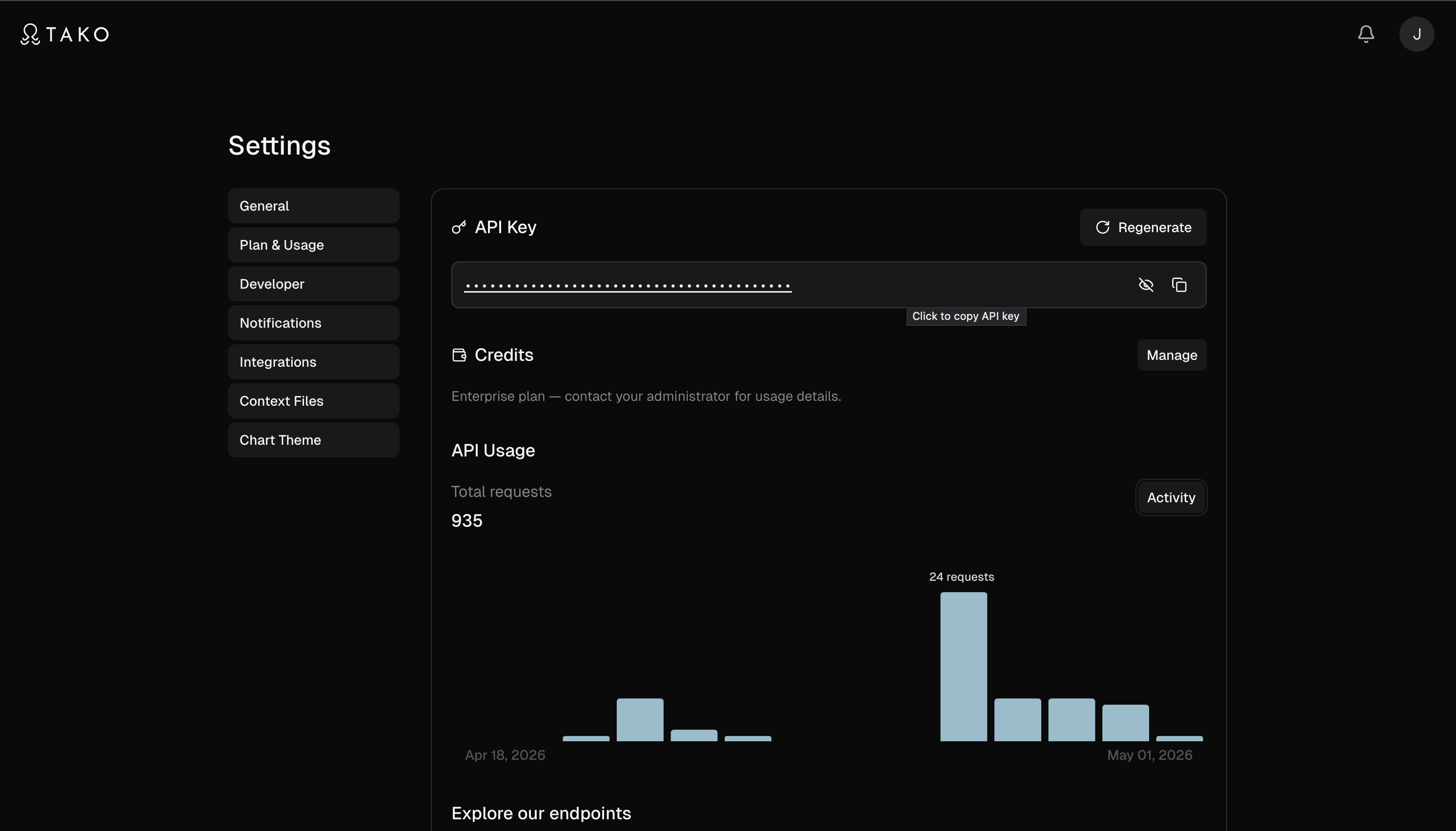
Prerequisites: just sign in at tako.com with the identity you'll authorize. You do not mint a token yourself — the consent flow creates a per-host key (named MCP: <client>, visible and revocable at tako.com/console/api-keys). Connecting a new host never rotates another host's key; Tako trims your oldest MCP key past ten.
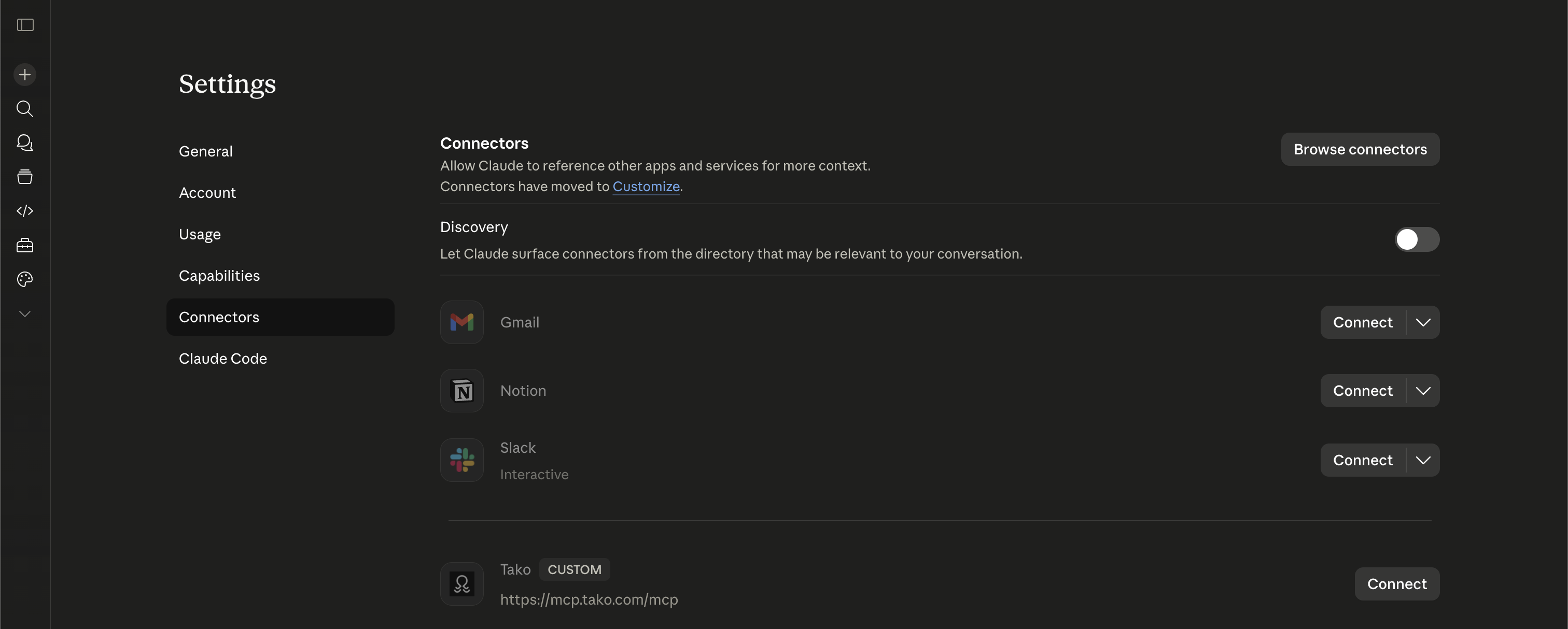
Claude.ai (requires Pro, Max, Team, or Enterprise)
- Open Claude.ai → Settings → Connectors
- Click Add custom connector
- Paste
https://mcp.tako.com/mcpand click Connect - Complete the Tako sign-in flow; Tako then appears as connected
Claude Desktop (same plan requirement as Claude.ai)
- Open Claude Desktop → Settings → Connectors
- Click Add custom connector
- Paste
https://mcp.tako.com/mcpand click Connect - Complete the Tako sign-in flow; Tako then appears as connected
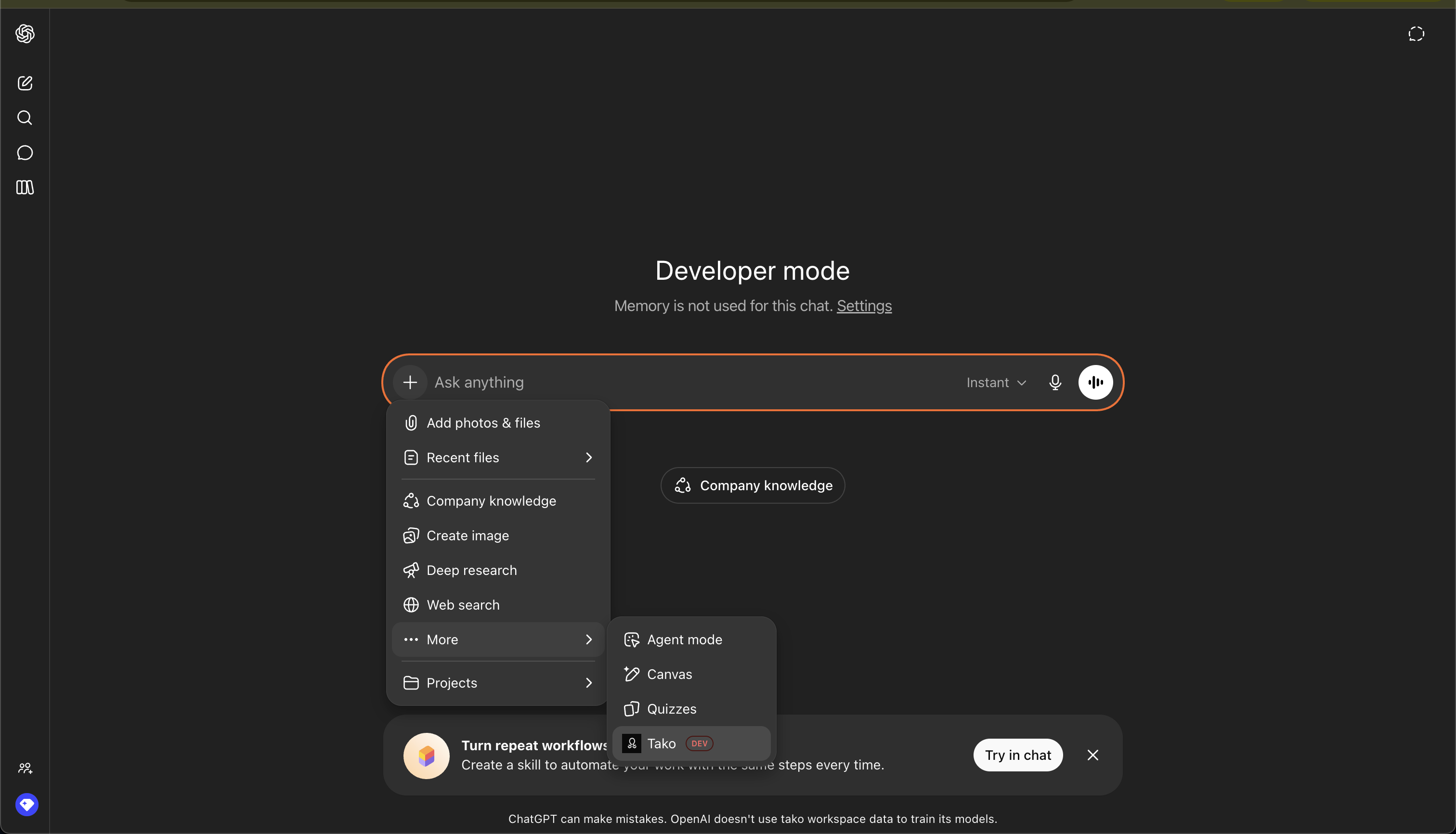
ChatGPT — install the Tako app from ChatGPT's app directory (it connects via OAuth and uses the app surface at https://mcp.tako.com/mcp/chatgpt). To hand-add it as a custom connector instead (requires Pro, Business, or Enterprise; Developer Mode enabled):
- Open ChatGPT → Settings → Connectors → Developer Mode and toggle it on
- Click Create custom connector
- Paste
https://mcp.tako.com/mcp/chatgptand click Connect - Complete the Tako sign-in flow; the connector is then listed and ready
The /mcp/chatgpt surface is OAuth-only and tuned for ChatGPT (interactive chart widget, a fixed five-tool listing; ?tools= is ignored there). The generic /mcp URL also works there — you get chart images instead of the interactive widget.
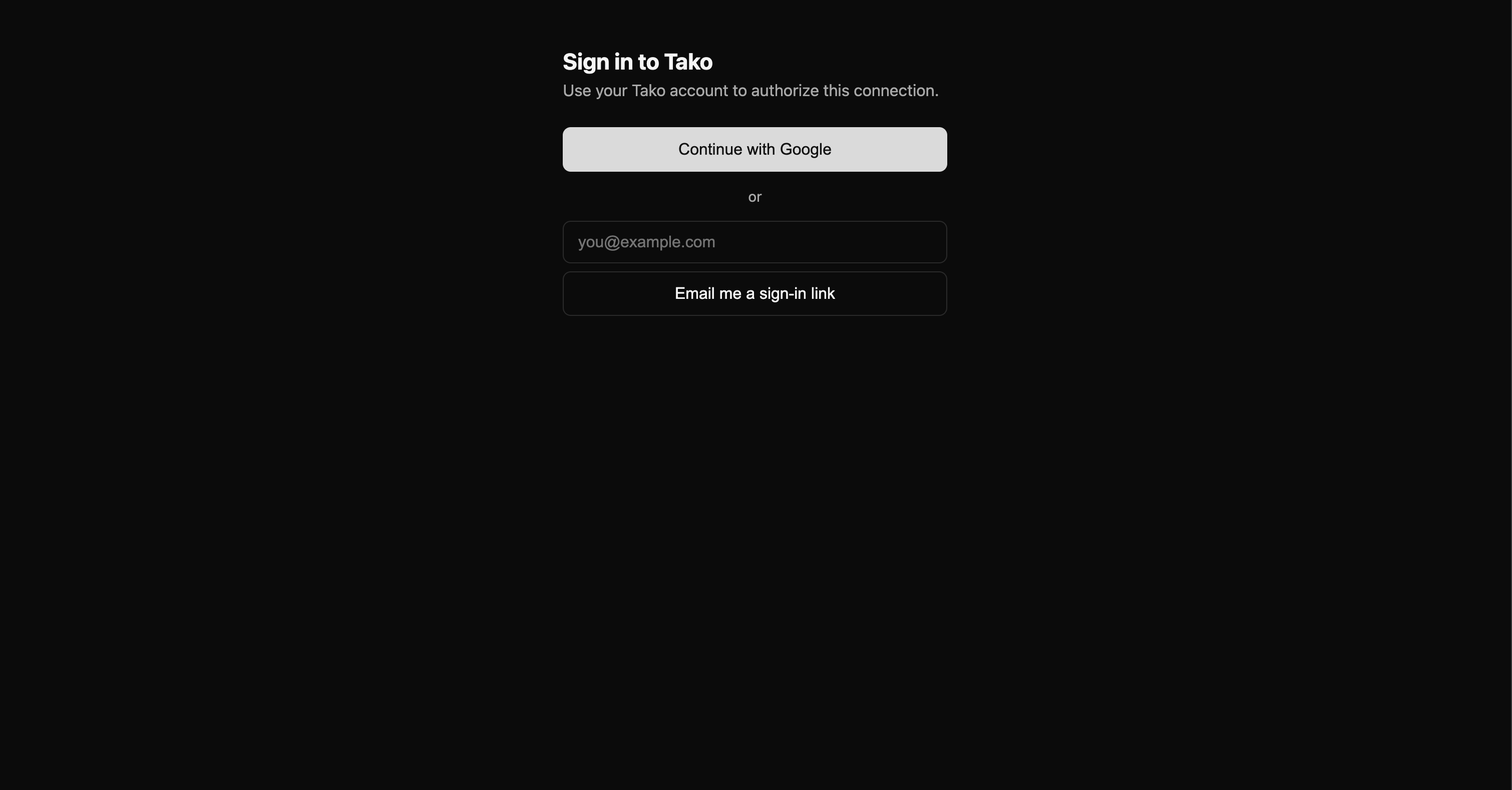
During connect you'll see three Tako-hosted screens regardless of host: a sign-in page (Google, or your Tako email and password), a consent page ("Connect [host] to Tako — Allow / Cancel"), then a bounce back to the host. The host may show its own consent prompt too — that's normal.
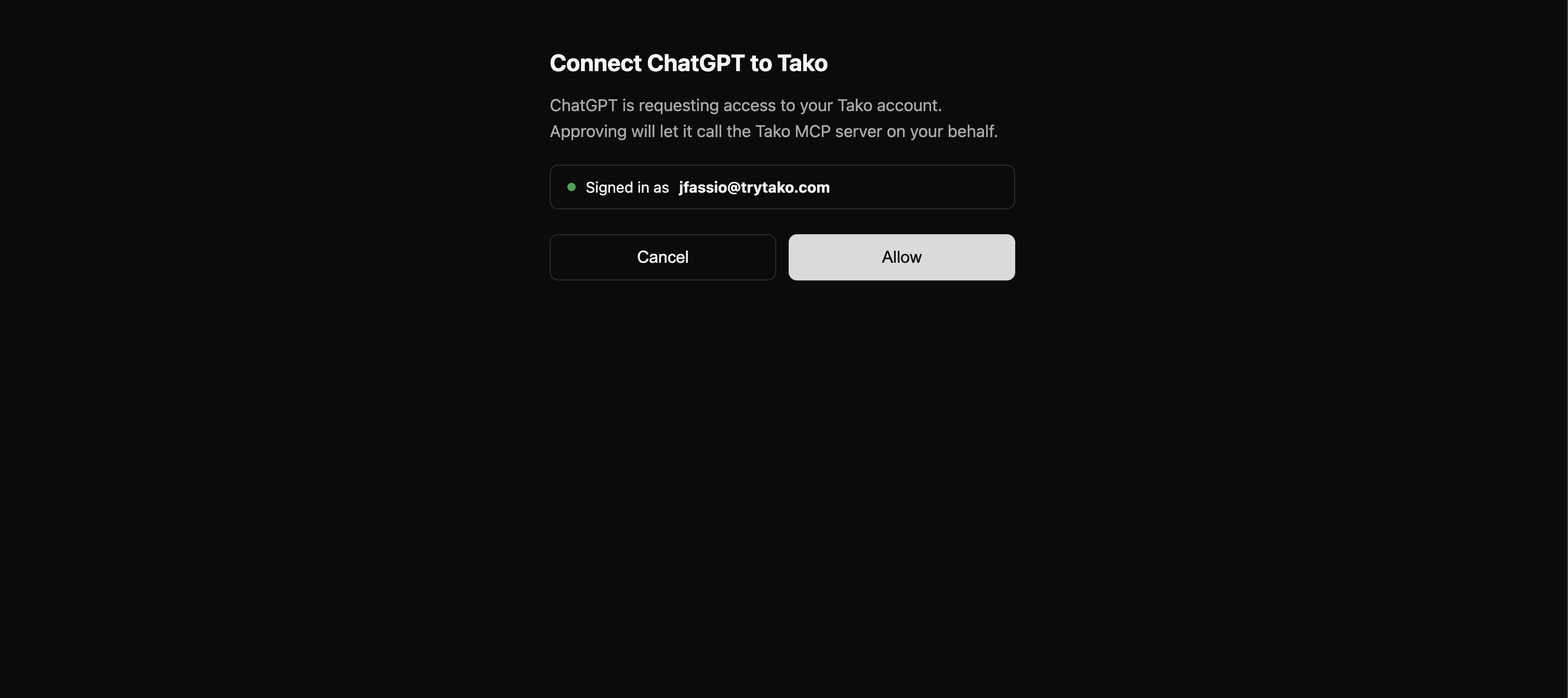
Disconnecting. A per-host disconnect (remove the connector in host settings) stops that host only; other hosts and Bearer-auth clients keep working. To hard-kill everything, rotate your key at tako.com/console/api-keys — every previously-issued grant across every host stops authenticating immediately.
Endpoints:
| Environment | URL |
|---|---|
| Production | https://mcp.tako.com/mcp |
| Production, ChatGPT app surface (OAuth-only) | https://mcp.tako.com/mcp/chatgpt |
| Staging (testing only) | https://mcp.staging.tako.com/mcp |
Tools are discovered automatically via the MCP tools/list handshake, so your client always sees the live surface. Auth is connection-level — once connected, tool inputs need no api_token argument.
API keys and headless clients
Sign-in is the default path, but some setups need a key in config: CI and other headless runs, Roo Code, Warp, and mcp-remote pinned to a specific identity. Get your API key and send it as a Bearer header on the same URL:
// any config-file client
{
  "mcpServers": {
    "tako": {
      "type": "http",
      "url": "https://mcp.tako.com/mcp",
      "headers": { "Authorization": "Bearer <your-tako-api-key>" }
    }
  }
}
A key connects exactly like OAuth — same tools, same account limits. Rotating the key at the console kills every connection using it.
Available Tools
The full reference — every description and parameter exactly as the model sees them, per surface — is generated into docs/TOOLS.md. Summary:
Listed by default on /mcp:
| Tool | What it's for |
|---|---|
tako_search | Find the data. Fast search over Tako's curated graph and the live web. Four parameters — query, sources, country_code, locale — and no defaults of its own, so an omitted field takes the API's. Cards carry headline values, node ids and chart links; tako_contents reads the rows. The top result renders inline as a chart with an Open in Tako link. Parallelize broad questions into narrow single entity+metric searches. |
tako_available_data | Find what structured data exists on an entity or metric in one free call — the exact metric name to search on, a node_id for graph traversal, and a ready-to-run next_call. Ambiguous names come back as candidates with subtype and label; metric doubles as the substring browse filter; limit widens the candidate list. |
tako_contents | Fetch what's behind result URLs (1-10 per call): a card's rows (billed per 1k rows) or a web page's text — pass query for just the matching passages. Requires a signed-in connection. |
tako_graph_related | Explore a graph node: a compact overview (each relation's key, total, first three items) or one paged relation — metrics, the entities a metric covers, competitors (rel:competes_with), memberships, sources. q is a substring filter. Free. |
Anonymous connections (no credentials): the tool list is the same — it never changes with auth state. tako_search and tako_available_data run anonymously (rate-limited, on shared capacity); the others answer with sign-in instructions.
On connect, the server also advertises MCP server instructions that hosts like Claude.ai, Claude Desktop, and Claude Code place in the model's system prompt. They steer data and metric questions to tako_search ahead of the host's built-in web search, and note that tako_search covers the live web too, so one call can stand in for a separate web search on mixed questions. Built-in web search remains the fallback for queries outside Tako's coverage.
Opt-in on /mcp — name them in ?tools=:
| Tool | Token | What it's for |
|---|---|---|
tako_search_advanced | search_advanced | The v3 search request's retrieval options: per-source count, inline rows and max_rows, graph pins (node_ids + strict), web include_domains / exclude_domains / category / snippet_max_chars, and effort: deep. Same structured payload as tako_search, minus the auto-rendered inline chart — embed_url is still there to click through. |
tako_answer | answer | One synthesized, citation-backed prose answer. Not recommended — your model already synthesizes from tako_search results. |
tako_agent | agent | Tako's Answer Agent: multi-step research (~30–90s) across many retrievals, returning a synthesized answer plus chart cards. |
tako_visualize | visualize | Author an embeddable chart/card from your own typed components (timeseries, bar, table, financial boxes…). On by default on /mcp/chatgpt, the host that renders the widget inline. |
?tools= is an allowlist that replaces the defaults. ?tools=search,contents lists exactly those two; ?tools=agent lists only tako_agent. Tokens are tool names with the tako_ prefix optional. Unknown tokens are ignored, and a param that names nothing yields the defaults, so a typo never breaks the connection. Include the defaults you rely on:
claude mcp add tako --transport http "https://mcp.tako.com/mcp?tools=search,available_data,contents,graph_related,agent"
- Claude.ai, Claude Desktop, ChatGPT developer-mode connectors: put the param on the URL you paste. OAuth is unaffected (the server canonicalizes the resource, query string included).
- Claude Code plugin: the plugin pins the default surface (its URL isn't user-editable). For a different set, add the server yourself with
claude mcp addas above, and keep only one Tako connection active so you don't get two copies of every tool. /mcp/chatgptignores?tools=: its listing is fixed at submission —tako_search,tako_available_data,tako_contents,tako_visualize,tako_graph_related.
Two tools, one step apart — tako_search locates, tako_contents reads:
| You want… | Call | What you get back |
|---|---|---|
| To see what exists — recon, fan-outs, a chart to embed | tako_search | Cards with headline values, node ids, and chart links, plus web results. Cheap; safe to parallelize widely. |
| The values themselves — rows to compute over or quote | tako_contents on the card's url | Up to 2,000 rows of an exportable: true card, billed per 1k delivered. |
| A web page's text | tako_contents on the web result's url | The page's extracted text (query narrows it to matching passages). |
More search options — per-source counts, graph pins, domain filters, effort: deep | tako_search_advanced (opt-in, ?tools=search_advanced) | The same structured payload as tako_search. No inline chart render — the response still carries embed_url. |
- Broad or multi-part questions → parallel narrow searches. Decompose into single entity+metric queries fired concurrently — e.g. "US CPI inflation", "US core CPI inflation", "US PCE inflation" — then synthesize yourself.
- Unsure what Tako covers →
tako_available_datafirst. It is free, returns the metric's exact name to search on, and a miss there still leaves web search.
Specific question → search, then fetch the rows:
- User asks: "What was US GDP in 2024?"
- Agent calls
tako_search; the top card carries the headline value and its chart - For the series itself, the agent calls
tako_contentson that card's url, then answers with the chart inline
Data to work with → parallel tako_search (synthesize yourself):
- User asks: "Compare US CPI, core CPI, PCE, and core PCE inflation."
- Agent fires four narrow
tako_searchcalls concurrently — one per entity+metric - Each returns a card with headline values (top result renders inline as a chart)
- Agent synthesizes the four results, calling
tako_contentson a card'swebpage_urlif it needs full rows (when the card isexportable: true)
Agent Skills
Ready-to-use skills for Claude Code. Each teaches Claude how to use Tako for a specific kind of data work. Copy the block inside a dropdown and paste it into Claude Code — it sets up the connection and skill for you.
Copy the block below and paste it into Claude Code. It will set up the MCP connection and skill for you.
Step 1: Install or update Tako MCP

If Tako MCP already exists in your config, update it to this endpoint. Run this in your terminal:

claude mcp add tako-mcp --transport http "https://mcp.tako.com/mcp" --header "Authorization: Bearer $TAKO_API_TOKEN"


Step 2: Add this Claude skill

---
name: tako-financial-research
description: >-
  Company financials and markets via Tako (sources vary by metric — S&P Global, Fiscal.ai, Visible Alpha, Xignite, and others). Revenue, earnings vs. estimates, margins, valuation, stock quotes, and head-to-head company comparisons as citation-backed charts. Use for equity research, company deep-dives, competitor financial comparison, or any "what are/were <company>'s <financial metric>" question.
---

# Financial Research (Tako)

Tako serves proprietary company financials as interactive, citation-backed charts. Sources vary by metric — S&P Global, Fiscal.ai, Visible Alpha, Xignite and others, so always cite the source the card actually returns, never a fixed name. All tools below live on the Tako MCP server installed in Step 1.

## What's in range
Broader than statutory financials, so assume coverage and check rather than talking yourself out of a search:
- **Income statement, balance sheet, cash flow** at annual and quarterly cadence, plus derived metrics (margins, ratios, per-share).
- **Valuation and market data**: `"Nvidia PE ratio"` returns P/E history; `"Apple stock price"` returns a Stock Overview card with price, market cap, P/E, and 52-week range.
- **Private companies**: coverage is not limited to listed issuers. `"SpaceX revenue"` returns real S&P Global and Visible Alpha cards. Never assume private means uncovered.
- **Segment and KPI detail** (Visible Alpha): bookings, subscribers, per-segment revenue and margin.
- **Analyst estimates and consensus**, alongside actuals.
- **Crypto spot rates** (CoinMarketCap) — `"Bitcoin price"` works.

Reliably NOT in the data graph, and where web carries the answer instead: forward-looking calendar facts (`"Nvidia next earnings date"` returns an Overview card with no date, while the web results have it), revenue for companies with no filings or analyst coverage (`"OpenAI annualized revenue"` returns zero cards), and anything qualitative (moat, strategy, management commentary).

## Pick the tool by what you want back
- `tako_search`: **the default for any "<company> <metric>" question.** One narrow entity+metric query returns the cited chart with the headline value in the card's `description`; call `tako_contents` on the card's url when you need the series itself (billed per 1k rows — S&P Global and Visible Alpha cards are license-gated and never export, so read those cards' headline from `description`). It retrieves reported values; it does NOT compute derivations. For a growth rate, ratio, or margin change, pull the underlying levels and compute yourself. Also the breadth tool: fan out across several companies or metrics in parallel, or pull the card when the chart itself is the deliverable. One card renders inline (see Pick the right card).
- `tako_available_data`: FREE, and the right tool when the question is **what Tako covers**: does this metric exist, under what exact name, for which entity. It also surfaces entity ambiguity early (`"Costco"` matches both Costco Wholesale Corporation and Costco Wholesale Australia).
- Protected sources are read-only: S&P Global, FactSet, Visible Alpha, and CoinMarketCap cards come back not exportable, and `tako_contents` cannot export their CSV. This is a licensing wall, not an error, so never retry the export. Read the headline value from the card's `description` and cite the chart. (Fiscal.ai cards export normally.)
- Cohort/ranking asks ("which of the largest US chipmakers grew revenue fastest since 2020?") → resolve the cohort yourself, fire one narrow call per member in parallel, and rank from the results. Recon with `tako_search`; call `tako_contents` per member when you need the actual figures.

## Query patterns (Critical)
- Query is ENTITY + METRIC: `"Nvidia revenue"`, `"Tesla free cash flow"`, `"Coca-Cola dividend yield"`. One entity + one metric per call, plus a cadence word (`quarterly`/`annual`) to steer the period.
- Multi-metric or multi-company asks → fire PARALLEL narrow searches and synthesize yourself. Do not send a multi-part question as one query; a compound query returns cards for some metrics and silently misses others.
- `sources`: default to BOTH `["data", "web"]` (also the tool's default when omitted). The card grounds the number while the web results carry the qualitative half of the research and the facts the graph doesn't hold, and web is the built-in fallback when no card comes back, so every query returns something answerable. Price is identical either way, and web does not degrade card selection. Narrow to `["data"]` only when you already know Tako has the metric (`tako_available_data` confirmed it) and want just the number, or in a parallel fan-out where ~10 web results per call would swamp context.
- Empty result (zero cards): do NOT reword and retry blind. Every search is billed. Recover in exactly this order: (1) `tako_available_data` (free) for the exact metric name; (2) if it reports coverage, ONE more search using that exact name — the canonical NAME is what recovers cards, and `tako_search` takes no pin; (3) if not covered, stop searching Tako and answer from the web results already in the response. Never send more than 2 priced searches for the same underlying question (in a fan-out, each entity+metric query has its own budget).
- Empty is usually genuine non-coverage but has been observed transient — the same query returning zero cards once and real cards minutes later. That is exactly why the free `tako_available_data` check sits between the two priced calls: let it, not a hunch, decide whether a retry is justified.
- Empty also means "not covered in Tako," NOT that the fact is false. The response is identical for an uncovered metric and a genuinely-nonexistent one, so never infer a business fact from silence (no dividend card ≠ pays no dividend).

## Reading a result
Every card carries a title, a `description` holding the headline value, and retrieval facts: whether it is exportable, its relevance, its card type, its as-of date, its `nodes` (the graph entities and metrics it was built from), its source name, and its chart/embed URLs.

Field names depend on the response format, so the checks below name the **concept** and you read whichever your response carries. A markdown response prints them on a facts line (`exportable · relevance · type · freshness · nodes · source · chart · embed`); a JSON response uses `exportable`, `relevance`, `card_type`, `data_freshness.data_as_of`, `nodes`, `sources[].source_name`, `webpage_url` and `embed_url`.

## Pick the right card (Critical)
A search returns several cards and **#0 is frequently not what was asked for**. The relevance fact does not rescue you: the correct card is routinely tagged `Low` while an off-intent card is `High`. Tako auto-renders #0, so if the right card is elsewhere, reference it explicitly by linking its title to the card's chart URL and say it is the authoritative one. Walk this checklist before quoting any number:

1. **Right shape?** Prefer a card whose type is `chart` and whose title is the bare metric. Overview cards — "Earnings & Estimates Overview", "Ratios Overview", "Stock Overview" — routinely take #0 and lead with an estimate-vs-actual narrative rather than the value asked for. Skip them unless the question was about estimates. Precision in the query does not save you: `"Apple Gross Margin (%)"`, the exact metric name, still ranks the Overview at #0 and the real chart at #2.
2. **Right scope?** Segment- and geography-scoped variants outrank the company-wide metric, especially Visible Alpha cards. `"Apple gross margin"` puts "Gross margin - Products" (38.7%) above company-wide gross margin (46.9%); `"JPMorgan net interest income"` returns only "- Corporate & investment banking" cards; every top card for `"Airbnb gross bookings"` is a segment card. If no company-wide card appears, say so — never pass a segment off as the total.
3. **Right unit?** Asking for a rate can return the level. `"Microsoft operating margin quarterly"` ranks Operating Income ($38.4B) above EBIT Margin (46.3%). Check the units in `description` match the question.
4. **Actual, not projection?** The as-of date must not be in the future. A future date is NOT confined to cards titled "Analyst Estimates" — a plainly-titled "Toyota Revenues (Normalized) (Annual)" card carried a 2026-12-31 as-of. Trust the as-of date; the title is not a reliable signal.
5. **Right entity?** Related listed entities compete for the same query: `"Coca-Cola dividend yield"` returns The Coca-Cola Company, Coca-Cola HBC, Coca-Cola Europacific, and Coca-Cola FEMSA — four different companies with different numbers. Confirm the card's `nodes` names the one asked about, and note some cards (Fiscal.ai charts, Stock/Ratios Overviews) carry no nodes at all, so fall back to the title there.

## Comparisons and rendering
- A true comparison card (2 series, all entities in `nodes`) exists but is **not guaranteed**. `"Coca-Cola vs PepsiCo revenue"` and `"Toyota vs Ford revenue"` return one at #0; `"Intel vs Nvidia revenue"` reproducibly returns two separate single-entity cards instead. Always verify every compared entity appears in the chosen card's `nodes`/title — if none has them all, use the per-entity cards and synthesize. Comparisons default to annual; say `quarterly` for quarterly.
- On a comparison card, the as-of date is the QUERY date, not the data date — the Toyota/Ford card reported the day it was run while its latest point is Dec 31, 2025. Cite the period from the card's `description`, not that fact.
- Cross-currency comparisons are a correctness trap: a two-series chart can plot different currencies on one axis unnormalized (Toyota 43.6T JPY beside Ford's USD reads as ~250× raw, but ≈1.7× once converted). State each series' currency and convert before comparing — never present the raw chart as apples-to-apples.
- Period labels are calendar-normalized (Apple's annual points show "Dec 31" though its fiscal year ends in late September). Don't cite a label as the issuer's fiscal period; flag the normalization when precision matters.
- Cite the card's actual source name and as-of date. The source varies by metric — the same company can come back from S&P Global on one card and Fiscal.ai on another.
- Reference the chart in prose ("as the chart above shows"); do NOT re-post the card's image URL as a markdown image — that double-renders the inline chart.

## Examples
- Single metric (the common case) → tako_search {"query": "Nvidia quarterly revenue", "sources": ["data", "web"]} — the figure (in the card's `description`), its chart, and the earnings release in one call; add a tako_contents call on the card's url for the rows
- Comparison → tako_search {"query": "Coca-Cola vs PepsiCo annual revenue", "sources": ["data", "web"]} → check both entities appear in the chosen card's `nodes` before treating it as a comparison
- Chart is the deliverable → tako_search {"query": "Coca-Cola vs PepsiCo revenue", "sources": ["data", "web"]} → embed the card; call `tako_contents` on its url if you also need the values
- Coverage question (free; note the arg is `q`) → tako_available_data {"q": "Costco"} → then reuse the exact name it returns: tako_search {"query": "Costco Wholesale Corporation annual revenue", "sources": ["data"]}
- Growth rate / ratio → pull the levels, then compute: tako_search {"query": "Apple annual revenue", "sources": ["data", "web"]} → tako_contents on the card's url → compute the % change yourself from the rows
- Breadth recon → one narrow `tako_search` per company in parallel with `"sources": ["data"]` to see what exists; call `tako_contents` per company once you need the figures
- Not in the graph → tako_search {"query": "Nvidia next earnings date", "sources": ["data", "web"]} → no card carries it; the answer comes from the web results, so say the figure is web-sourced

## Output (tight and structured)
1) A 1–2 line read of the finding, referencing the intent-matched chart
2) Source name — as-of date, and say so plainly when a figure came from the web rather than a card
3) A single `[Open in Tako]` link built from the card's embed URL, for the card you embedded

Step 3: Ask the user to restart Claude Code

Ask the user to restart Claude Code so the config change takes effect.
Copy the block below and paste it into Claude Code. It will set up the MCP connection and skill for you.
Step 1: Install or update Tako MCP

If Tako MCP already exists in your config, update it to this endpoint. Run this in your terminal:

claude mcp add tako-mcp --transport http "https://mcp.tako.com/mcp" --header "Authorization: Bearer $TAKO_API_TOKEN"


Step 2: Add this Claude skill

---
name: tako-web-traffic
description: >-
  Website and app traffic via Tako (source: SimilarWeb). Monthly visits, app active users, traffic trends, and top-sites rankings for any domain as citation-backed charts. Use for competitive traffic analysis, share-of-attention, or any "how much traffic does <site> get" question.
---

# Web & App Traffic (Tako)

Tako serves SimilarWeb traffic data as interactive, citation-backed charts. All tools below live on the Tako MCP server installed in Step 1.

## What's in range
- **Monthly Visits** per domain — the core metric, with roughly a one-month lag.
- **Head-to-head domain comparisons** and **ranked top-sites** cards.
- **App usage**: `"Spotify app monthly active users"` returns a SimilarWeb "Monthly Active Users" card keyed by the bare app name (`spotify`), not a domain.
- Coverage reaches well into the long tail: `"kagi.com monthly visits"` returns a real card (4.68M visits).

## Query patterns (Critical)
- **Query by DOMAIN, not brand**: this is the single highest-leverage rule here, and getting it wrong produces a confident wrong answer rather than an obvious failure. Use the bare domain: `"netflix.com monthly visits"`, `"youtube.com"`, `"chatgpt.com"`. For app usage, use the app name plus the metric.
- What a brand-shaped query actually does, and why it is dangerous: `"Netflix traffic"` on data returns three Netflix **subscriber** cards (84.0M average streaming subscribers), plausible-looking numbers that are not web traffic at all — while on web it returns CDN and BGP network-engineering articles about Netflix Open Connect. `"Netflix website traffic"` returns no card either way. None of these is the answer; only the bare domain produces a Visits card. If a traffic answer isn't backed by a card whose title is `<domain> Monthly Visits`, you do not have the traffic number yet.
- Comparisons: `"youtube.com vs netflix.com monthly visits"` returns a real 2-series card. Rankings: `"top websites by visits"` returns a ranked card (google.com 84.9B, youtube.com 28.8B, …).
- `sources`: default to BOTH `["data", "web"]` (also the tool's default when omitted). The SimilarWeb card grounds the number and web results add context (competitive write-ups, ranking roundups) that turn a figure into analysis. Price is identical either way, and web does not degrade card selection on a well-formed domain query. Narrow to `["data"]` when you only want the number for a domain you know is covered, or in a parallel fan-out.
- Empty result (zero cards): do NOT reword and retry blind; every search is billed. The #1 cause is a brand-name query: if the query wasn't a bare DOMAIN, fix it to one (`"Netflix traffic"` → `"netflix.com monthly visits"`) and retry ONCE. That is the recovery. If a domain-shaped query still comes back empty, stop searching Tako and answer from the web results already in the response, labelling the figure web-sourced.
- Do NOT use `tako_available_data` to rule a domain out. Its graph is entity-based and misses long-tail domains SimilarWeb covers: it reports `found: false` for `kagi.com` while the search returns a real card. It is still useful for resolving a brand to its canonical entity name and `node_id` (`tako_available_data {"q": "Netflix"}` → `ent::netflix_inc::…`; note the arg is `q`) — search on the canonical NAME, and hand the node id to `tako_graph_related` to explore the graph.
- Empty also means "not covered in Tako," NOT that the domain has no traffic — don't infer a fact from silence.

## Pick the tool
- `tako_search`: **the default for "how much traffic does <domain> get".** One bare-domain query returns the Visits card; SimilarWeb is licensed, so the card carries NO rows on any path — the figure lives in the card's `description` (latest value + % change over the period) and the chart. Also the breadth tool: the ranked top-sites card, a head-to-head embed, or scanning several domains to see which are covered.
- `tako_available_data`: FREE brand→entity resolver, and the right tool when the question is what Tako covers. Do NOT use it to rule a domain out (see the empty-result bullet).
- SimilarWeb is a protected source, so EVERY traffic card is read-only: not exportable, and `tako_contents` cannot export the CSV. This is a licensing wall, not an error, so never call `tako_contents` on a traffic card. The numbers live in the card's `description` (latest value + % change over the period) and the chart. (Web-result urls remain fetchable.)
- Cohort/growth asks ("top 5 streaming domains by visits, and which is growing fastest") → get the ranked card with `tako_search` (breadth is its job), then one narrow single-domain search per domain in parallel and compute growth from each card's `description` figures.

## Reading a result
Every card carries a title, a `description` holding the headline value, and retrieval facts: whether it is exportable, its relevance, its card type, its as-of date, its `nodes` (the graph entities and metrics it was built from), its source name, and its chart/embed URLs.

Field names depend on the response format, so the checks below name the **concept** and you read whichever your response carries. A markdown response prints them on a facts line (`exportable · relevance · type · freshness · nodes · source · chart · embed`); a JSON response uses `exportable`, `relevance`, `card_type`, `data_freshness.data_as_of`, `nodes`, `sources[].source_name`, `webpage_url` and `embed_url`.

_Documentation truncated — see the full README on GitHub._
Reviews
No reviews yet
Be the first to review this server!
More Developer Tools MCP Servers
Git
Freeby Modelcontextprotocol · Developer Tools
Read, search, and manipulate Git repositories programmatically
Fetch
Freeby Modelcontextprotocol · Developer Tools
Web content fetching and conversion for efficient LLM usage
Toleno
Freeby Toleno · Developer Tools
Toleno Network MCP Server — Manage your Toleno mining account with Claude AI using natural language.
mcp-creator-python
Freeby mcp-marketplace · Developer Tools
Create, build, and publish Python MCP servers to PyPI — conversationally.
MCP Marketplace
Freeby mcp-marketplace · Developer Tools
Search and install MCP servers from inside your AI client.
MarkItDown
Freeby Microsoft · Content & Media
Convert files (PDF, Word, Excel, images, audio) to Markdown for LLM consumption